
Ep078 - Building A Stronger Relationship With Your Food: Jason Erman
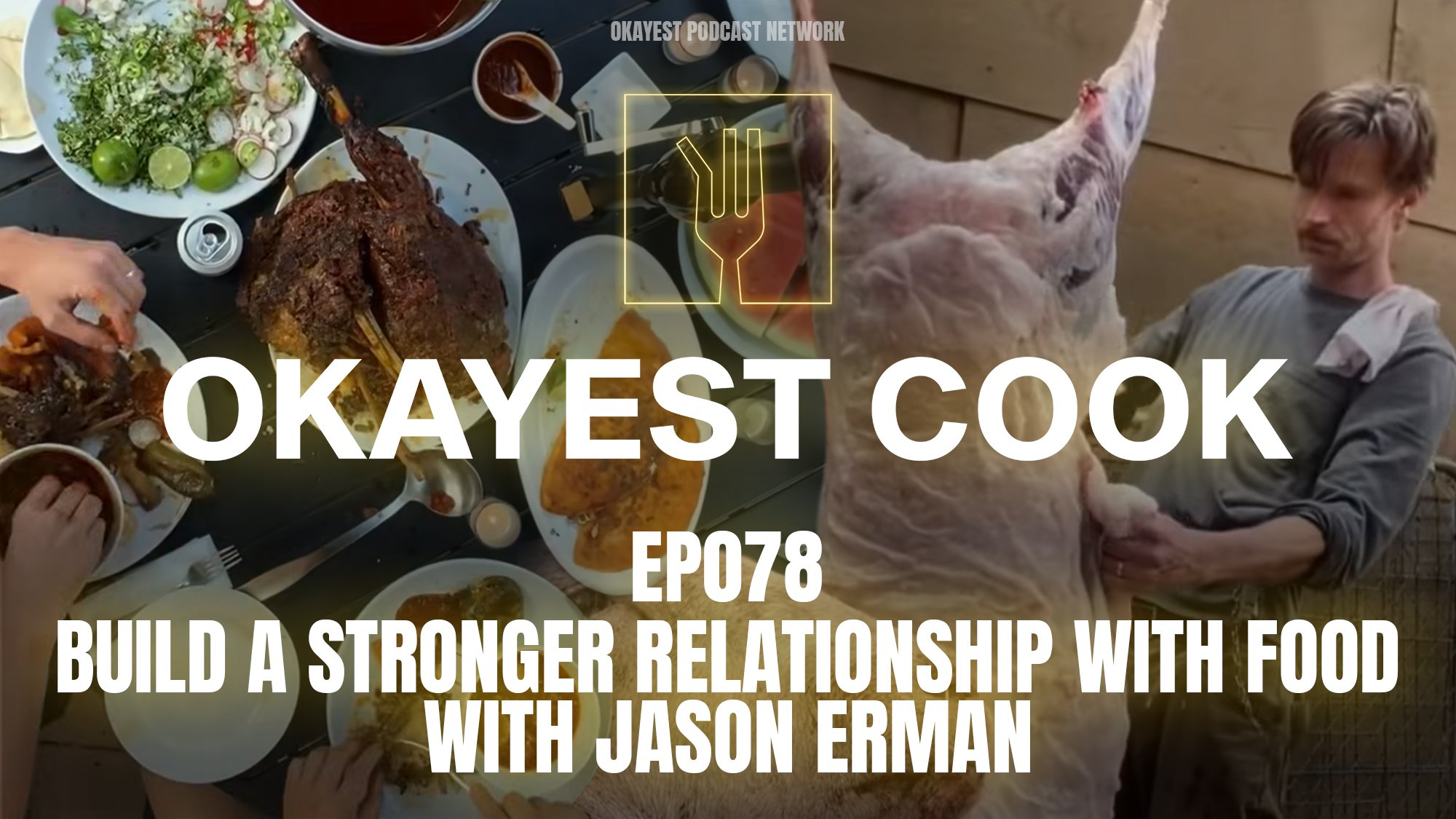
In this episode of the Okayest Cook Podcast, host Chris Whonsetler and co-host Andy Heiser chat with their guest, Jason Erman, an advocate for homesteading and nose-to-tail eating. Jason discusses his journey from culinary school to raising and butchering his own animals in Nevada County, California. The trio delve into utilizing lesser-known cuts of meat, commonly referred to as the fifth quarter, such as pig heads, hearts, and liver. Jason shares practical recipes and insights on optimal cooking techniques, the cultural shift in food consumption, and the importance of connecting with local farmers. The episode also touches on America’s national eating disorder and how returning to whole foods can enhance both diet and enjoyment.
Help us keep the episodes coming by shopping our affiliate links. All brands we use and love! happy to chat about our recommendations






Chris: We'll just go with him. Here we go. Alright.
This coffee,
Andy: I am a little worried about running out of coffee. I have half a cup
Chris: so you can dip out. You can dip out.
Andy: I'll try not to.
Chris: Yes. Hey, welcome back to Okayest Cook podcast. I'm your host, Chris Whonsetler, coming at you from the office with Mr. Andy Heiser.
Andy: Hello,
Chris: how are you today, Andy? Yes sir. Doing well. We we're currently the only cooking show on the Okayest Podcast Network.
Andy: That's news.
Chris: Go check out the other. Yeah, go check out the other shows for your wild game. Procurement. Procurement, I can't say that word. Procurement. Gather the proteins via the other channels. Come back here to learn how to cook them better and utilize more of the animal spoiler alert to the conversation we'll have here in a second.
But yeah, we, I just wanna touch. Base on our four pillars. Once again, it's been a minute since we've talked about those. We've got commensality and I'm still struggling with the second one, the hunter gatherer mindset. I think we can word that a bit better. Basically, it just means we're using wild things to fuel our bodies.
So whether that's hunting, just eating better food or foraging and gardening so on and so forth. So just, using nature to fuel ourselves. And then we've got education and nutrition, and I'm really hoping nutrition's gonna play a little part of today's conversation as well.
Just dip it into, the fifth quarter, a term I just learned and I'm in love with Mr. Nick from the Hunter Bore introduced it to me. And, I know Jason or Justin, sorry, Justin from the Harvesting Nature Crew. They all are familiar with the term, so yeah, the fifth quarter I'm in love, but I think our guest can speak into that a little bit more.
Yes. Today we have Mr. Jason Irman. Welcome to the show, sir.
Jason: Guys, thanks for having me on.
Chris: Absolutely. Yes. The Instagram algorithm is just feeding me so many cool people and you are the latest victim that I've found. You're the latest guy to
Jason: respond to our email requests.
Chris: That is more like it.
Jason: You, you found yourself on the cool side of Instagram.
Chris: Heck yes, we did. Yes, we did. Mr. Jason, do you mind giving the listeners a quick little intro to yourself, who you are, what you do, and. We'll just we'll dip into notable meals right after that.
Jason: Yeah. Yeah. My name's Jason Erman.
The Instagram account is nose to tail, Nevada County, so it's a little bit clunky, a little wordy. But I live here in Nevada County, California. We're right, we're bordered with state of Nevada. So we're in the Sierra Foothills here, not too far from Lake Tahoe. And what I'm all about is homesteading lifestyle.
Just raising all my own food as much as I can. Did you hear Rooster Crow? I don't know. I just heard one.
Andy: I missed
Jason: it.
Chris: We'll add in post.
Andy: Yeah, we'll add it in post.
Jason: Yeah. Yeah. Put one in. Perfect. But yeah what I've started doing, what I started doing a little less than a year ago. 'cause I was in the middle of raising some pigs for my own freezer, and I had never done that before and got to the point.
Chris: Oh, so you like brand new into it?
Jason: Oh yeah. No, I, okay. I'll tell you a little bit more about my background, but I grew up in the suburb in suburbs, in the Seattle area. Had never really spent any time farming or working on a farm or anything. Just been my whole life, a cook, I'm just, I come from a cooking background.
I went to culinary school and worked in restaurants and so my whole thing's cooking and just eating well and enjoying life in that way, which I think we'll probably talk about a little bit later.
Chris: Yes sir.
Jason: But yeah, about a year ago I started just posting what I was doing and showing the world, and the first couple of videos that I posted were about slaughtering the pigs and breaking 'em down myself and how to skin and gut 'em and that kind of thing. And yeah, it just took off and got a bunch of followers on Instagram, which is exciting.
Chris: Yes,
Jason: I don't know where that all is headed, but I'm here.
That's cool you're here. I got to link up with you guys. Yeah.
Andy: Heck yeah. Heck yeah. It's early for you. I was like, look, my day's on the road now. But yeah. I guess that would be pretty early for you, but no, that's, it's awesome. I get looking through some of what you're doing too, especially for us, like we talked about the hunter gatherer side of our pillar.
One of the things that we talk about a lot in the show is that just people's relationship with where food comes from has gotten so disjointed over the years. Yes. So it's really cool to talk to somebody who's, like you get to reintroduce the fact that hey, a goose was a living thing at one point.
A pig was a, that pork chop you ate was actually part of an actual pig. Yeah. And remind, I feel like it almost should be required that a, that people see where things come from before you buy it. But but yeah. That's cool. Notable meals. Chris, do you wanna kick it off or?
Chris: Yeah I've got two. I've got two actually. So I think I'm gonna go first and last.
Andy: Okay.
Chris: And so you guys, I'll let you guys fight over the middle.
Andy: Okay.
Chris: But the my first item, I've got a physical item Andy as going back to the original podcast days, I like my props and my favorite brings Won't bring a prop in,
Andy: won't
Chris: tell anybody either
Andy: if all of a sudden something
Chris: will come up, won't tell anybody.
And you also know that I'm a sucker for good branding. Yes. So I saw this also the Instagram algorithm. If all focus, will it focus? There we go. Yes, dude, I saw this account on Instagram. It is Duck Camp Bourbon. Dude. Just old. That's the branding right there. Old school field and stream style illustration.
There just looks sick and it's got ducks on it. So I can't complain about that. Is it good? I haven't opened it yet, no. Dude, it's it literally just came in the mail like yesterday. So nice. Me, I gotta, I'm gonna take some photos of it,
Andy: yeah. Take some photos, but say it's what, 1145?
You got fif you got 15 minutes before you can get into it without someone labeling you as having a problem.
Chris: Yes. Yeah. Yeah, a good branded bourbon is my notable drink for slot number one here. And I'll report back on, on what I think. I'm not a bourbon expert. I've got a couple of opinions, but generally,
Andy: generally you like them is usually the take.
Chris: Yes, sir. Yes, sir. I'm a fan of the bourbon, so Yeah. I'll report back on, on expertise taste.
Andy: To give Jason more of a guidance on what this is usually supposed to be about a meal that you eat. So usually, so this is one that actually, hey, now
Chris: bourbon. Bourbon can be a meal back up.
Andy: It can be
Chris: back to the nutrition pillar here.
Andy: Okay. I've had
Jason: plenty of those meals.
Andy: Yeah, some, yeah. If you get cold, it's a good way to warm up too. No, the so the one that I got, I think originally was also fed to me in some sort of Instagram algorithm, and then in my usual ways of. Doing my own version of things I'll I'll change some stuff of it and make it my own.
But this is a venison, cowboy casserole, and it wasn't supposed to be venison. I just made it venison because I, obviously, I hunt and I have a, I have, four deer this year, so it was a good year. So I've got plenty of meat in the freezer. But this cowboy casserole, this is an old school meal, especially in this area, I've been told like, ah, this is like staples of things, but it is remarkably good.
So it's a cast iron skillet, meal. So you start by, browning your meat. And then in that same skillet you basically it's the meat. It's this it's ranch beans, some corn, some cream of corn made into the cornbread, like topper. And then you put cornbread at the top and then you bake the whole thing, and then it comes out like pie slices.
And so I made this just as like a. Just experimental dish. And then Anja just loved it. She was like, this is legitimately like good. This is awesome. And I was like, ah. And I liked it. I was like, I liked it too. It was good. So we ended up having a for New Year's Eve, we had a party.
We were, we went to a party and everyone brought, I brought a dish, so I brought that, I brought a cowboy casserole, and it was literally like the hit of the party and pe to the point that we actually hit. Like just yesterday, a buddy of mine who was at the party was like, Hey, can you send me that that recipe?
So I quite literally was taking pictures outta the recipe book and sending it to him. So again, easiest meal ever. Feels like a cheat code, you could probably sneak any form of meat in it. So again, on our subject matter of nose to tail, there's probably ways to put all sorts of different meat in this.
But yeah, so that was my notable meal. Nothing fancy. It was actually a callback to the basics.
Chris: Ooh. Is that now, would you put that in like the shepherd's pie category?
Andy: This is just easier than that, but yeah. Okay. I guess a chicken pop, pie, like traditionally
Chris: is like a, like mashed potatoes on top, right?
Jason: Yeah.
Andy: I think, yeah. This is cornbread. Yeah. But again, this is like cornbread on the top. So I almost more, it's more of a chicken pot pie, but not the same flavor but more looks, looks more like that. Gotcha. But again, it's cool too 'cause it's just the full skillet. Corey from the show would love it.
'cause like I, I use my big skillet there my big lodge. Yeah. So that's, I try to do most
Jason: of my cooking in, in, in my cast iron. Big cast Iron. Iron. Yeah.
Andy: Yep. It's so fun. It's I don't know. It feels more rewarding. I don't know. It just feels better. It just looks awesome. Yeah, that's mine.
So yeah. Jason, you're up.
Jason: Okay. I I just wanna say I love corn. It's the, something about corn man. The flavor of it. The, my favorite chip ever Fritos. The Fritos scoops.
Andy: Yeah. You're talking to two boys from Indiana, so we are well aware of corn for Oh,
Jason: Yeah. The people of the corn.
Andy: Right.
Jason: So I I'm thinking of a notable meal that I served last week. I did a popup lunch in my town. So cool, every once in a while I'll head into town every so often about once a month and I'll do a popup lunch. It's always on Fridays and I. If you live in the Nevada County or anywhere in Northern California and you're listening to this, make sure you come sometime.
Just pay attention to the Instagram as far as when I do them. 'Cause I always announced like about a week ahead of time is when I'm gonna be there doing it. But I served last week some lamb that I harvested, braised lamb, neck my favorite cut of meat on the lamb. And now that I'm saying that, it's like maybe that's my favorite cut of neck of meat on any ruminant,
Chris: I
don't
Chris: know. I have to follow a suit. Yeah. It's very very slept on in my opinion.
Jason: Yeah.
Chris: Yeah.
Jason: Yeah. I don't have a ton of experience with venison. God I want more experience with venison. I have three brothers. They're all hunters. And so they're all like into that hunting and being out harvesting their own food and everything.
But I just have a different approach. I'm like no, I'll just raise the animals and then slaughter myself. So yeah, I, I served a lamb neck, braised lamb neck, and I braised it with beer and garlic and ginger and shallots and a tiny bit of dark soy sauce. So it had this Asian, almost Chinese
Andy: dark
Jason: braised kind of car caramelized flavors going on.
The beer was a, I'm
Andy: cheating right now. I'm looking at it on your Instagram account, so I'm looking at it right now. Oh,
Jason: yeah, I posted it. Yeah.
Andy: Or if you want, if you wanna see this team go to this, go to the Instagram account. We'll past some
Chris: photos here.
Andy: We'll do some screenshots, photos for
Jason: those who watching.
So yeah, brazen braise him on the bone. The whole necks for about four or five hours. And then very carefully let 'em cool in their liquid completely. That's the key thing about brazing. Anything. I let 'em cool completely the following day very carefully. Peel 'em, peel the meat off of that neck bone.
It almost, the bone almost just rolls out. It's like really super easy. You guys seen that tender guy on Instagram? No,
Chris: I don't think I have.
Jason: Okay. No, it's like there's this viral guy. Everything's everything's so tender. He's, it's, he's talking about that's tendon. So it's tendon for those who know it's just so falling apart.
And then very carefully portion those so that you get a nice piece on the plate. And then what I served that with was caramelized sunchoke puree and crispy Brussels sprouts. Do you guys know about Sunchokes?
Andy: I don't know what a sunchoke is.
Jason: Okay. I don't think I do. They're incredible, delicious.
They're a member of the Sunflower family, also known as Jerusalem artichokes, and it's like a, I dunno if it's a rhizome or a tuber, but it's something that you dig up out of the ground.
Andy: Yeah. It's a root of some sort.
Jason: It almost, yeah. And it almost looks like ginger if you saw it in the store, you
Andy: think it, I was gonna say it looks like a really big chunk of ginger.
Jason: Yeah. Yeah, but really wonderful starchy kind of vegetable. So almost treat it like you would a potato. Nice. Does have like potato flavors or what? Like where does it sit? No, it's, I would say flavor. Say it's got a sweet kind of nutty flavor, I would say. Paired really well with the lamb, the braised lamb, and the, the reduced sauce with the porter beer in it and the, all the caramelized onion and everything in that had this kind of, the dish was like a sweet thing, it was like sweet, nutty sunchoke puree, crispy brus, Brussels sprouts, a little bitterness to balance everything, and then the braised neck on top of that sauce.
Chris: Oh my gosh.
Jason: I would, it was all also an experiment. Every time I cook I'm just experimenting, I never write anything down but people loved it, so I wanted to mention that.
Chris: Yeah, it's beautiful. Yeah. Yeah. I'm glad you broke that down because that was my first question was, what?
Is this sun choke?
Jason: Oh yeah,
Andy: it
Chris: does. You reminded me of my favorite. Yeah. Oh yeah. Oh yeah. Yeah you just reminded me of a conversation I had with a listener, Mr. Calder, who wrote in, with a story, his notable meal of the week was some steak. He was marinating and he used pineapple juice and he said he had two or three cuts of back strapp marinated for four or five hours, cooked one, or cooked some of them, and left some in the marinade overnight.
And went to cook the backstrap the next day and said it was just way too tender. So beyond edible, like to a, to the mushy state. Oh, really? And reminded me of a, an episode meat eater did ages ago where they talked about, the best marinades for tenderizing meats. And yeah, pineapple juice was way, way up there.
I believe kiwi juice was the best. At tenderizing.
And by, me saying the best, it's probably not good because it's gonna tenderize it way too much. Yeah. It's
Andy: too tenderizing.
Chris: It's too good. It's too good. Yeah. Yeah. Calling back to the strong bad quote, it's way too much of an awesome thing.
So it's dumb in bad
Jason: guys.
Andy: Do you
Jason: know there's time on that? Is there an enzyme in the
Chris: juice that breaks down, down, I dunno, the science Yeah. There's something in there that Yeah. Attacks the proteins in a bad way because it can't be the acids.
Andy: Right.
Chris: It's gotta be a combination of all of the bun.
Yeah.
Andy: Because I've braise a lot of things. I, we use lime a lot in my house especially as marinades and that's way up there too. Yeah. Does a good job of careful to marinade the
Chris: long-term
Andy: marinades. Yeah. But I also, I'm a big believer of a couple hours, maybe a day but nothing more than that.
Typically few hours. Yeah. So especially on a marinade. Now, but brazing is one of those things where the closest I get to it, you mentioned the neck rose, Jason, it is my favorite cut on venison because it's the most it's such a huge amount of meat that oftentimes either goes to the trash or maybe somebody cuts it out for some grind.
But it's one of those pieces that you let it sit in a slow cooker overnight. It's the easiest thing. It's the best pulled pork you'll ever have for those of you who can't eat pork. It is, that is how I like it. It's think of making a pulled pork, use a, apple cider barbecue saucey type of whatever you wanna put in there.
You can't screw it up. I typically use a beer. Some apple cider vinegar and some barbecue sauce. Maybe some soy, like some soy sauce. I've been playing a lot with fish sauce lately. Just a little bit. Yeah. Adds a huge unique flavor to things. But I just did a neck roast a couple weeks ago and geez, I was like giving it out.
This is the best, like pulled pork you'll ever have. That's not pork.
Jason: How do you do it? How do, right now do you do it in a, like a slow cooker?
Andy: Yeah, so I this one is actually like Chris. I actually had to go, you'll appreciate this. I had to go out and buy a food grade hand saw, because my neck roast was too long to fit in the crockpot, so I had to cut it into two.
But I typically start with a I use the Blackstone this time to, to sear the neck roast, just usually pat, dry salt, sear it on all sides. And then for the sauce, like this was, like, this, the easiest. I put one, it was a, I used a lone star shout out to Texas. So I used a lone star original some apple cider vinegar.
I used I grabbed a local barbecue sauce, but sweet baby rays style sauce, sweeter type of sauce, trying to get the sugar. Everything else is acidy, right? So bounced that out with some of that. And then as. I think I've shown this on the show before, but my Texas dust is a spice, is a combo.
You mail me some look up cup. Yeah. Texas dust, you can find it. It's got some kick to it, but salt and sugar based. So again, like bringing some of that stuff together and then just let that thing sit on low. I usually will make it at eight o'clock at night and then by 6 30, 7 o'clock in the morning when I get up.
I mean you could, like you said Jason, you literally, the bones just pull right out. Like it's just there and then you just, I shred it right there in its juices and let it sit there and then I turn it off and I let it just cool in the crockpot in its juices and it is so good.
Jason: But that it's that cooked meat just as it's resting and as it's cooling.
Yeah. It's just soaking up that incredible flavorful brazing liquid. I mean it's it's a key step.
Andy: Yeah, you went to culinary school and I think this is like one of the most missteps in all things of steak cooking or really any cooking is rest time. And we've talked about it on the show before.
Yeah. But no matter
Jason: temperature when you're, before you go to see her
Andy: before Yeah.
Jason: Start
Andy: with
Jason: room temperature, meat.
Andy: That's the thing. Like people are so weary about letting your meat sit out. Like I to the point now where it I promise you, if you were to side by side just brown meat, one at room temperature, one from the fridge, thawed, but from the fridge, you'll taste a difference in the flavor profile and in the tenderness of the meat.
Yeah. It cooks different. It's so much better. And it's not unsafe.
Jason: Yeah. Yeah. And dryness is another thing too that I've been learning about over the past year of just like butchering all my own meat, lamb, goat pig, the dryness of the meat, the exterior is huge. A hundred percent. A lot of people like, you'll take something out of a backpack or something and of course you pad it with paper towels or something.
But you could go even further and put it on the rack in your refrigerator, just totally uncovered for a couple of days. Get that pellet on the outside of the meat itself. Any birds? I do,
Chris: yeah. Chickens. Turkeys a hundred percent needs to sit in
Andy: the fridge overnight. Chris has a really fun like urban setup of a garage fridge that he hangs all of his quarters from deer.
For that same reason, to get that crust on the outside and let it, it's so much better. Oh,
Jason: yeah. Yeah. It's key. Chris, you probably know then the, it's not uncommon to hang meat for two, three weeks.
Chris: Easy. Yeah. Definitely Let it, evaporate some of that moisture and Yeah. Just all the flavors are gonna intensify and it's just gonna be Yeah.
A better quality meat. Again, another meat eater episode. We just need to start linking them. But they did I believe it was the red cutter look it up, but they talked about meats going through rigor and the best place for that process is on the bone. And I know it's not possible for a lot of people who do their own butchering, but as often as you can leave that meat on the bone as it goes through rigor and it's just gonna perform way better across the board.
Flavor wise, texture wise, leave it
Jason: as whole as you can. You probably have the same issue I have where I don't have a walk-in cooler. Even though I'm trying to start a business here at locally as a butcher and as a ranch butcher, a mobile butcher. I don't have the walk-in yet, but what I do have is a bunch of random little refrigerators all over the place.
I've got two in the garage, two in my butcher shop. And so you probably do the same thing. Yep. Put it, get 'em into their primals or whatever, some larger cuts that you can actually fit in there. Eh, I just do my best, ideally it would be hanging the whole carcass. It's like you say.
Chris: Yeah.
When it's possible. It's not always possible. Before we get too much more derailed here, you're off track. I'm gonna throw in my second notable meal of the week, and it's another unconventional one. It is not a meal that I had, but it's a meal I saw, and it is from a former guest, Mr.
Jose Alberto, El Jose, Alberto Barza. I'm not rolling that r properly, so Jose I apologize. Yeah. The attempt was that, but he just made a post about eating the fifth quarter, eating awful. He was gifted what I think a heart, a. Some testicles, kidneys, liver, I forget what he was given, but it was internal organs and he basically said, I'm gonna cook it and you're not gonna ask questions, you're gonna eat it and tell me what you think.
Typical Jose style like when he was on our episode and he said people liked it, but once they found out what it was, they didn't really ask for the recipe. So I'll link some of those photos here. Yeah, definitely a link to the post below, but talk to Jose about more about how he cooked them. I'm sure he'd be thrilled to give you the recipe, but definitely segues really well into our conversation where I wanna take this chat with you.
Mr. Jason is just eating more internal organs and I just shared Jose's post and basically said it's, these cuts are what our bodies are craving. Whether we know it or not, our bodies are craving these cuts of meat. We could say meat. It's meat, right? Yeah. It's all muscle and organs. Oh yeah.
It's meat.
Jason: Yeah, it's
Chris: meat. But but our brains often shut it down. It's yucky. It's icky, it's taboo. It's just, it's not, it's steak. It's not a roast, so I don't wanna eat it.
Jason: Dude. My brain still tells me that sometimes I grew up, it was like late eighties, nineties, early two thousands. It's my adolescence.
And it's, it just wasn't in our culture to eat. Awful. It's becoming more so now. Luckily there's it's making, it's
Chris: a little bit of a resurgence, but yeah. Not where it once was like, I would say like my grandparents and
Jason: And why didn't I grow up eating liver and onions because my dad grew up eating that and he hated it.
Andy: Yeah,
Jason: so
Chris: see my dad loved livering onions, but as a child,
Jason: It's like my grandma a good intro meal for just not a good cook. It's just
Andy: Yeah, and we've talked and that's the part I'm excited to hear you talk about it from a culinary background. Yeah. And like we talk about it ad nauseum on the shows, like 90% of the time if you've had something you didn't like, I'd almost bet you whoever cooked it just didn't do a good job preparing it.
You did. And not that they didn't cry, just it just more, they just maybe didn't know what to do. Your, grandmother's liver and onions, maybe it, she wasn't the best cook of liver and onions, but you, there's some things to know about how to prepare some of these things.
And that's a part of it. I'm really interested in hearing, 'cause like I still, to this day, I've got bird hunter buddies. That will shoot geese outta the sky, but don't eat it. And I'm just like I don't understand, like it's actually one of the preferred things in our household here, but Chris was the one that showed me how to bleed them and actually I put them in water and then when you prepare the meat properly, how to dry freeze it from that point, when you pull it out, you could damn near cook that thing like a steak and it's gonna be good.
A hundred percent. And yet I've got, people who say they won't eat it. So that's what I'm interested in. And Jason what are these like approachable, awful meats that are there and what are some of the trick tips and tricks on, Hey man, like this isn't bad. You just gotta do this step and you haven't done that step and that's why it's bad.
Jason: Sure. Yeah. Do you want like a really great example we could just talk about one of the, one of the best cuts in my opinion, I guess you'd call it a cut, it's the head, the pig's head or the sheep's head, or the goat's head. It's incredible. Just look at all of the wonderful things inside of it.
You got meat, bones, cartilage some weird like glands that you need to be aware of and just maybe get those outta there. Like I, I prefer to remove the brain before I make my soups or stalks or whatever out of the head, just because people say it will cloudy up the stock.
Make it like muddy looking. But yeah, so that's probably my favorite thing. And one thing I'd like to talk about for sure is just utilizing the head. You never see the head available on the American market. Yeah. Like in, when's the last time you saw head for sale in a grocery store?
Small butcher. Butcher
Chris: shop.
Jason: And that's, if you can find like a little independent butcher shop, right?
Chris: Yeah.
Yeah, for my 40th birthday, I did a whole hog and yeah, threw the head on a, its own little separate smoker. And that was super fun to pick at. But we a hundred percent I'll be honest, like I didn't utilize it like I should have I just picked off the cheeks and poked around a little bit here and there and
Jason: yeah.
Chris: Did not eat
Andy: though as much as I should
Chris: have.
Andy: It was good. I was there,
Chris: it was tasting.
Jason: Yeah. So what I do, my favorite thing to do with I'll treat like goats and sheep's heads a little bit differently. That's all. I always just make soup out of those. So delicious.
Man. The 'cause you get the cheek meat, the tongue meat, there's always really nice eat meat behind the eyes.
And this is, by the way, this, it's just meat. That's, it's actually not, I'm not talking about anything weird. It's not an organ. But it's just like cheek meat, like braised meat that you would find in your crockpot maybe. But yeah, there's all kinds of great meat on it. And then the bones, of course.
So there's like really great bones inside of the head that will break down in your soup pot, your stock pot. And that collagen turns to gelatin and creates a, an awesome stock. So I do a lot of goat and sheep head soups. But one of my favorite things to do with pig's heads is to cook it the same way.
So I'll just boil it whole in a big stock pot, basically. I shouldn't say boil, it's more of a braise kind of a thing. It's really gentle. Keep it low, super low boil, but with the lid off, because I wanna have. The stock and I want to have that evaporation going on, making my stock richer.
And then same thing like with any braised meat, I'll let it cool completely in the stock pot. In its in the stock. And then the following day I'll go back and dig through that big collagen that big like gelatinous mess and get the head out and then carefully pull off all the meat that I want.
You separate the fat if you want. It depends on what you're doing with it. One thing I love doing with that, with any cooked head is to make tacos.
Chris: Yes,
Jason: tacos de casa, easy and delicious. It's just awesome mix of fat and meat. That's a great use for, I'm just thinking of
Chris: The collagen and connective tissues.
Another guest we had on was talking about using the deer's feet to make stock.
Jason: That's right. Yeah. Which you
Chris: did. Yeah, I saw it was out standing seriously, the best stock I have ever made. And I'm just thinking okay, like what's in that head and the neck and all that connective tissue, the tendons, the all of it.
The silver skin, like that's just gonna turn like arguably probably better than the feet.
Jason: Yeah.
Chris: Like for making stock.
Jason: Yeah. All extremely edible stuff.
Chris: Yeah. That's beautiful. Yeah. I definitely need to try more with utilizing more of the head and definitely, watch local, I don't wanna say regulations, but if you've got CWBD in your area, like just be mindful of stuff like that.
Yeah. Thankfully right now here in Indiana, I believe we don't really have too much of that. If we're do utilizing wild game, we can. Use more of the bones in that nature. No. But domestically, like there shouldn't be any issues. If you find a good local butcher, a local farmer who's willing to sell you the entire animal
Jason: Yeah.
Chris: That they should be more than fine. With pigs or beef.
Jason: Oh, yeah. I don't, I'm not aware of any concerns I mentioned removing the brain from there. That's more from like a culinary standpoint. The brain's just completely and totally edible. In fact, a lot of people, what's
Chris: fat, mostly
Jason: love it. Yeah. It's very incredibly rich. It's mostly fat. Yeah. And
Chris: That's where flavors, so
Jason: Yeah.
Chris: It makes sense.
Jason: Yeah. I don't have a lot of experience with actually eating brain. You would think I've tried everything just from, I've got an Instagram account called Nose to Tail.
Yeah. But I haven't, I'm, I'm just getting more and more into it. Now after having been a cook for a long time worked in restaurants and just over the last year or so, and the reason why is because it's a, it's, I wanna show my appreciation, the full utilization of these animals that I'm raising.
Yeah. Something weird happened when I started raising the animals myself. It was like, oh, there's so much material here that normally doesn't get used or gets turned into, dog food or grind like Andy. The, what you talked about with the neck, how some people will try to get some grind out of it.
It's incredibly difficult that neck bone is like a star shape almost. So you have to like, yeah. Go down the whole length of it. And get these little teeny strips of meat.
Andy: Yeah. And your butcher, if you're taking it to a processor, they're not gonna take the time to do that. They're just gonna cut it off and not use it.
Chris: Not efficiently, no. We've talked about that before I imagine like butchering your own animals versus it's the same, you butcher your own animals, but just the fact that you're getting your hands on the animal, like you're really seeing, what this animal's giving you.
And it's not just steaks and roasts and the shanks, if you ask your butcher for that, it's so much more. And do you feel like, by butchering yourself and raising yourself just like how is that, like the respect for the animal and
Jason: Yeah.
Chris: Like you just feel like you need to use more just, out of respect and,
Jason: yeah. Not that I ever wanted to waste or anything.
Chris: Yeah,
Jason: but it's, yeah. Just when you're involved in the process from square one, you're like, you go and buy those piglets. You go and buy all the bulk feed and the sacks of food, and you bring the water to 'em every day. And it's so much work.
It's fencing work all the time. You've got a lot invested in it when you're raising your own food. And so when you get to the end, you get to the finish line and you're butchering that animal, it's wow. I want to use absolutely everything that I can get my money's worth out of this pig, because it was incredibly expensive to raise, not just monetary the time not just in a money sense.
It's like it was expensive and dear in a sense. Not deer like DEER DEAR kind of deer. Yeah. Because so much went into it.
Chris: Yeah. It's emotional and yeah. Time consuming and. Yeah, I get it.
Jason: Yeah.
Andy: So on, on some other cuts too, Jason, that I'm trying to think about bringing this back to okay, somebody who maybe wants to try to go outta the box, but they don't raise their own animals.
They don't have, they're not doing the homesteading thing. But they can go to the, they can go to the butcher shop. And so maybe we can go over some common off all that you'll find in the butcher shop. And I don't want to steer the question directly, but oftentimes you'll get oxtail, you can get tongue there's a lot liver.
These are some of the basic ones that are there of, are there any that come to mind for you? They're like, Hey, if you're gonna start with something that maybe isn't, the head, or if something that you might find in the butcher shop, which one would you think would be a good starting point if somebody wanted to get into cutting something out of the fifth quarter?
Jason: I'd probably go with heart. I'd probably say heart. It looks like you guys probably agree and it's the reason why, and he's got
Chris: a good heart taco recipe for you.
Jason: It's just I think more approachable, it's not like an organ let's say I'm trying to think of something really weird, like a spleen.
Spleen is weird. Yes, I'm not into it. But the thing about a heart is it's just a muscle. It's just, it's not an actual organ that's secreting anything. It's just a muscle that's doing a job. It's pumping and so it's just this really lean red meat. And it's used to working out a lot and it doesn't have a lot of fat, so it's actually pretty tough.
You need to be, you need to know how to cook the heart in order to make it delicious. I suppose You could braise it, of course. What I think and I haven't tried this yet, but I think what I'm gonna do is I've got a bunch of pork hearts in the freezer from when I slaughtered my own pigs.
And what I think I'm gonna try this, I'll put on the Instagram too is just slicing the hearts really thin against the grain, marinating those pieces and then trying 'em, like either in a stir fry or like seared, like a steak. And that could be really delicious.
Andy: Yeah. Hot and fast, man. That's basically my heart taco recipe is
Jason: Oh, is
Andy: it?
And yeah. And I've done a, I've done a braised, I've done like a marinated one version, so a braised version, but I've also done. Honestly I don't even go that far anymore. I'm a big fan of the heart, basically. You can cut it apart and lay it flat once you start cut, like once you start cutting at it, and then it allows you to clean up all the fats again.
I use a lot of venison heart, so the fat isn't good. We're on a pig's heart. Any bit of those little pieces that actually gonna help with that flavor profile, like your version's gonna be better 'cause it's pig. But I do exactly that. I pull the whole thing off and then cut against the grain into strips basically.
And I've done it before, just as full, like full size heart and just cut into what looks like tomato slices, for lack of a better explanation. And just simply what you're talking about, some salt on those bad boys and hot and fast serum 'em, so like the outside edges get. That sear, and then when you go to dice 'em up like you would inside of a taco and man, like it is a solid meat.
It is to your point, it's a muscle that is pumping all the time, so it's a tough muscle. So it's got a little sponge, a little kickback when you chew into it. So it's a different texture. But to your point, Jake, solid. It's a good kind
Chris: of resistance
Andy: though. Yeah. It's a solid entry level into that that fifth quarter because it's gonna be more like something from the other four quarters,
Chris: yeah.
Jason: Exactly. There's a little bit of similarity there and it's maybe a good bridging Yes.
Chris: Point.
Jason: A great
Chris: way to restart
Jason: it.
Andy: Yeah.
Chris: One another. Great. A gateway meal. Chef Neil Brown and Chris Eley here in town gave us a recipe for sausage that utilizes a lot of hearts and a lot of liver.
Which I'm still working on, admittedly, like just trying to use more liver. But yeah, that, that sausage was so freaking good and a great way to start eating more liver.
Jason: What were the seasonings in the sausage? What kind of sausage is it?
Chris: Oh, I'd have to dig it back up. Yeah. Core, it's starts with a c, they're like little like meatball type sausages, wrapped in call fat.
I'll send it to you.
Jason: Oh, C cripp net.
Chris: Yeah. C
Jason: crip net.
Chris: Yes sir. Yeah. Yeah. But it was outstanding. It was crazy good. And zero liver taste. We asked him about it at the end of the meal and Hey, what's in that sausage? He's way more liver than you think.
Jason: Neat. Yeah.
Chris: Yes.
Jason: That's good.
Chris: Yes. Now on that topic, I've got a question here and how much of the fifth quarter is actual cooking technique and how much of it is just like getting over that mental hurdle? Because I know a lot of these cuts, that mental hurdle is quite high, but do you think it's more of a mental game or more of a, in game?
Jason: I'd say it's both. It's both for sure. Lot we're typical Americans, like we did not grow up eating this stuff which is just so weird. It's just not even go back
Andy: like 50 years before that typical Americans would be eating all of this stuff.
Jason: Yeah. It's like this is not part of our experience.
And so I mentioned earlier in our call that I'm still getting used to it. There's things like the pig's head, you cook it whole really approachable, really great eat, eating a heart that's pretty approachable. But like when it comes to eating liver and spleen and some of these like really strange organs a lot of times I'll just feed him to my dog.
Yeah. And that's like snows to tail, it is. We've got a system here. It's a homestead. It's, we're producing this protein. It's, we've got other animals to feed too. So there's nothing wrong with that. What was my point on that?
Andy: No, whether or not it's that these things are approachable.
If it's how much of it's a mental hurdle versus a cooking hurdle? Yeah.
Chris: Proper cooking and handling. Yeah.
Andy: Like liver's one that I think is an easy one to go to next. 'cause it's a cut that you can find in a lot of stores. Maybe not all, but a lot of stores and the people talk about getting livered onions is like a very common American.
Meal from a million from a long time ago that is now basically gone. But there's a reason why they cooked it for a lot of, liver and onions was, it was a cheap cut of meat that you could feel a lot of people off of, and that's why it was prepared that way. But there are ways to make things like liver taste really good.
What are, I guess maybe this would be another good one. What's a common mistake on a, on preparing a li on preparing liver that people make. And then maybe what's a con, what's a, what's an easy recipe? Or easy technique that might make any, if you're gonna try liver, like definitely do this.
I
Jason: guess it depends on the liver too. So like a like on a pork liver, I was gonna say don't, you wouldn't wanna undercook it. I think one of the most common mistakes probably is just overcooking liver, okay. People feeling like it's this weird organ. It's gross.
So I'll just cook the living hell out of it. But no, I do a
Chris: liver pot roast. Shred it.
Jason: Oh, pureed liver.
Chris: Ooh, we've, I've tried that. Not the biggest fan.
Jason: Yeah. You can make you can make mousses and things like that or liver pate. Which is, and again, like a lot of Americans didn't grow up eating this stuff.
It's, that's more of a European taste,
I dunno, I
Chris: think when I did it, it was a little too plain. It was very liver forward. So I just think add some extra spices next time. I try,
Jason: that's another thing I would recommend with any organ meat. Spices are your friend.
Andy: Yeah. Yeah.
More is better there. And and that's the thing which is opposite of that, of a good steak. And arguably a good cut of a good steak should just require some salt and pepper. Arguably if you like the flavor of meat, then that's how you're gonna taste the difference of the flavors of the meat, how long you aged it, all of those things over seasoning can hide a lot of bad preparation.
And so usually people want to stay away from that, but it, with a liver or some of these other organs, like that's maybe your like lean in, make it, make that ate taste like sage ate, or whatever flavor profile you're going bring
Chris: on that Texas dust.
Andy: Yeah. Make it spicy baby.
Jason: Just go for it.
Andy: Yeah,
Jason: just go for it. Yeah. Now you're really cooking.
Chris: Yeah. I don't wanna derail the conversation here. We are approaching the hour mark, which is crazy. But I want to take this in a direction where so our pre-chat, you made a couple comments that I am super fascinated with around just like the national eating disorder
That we have developed. Do you want to rant on that for a little bit?
Jason: Yeah, man, let's go. He's yes,
Andy: I do.
Chris: Yes,
Andy: please.
Jason: Look, while I've got the opportunity I've never been on a podcast before. This is actually, this is super cool, by the way. Thank you for the opportunity. Yeah. We, before we got together like this, we were emailing back and forth thinking about, what should we talk about?
And it's just something that I think, I'm not the only person. A lot of people feel this way now. There's just, this seems to be this very strange relationship that Americans have with food. And I think that's the point of my page is my Instagram page is just to show an example, that's all I'm trying to be is just, you can raise your own food and cook your own food and have a different appreciation for food than our culture tells us to.
What I see a lot of when I look around is like fad diets, calorie counting. There seems to be like more anxiety and concern around food rather than enjoyment. And so through my lenses somebody who's grown up around food and cooking my whole life, I went to culinary school, worked in high-end restaurants where it was all about.
The gourmet aspect of it, like getting the most enjoyment out of the food. It's rather than cutting back on the amount of butter we're using in a lot of these restaurants, it would be like, no more butter. That's more
Andy: butter.
Jason: Yeah. All
Andy: the butter.
Jason: So that's always been a little dumbfounding for me is I look around at the culture and I'm just confused with what I see.
It's for me, food is just about enjoyment and about the project. My recipes, I always say the recipe starts in the field. All my recipes start out on the homestead. Yeah.
Chris: What remind us of your hashtag. I love that.
Jason: So it's hashtag recipe starts in the field.
Chris: Yes.
Jason: That's gonna resonate
Chris: real well with our audience.
Yep.
Jason: Yeah. I say it all the time too. The recipe starts in the field as much as it possibly can,
Chris: whether we know it or not, if your meat comes from the grocery store where it started in the field, technically it could have been a barn. Unfortunately, but yeah, it started, it's technically the air quote field
Jason: whether it's your field at your five acre homestead or it's some feedlot in Kansas, it's still starting a field.
I think that's the reminder is that every time we eat meat, you're eating a, an animal, a real living, breathing thing. I hope that my page is just serving as like a reminder for that. And I know sometimes the imagery's a little shocking. It's a little bit gnarly, like some.
Andy: Yeah, Andy, go ahead.
And the hard part is the people that do like the, that participate in hunting, it's not shocking. It's part of the process. I quite literally, this year alone, because I hunt with friends and so I have, I myself have field dressed eight different deer this year and have processed myself.
Four of those deer. I had to send the other four to a processor just 'cause of time. But the, like the, that relationship with that food is very real. And when you say things start in, in the field man like the. I have conversations with people and I am just, I am dumbfounded at like how people have forgotten that this was a living, breathing thing.
Like your chicken that you're eating. Yeah. That, that if you go to that little rotisserie chicken guy that you're, that you took from the heat section and then came home and made whatever you made with it. That was a real chicken,
Chris: or let's think about a, there's a football game approaching us yeah.
I dunno when this episode's coming out, but yeah, there's a football game and when you eat that plate of chicken wings,
Andy: a lot of chickens.
Chris: How many birds? How many birds did that take?
Andy: There's only two of those four pieces that are on chicken wings that for bird. So if you got a 20, a lot of chickens to make the math Yeah.
Play the wings, no I, that part of it's so cool to I think it's and I said this at the top too, and it's an in, in line with your page like. People on, it's almost should be a requirement. Hey, before you eat that pork chop, here's a pig. Just so you remember where it came from.
You don't have to see it cut apart. Like I get no one's asking you to get into the gore of all that. And we're blessed and lucky to have processors and people who will provide you're a homestead are like, you might take some of that to a farmer's market and we're a big proponents of farmer's markets, so get your eggs from people, but that egg was laid by a real life chicken that you're eating.
It is it is, it's such a cool part that you're bringing to the table.
Jason: Thanks. Yeah.
Chris: And it's respecting, you know where it came from and you know where it's going and, try not to be wasteful. Don't just, order your chicken wings and forget about the rest of the bird.
Andy: Yeah.
Chris: Yeah. But I love your that pursuit of pleasure, comment you made, just, it's okay to, eat good food. Let's not, have chocolate cake every single night maybe, but that's not where, that's not what we're ref referencing here. But don't be scared of things like fat.
Fat is flavor or it's okay, it's not gonna blow you up.
Jason: Or Chris do have the chocolate cake every single night. Just make sure it's made with like real eggs and butter, grass fed good grass-fed butter. Yeah. Flour that was sourced responsibly and as, as locally as possible. There we go.
I just I think I'm all about just whole foods and staying away from the processed foods saw this crazy thing the other day about, actually, I think you guys had reposted it, how it was like this visual representation of how Oh yeah. People's diets have changed over the decades.
And it used to be that. I just, what was it? A much larger percentage of a household income was spent on just ingredients buying real food. Yeah. It's 80% I believe. Yeah.
Just
Chris: 20 years ago
Jason: things like four years ago, I think. Eggs, flour, vegetables, fruit yeah.
Chris: Real.
Jason: And this tiny percentage was spent on processed foods, but now, and then it was cool to see, 'cause it, they laid it all out right there on the floor and it's now scary.
Chris: Scary to see.
Jason: Scary. It's now the majority of people's diets are actually coming from the ultra processed foods and not real ingredients.
Chris: Yeah.
Jason: That's bad
Chris: news. Yeah. To follow up that repost. I reposted another thing that was talking about oh, I, I ate that as a kid. It's fine let's give it to our kids.
But like the ingredient list on, they listed out like five or 10 different products and it's just back in our day, air quote, it's back in my day, it, a peanut butter might've just been peanuts and oil, and now it's got 20 different ingredients for preservatives,
Andy: preservative butter.
It's it's gross. Like even the same brands that you were use eating then, exact same things, today. And that's the part that like, again, that's the part that like, life is hard guys, right? There's so much to try to keep in mind and things that you want to go with that, but like the food part shouldn't be, it's pretty simple.
There's real food out there. You should make things with it. If it felt like it was e like this is a con, this is a construct we talk about all the time and what I do for work, you can get something fast, easy or cheap, you get to pick two, so then whatever you get, don't pick, you get the opposite of right.
If it's something that's super fast and super nutritious for you, it's gonna be really expensive. But if but if you're going with fast and and it's not great for you guess what? It's not good product. There's other things in it that are making it so that it can be cheap and fast and
Chris: convenience.
Andy: Oh yeah. And then, but like with a little bit of preparation, I'm typically the nutritionist, pillar guy here for a lot of this stuff. And you can, to your point, what Jason is saying, you can have things made with things that are. Bad for you, quote unquote. But if they come from real life things, they're no longer bad for you.
'cause real butter is just milk that's been churned really hard, bro. And if that milk came from a real cow that's really locally there, it doesn't have all the things they put in it to stabilize it. And if you buy what you need to prep what you need for the week, like you can have some really awesome flavors from real things like butter that aren't going to blow up your diet.
Like you can still have your health goals and your initiatives to lose weight or whatever it is, and eat real food. In fact, if you were to just eat the real versions of the same crap that you're eating to Jason's point, have chocolate cake, but have it be the chocolate cake you made with all the real things, not the hostess thing that's can, that can sit on the shelf for 25 years.
I dunno if you guys saw that post about the McDonald's hamburger from like 1980 McDonald's burger. Yeah. And he has it saved. And like the wrapper and paper is all like disintegrating. But the burger stealth is still there. The bread gotta be molding. It's terrifying. It's scary.
Chris: Yeah,
Andy: it shouldn't do that, man.
Chris: You're putting that in your body.
Andy: Yeah.
Chris: Yeah, we definitely need to be aware of what we're putting in our body. There's a reason I switched from Teflon to more cast iron and stainless steel. There's a reason I'm trying to cut out the preservatives in my meals. But like Andy said, like it's hard.
Like you gotta plan ahead and I'm not a planner, so Nope.
Jason: You are
Chris: not trying to
Jason: cross all these
Chris: bridges.
Jason: The modern world is crazy. People are, a lot of times two peop, two people in a relationship are both having to go to work. Schedules are hectic and. A lot of times people just gr reach for that thing.
That's really easy. I get it. Yeah.
Chris: And the cost, like we can't not talk about the cost of eating healthy. Like it's
Andy: Yeah.
Chris: Prohibitive to a lot of people, which
Andy: is the American industry has not made it easy for people to eat healthier. And this is where, like why we, in previous episodes, our listeners know that we rant about going to local food markets where you can and or go to the, the farmer's markets and things like that.
And guys, you can get good stuff at a regular grocery store. You just have to like, be mindful of staying on the perimeter. Typically, uhhuh the stuff on the inside is bad. But generally, yeah. But and then, and again, it's not one of those things that, this is one of the things, especially on the nutritionist side of things, I get asked a lot.
I'm the guy that works out in the group, so I'm the one that gets how do you do that all the time? It's it, you don't just one day get to the thing level that you see certain people at. It starts with little changes. So again, pick some of these things, like butter in my opinion, is one of the easiest changes people can make.
It's not that much more expensive to buy, kerrywood Irish butter or pick, pick a brand that's just butter, right? Not the, can't believe it's not butter, not the country tub. If it comes in a tub, it's. Probably not. Butter might be, but probably not. But just switch to a different butter and just start cooking with that instead of something that you were cooking with before.
And I promise you like then once you get used to that, then you move on to the next thing. And before you know it, over a course of time you'll actually identify you're back to eating more real versions of these things than some of the other versions. It's hard to get, like I have an egg hookup here, like most people have a weed guy.
I've got a, I've got an egg network here in Texas. And so I got six dozen eggs just yesterday. 'cause it was like I had someone who had 'em. And I get that's hard and he's easy to go buy eggs at the store. Again, you can go buy eggs at the store, but read which ones you're looking at and maybe stick to if there's a section there that's a dollar more, like your body will benefit from that one extra dollar.
But again, find, it's not. Don't feel like you have to have all of it, just start somewhere that's manageable. And I think that's the big introduction into this too, is not everyone's gonna turn their backyard into, throw a bunch of sheep out there or raise a pig, but
Chris: Oh no.
Andy: You
might
Chris: if you start following Jason,
Andy: but follow, but you might.
But if you, that's never gonna be in the cards for you. Just maybe be a little more mindful of where you're getting your meat from. Just talk to the butcher, at the butcher shop. They'll tell you which pieces might be the best fit for you based on what you're talking, what your goals are, yeah, I just think that these things might seem audacious or crazy when you see Jason's thing. But not everyone's, we're not saying that you should start your farm tomorrow. We're saying that be like, what little changes can you
Jason: I'm an extreme example. I'm like way out there as far as what your relationship with food can look like.
I'm literally trying to raise everything myself. What I don't raise, we usually just go to the farmer's market here in town. There's all these awesome local growers around here, which is so cool. I'm beautiful immersed in this community here of people that are like-minded.
Yeah. And that's really neat. It's a rural community hip hippie mentality up here a little bit. And that's cool. It's just not, that's not gonna work for everyone. Like I said, we have busy lives. The modern world's crazy. So that's crazy. What, little pieces of that can you incorporate into your life, I think is something to think about.
Andy: Yeah.
For sure
Jason: it could. Yeah. You don't have to go and start the chicken coop tomorrow or whatever. In your backyard. But yeah, maybe try to go to that farmer's market on the weekend and meet that local egg producer. Exactly. Yeah. I'm a big fan of buying direct locally from farmers.
That's like the way to go. And it's in the past it's been a little bit cost prohibitive, it's been this sort of bougie, elite thing to do. But it's, I think prices on that are coming down and it's just gonna be more and more accessible as we go forward. Here. I'm seeing like, cool thing, there's apps now that connect you with local farmers, Oh, nice.
Stuff like that. It's pretty cool.
Chris: Yeah. Like Andy said just talk, have some conversations, go to the farmer's market. Even if you don't buy anything, just talk to 'em. Yep. Figure out what, what's going on and
Jason: yeah.
Chris: They might meet you in the middle somewhere.
You never know, if cost is prohibitive or is an issue for you. So
Jason: let's try. Yeah.
Chris: Baby steps
Jason: to that.
Chris: Just
Jason: to that point. I think just building a community around your food
Chris: yeah.
Jason: Is huge. Yeah. Talking to people about your food, where that comes from, meeting that farmer having it be like a bigger part of your everyday conversational life is huge for me.
I don't have to try because it's just, it's who I am. I've always just gone around thinking about food all the time and food and cooking and then you couple out it, it's
Chris: unfortunate. Yeah. A lot of us do need to be reminded of those little things. Yeah. Where does good food actually come from?
Which, highly recommend. Yeah. Follow Jason. Even if you don't like the. The processing of things like the information solid. It's good to think about whether you like it or not.
Andy: That's what I think, the easiest thing for you can do by following Jason.
I feel like you're at least subscribing to what I think the prescription should be for all Americans is like, this stuff comes from somewhere. This at least give you a look. Go buy your stuff at the grocery store, but this is what your pig and when you get pork chops, that's Jason's real pig that he really skinned, that he really hung, that he really took everything out of, and then just have abr little just, again, I'm not asking you to have to have a moment for your pig as you're eating your pork chop, but I'm telling you like you're gonna get a better.
I don't know if it's just mental or if it does, I feel like you have a better appreciation. And I don't think you process things better when you just understand where it came from and what it took to get there. Even even no matter what it is, like if you're someone serves you food, and I think about this all the time at the restaurant, like how many people were involved with this getting to my plate?
And sometimes I think about that as I'm grateful for those people and sometimes I'm grossed out by it. Like how many times this has been placed somewhere before it's in my body. But but if anything, again, just allows you to have this appreciation that this very cool fast world that we have, modern age, that we have access to.
It all still comes back to what Jason said. It all, the recipe started in the field.
Chris: Yeah.
Jason: It's
respect
Chris: your food.
Jason: Super interesting stuff.
Chris: Nice. Unfortunately, I think I need to wrap it up. We're at our time. Any final thoughts from either of you?
Jason: No thank you guys for having me on this.
This is incredible. Like I said, never been on a podcast, so it's my first opportunity and,
Now
Chris: I wanna do more up with some more. Yeah. Please. Honestly just keep doing what you're doing. Keep, just keep being yourself, keep sharing your stories, share that mentality.
I think it's beautiful. It's like I said, not for everybody, but it is important to think about. Just, where did your food come from? Where does good food come from? And let's try not to waste it.
Jason: Yeah, for sure. And get to know local producers.
Chris: Yes.
Jason: Reach out to local farmers. That's huge message.
I think if I pass anything along is just that mindset.
Chris: Absolutely. Yeah. Hey I know we talked about some recipes early on. Does anybody have a specific recipe? I dunno, Jason, if you have something cool you already rattled off a beautiful, lamb neck. I don't, I forget what you call it.
Yes. I'm sorry. But
Jason: do you remember, so we were talking about cooking pigs heads hole. Yeah. Remove the brain, remove the eyes. I didn't mention that. Remove the eyes too. And then just cover with water in a stock pot. Cook for a couple hours, let it cool. P pick that meat off the head. And then what I've been doing, you guys if you're not from the South, which I'm not I'm from the Pacific Northwest, but if you're not from the South, you might not know about it.
It's called scrapple. Yeah. You guys heard of this? Yeah. Oh,
Andy: you talked about it before in the podcast.
Jason: I didn't grow up eating at all. I never even knew about it until I was like, I was probably 20, 21 years old. I was working in a restaurant in Portland and this other line Cook was tell telling me about it.
He was from North Carolina. But I eat scrapple all the time now. What a wonderful way to use odd bits and little bits and pieces of meat, like picking off the meat from a pig's head. What I do is I basically just make cornmeal as if you were making a pot of polenta or something.
And then put all the cooked meat and a little bit of fat and then you get some seasonings in there. I usually will saute separately leeks or shallots, garlic. Let that cool down. Then put that in the mix. Basically just mix all that up and pour it into a loaf pan. Like a bread loaf pan.
Let that cool down completely overnight. Then you pop it out of there the next day, you cut slices of it, dredge the slices in flour or corn starch or a mix of the two, and then just fry 'em in your cast iron skillet. With some lard. With some lard. Yes. In my case, homegrown rendered pork lard. I cook with lard all the time, every day.
And that is absolutely delicious, man. Savory meaty corn. I mentioned how much I love corn. And you put it on, it goes great with like eggs, as a breakfast thing, you put on a breakfast sandwich which I know is really common. But then, like last Friday, I served it at my kind of high end lunch popup that I did in town, and people loved it.
I put it on. I made it look really fancy. I put like a slice of fried scrapple on top of a little salad with apples and endives and mustard. And then I did a little celery root puree under that, so it was like a fancy plate. But came off as high end man. And people loved it, but it's just a simple, humble dish.
Chris: Yeah. It sounds just any way or any form you would use spam, scrappy.
Jason: Yeah.
Chris: Yeah. Substitute that. It
Jason: is quite
Chris: like
Jason: that. Yeah.
Chris: Yeah. But another awesome gateway into utilizing the odd bits. Yeah. Fifth quarter, throw some liver in there, throw some heart kidneys. A hundred
Jason: percent.
Yeah.
Chris: Yeah. But beautiful. Yeah. Try it. If you haven't made it, try it.
Jason: Yeah. And like when I make it there's chunks of meat in it. 'cause I pull the meat off of the pig's heads. But like you could grind all the meat, grind all the organs in there if you wanted to as a way to utilize everything.
That'd be awesome.
Chris: Yeah. Texturally speaking if you like it a bit smoother. Yeah, I would say leave it chunky if you don't know what to do. I think, the texture would be better, in chunky form. But that's my personal opinion.
Jason: Yeah,
Chris: that's what you're here for. I know that. Thank you Jason so much.
We'll post all the links below. So yeah, definitely follow Jason if you're not already on socials and just yeah. Follow his journey. It's beautiful. It's super cool. Really appreciate your insight. So Yeah, a hundred percent. Keep those stories going. Keep, just keep that mind flowing.
Yeah, I, we're here for it all. So really appreciate you and
Jason: thank you so much. Yeah. I need another little boost of inspiration here 'cause it's, yes.
Chris: We'll keep sending it.
Jason: I need another season. We'll put out another season of what I call the show. Yes. Which is the recipe starts in the field.
Chris: Yep. Use the hashtag, follow the hashtag and promote it, sir. Thanks so much Jason. We'll catch you
Jason: soon. Grab me on. Thanks.
Chris: That was awesome. Yeah, crush it. Great. It's crazy how fast.
Yeah, definitely appreciate.
