
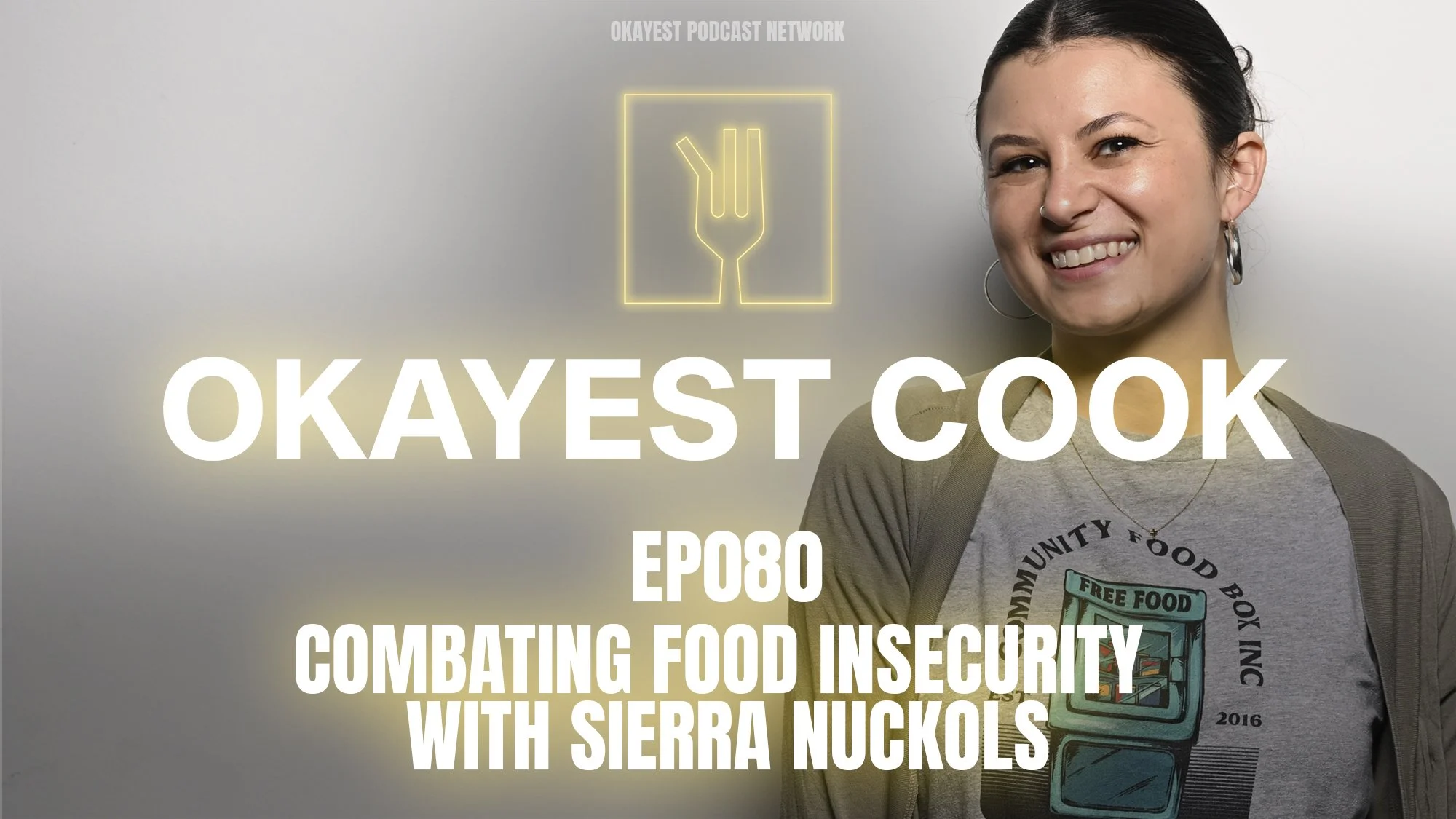
Ep080 - COMBATING FOOD INSECURITY WITH SIERRA NUCKOLS
Host Chris Whonsetler continues a conversation about community and commensality, connecting his lack of personal experience with food insecurity to the need to keep community needs front-of-mind. Guest Sierra Nuckols, an Indianapolis native, explains how her upbringing and interest in gardening led her to food justice work, including partnerships with urban growers and community gardens. She describes food apartheid as the historically rooted, racialized and class-based system behind “food deserts,” noting how food desert maps mirror redlining patterns. Sierra outlines the Community Food Box Project (under Cultivate Indy), emphasizing 24/7 access, easy-open high-protein donations, and biweekly volunteer meetups, plus plans for a live box-status map and upcoming March 7 fundraiser. They discuss donating regularly, attending local policy meetings, and simple habits like buying an extra item each grocery trip.
Help us keep the episodes coming by shopping our affiliate links. All brands we use and love! happy to chat about our recommendations





Chris: All right. Are you ready?
Sierra: I am.
Chris: Let's go.
Sierra: Alright.
Chris: Okay. Is your day going well?
Sierra: Yeah.
Chris: Starting out. All right.
Sierra: I had Cafe Patachou.
Chris: Oh, that's fun. That's always a good start to the day.
Sierra: Yeah.
Chris: What'd you have?
Sierra: I had like ricotta whipped eggs or something. Yes. Ricotta eggs. Yeah. They're really good.
Chris: They're so good. I love it.
Welcome back to Okayest Cook podcast.
your host, Chris Whonsetler, once again coming at you from the studio and we're continuing this chat about community. We are, I guess we're not really building on our pillar of commensality, but we're just talking more about it. You all know I love the word commensality and. We just had a beautiful conversation with Mr.
Stretch about community and keeping your community healthy, happy, strong, adding to your community, building your community. And I think it was off air. We mentioned that it's often Nicole neglected or misunderstood, like how well connected everybody is.
And if your community starts to suffer, eventually it's gonna impact you, which most people like we care about us.
I gotta take care of me, gotta take care of mine. And the community is often neglected and I'm massively stereotyping. But but I am building off of, you know, some of my experiences, my knowledge, and I related it to. My injured back. And so I threw up my back a couple, five, six years ago.
And when it hurts, you know it, and when it doesn't hurt, you don't think about it. It's not at the tip of my mind. I do something strenuous and I hurt my back again because it's not something I'm thinking about. And food insecurity is one of those topics where I'm very thankful that I did not grow up with food insecurities, but because of that, it's not at the front of my brain.
It's not at the tip of my tongue, and it's not something that I think about.
As much as I should be thinking about. And that is what I'm learning from doing this podcast and getting connected with the bigger food scene here in Indianapolis is. There is a lot of hurt and a lot of need around food security, food insecurity and all the things and fate or divine coincidence.
I don't know what it was, but I just met Sierra Nuckols who's at the table with me today. Welcome. Thank you so much being here. I bumped into you a few different places.
We met at Tinker here and there. We met at, I saw you at Community or Creative Mornings.
Sierra: Yes. Creative
Chris: where, yeah. So they gave you a little soapbox to, to pitch what you're doing, what you've got going on.
Sierra: Yeah.
Chris: And I was just like, I need to have you on the show. I need to talk to you about what's going on. Like all these thoughts that are swimming around in the back of my mind, but again, because of just life circumstances, just how I was born, like it's just not. Here at the front of my brain. Where I think it needs to live.
So do you wanna introduce yourself real quick and just kind of tell the listeners Yeah. Who you are, what you do, and
Sierra: definitely
Chris: what we got going on.
Sierra: Yeah. So I am Sierra Knuckles. I grew up right here in Indianapolis. I'm from the near East side, 10th and Sherman area. So, I guess one of my rea, one of the reasons I'm so passionate about food insecurity is the area I grew up in.
A lot of the families dealt with that. And my mom had me at 15. Okay. So she, you know, struggled. She always made sure I had food. It wasn't always healthy. We, you know, ate a lot of, you know, boxed and canned and. Processed foods and things like that. But I'm very grateful that she always had food on the table no matter what.
And I think the reason she made sure of that is that when she was growing up, she had lack of access to food. So she would tell me stories about growing up and just like not having anything in the fridge or not have anything in the pantry to eat. And so that really stuck with me in my adolescence and throughout adulthood.
And that really is what sparked my interest in food specifically. I think I've always cared about social justice and helping the most vulnerable of our population, making sure that we just, like you talked about things that are sometimes in the back of our minds, how do we. Connect and think about what others are going through.
You know, our houseless community, people that are in poverty, people going through hunger or these different issues. People who've been incarcerated. You know, I've always wanted to do work in that field, but I think I really got into food because number one, you know, my childhood and the history of my childhood, but also I've always been interested in gardening and I really like getting my hands in the soil.
I like nature. Similar to you talked about hunting a little bit. I really like gardening and growing food as well.
Chris: Yeah.
Sierra: Yeah.
Chris: My dad had a garden my whole life. Oh,
Sierra: cool.
Chris: And yeah, huge inspiration into like you. You know, where we decided to end up living Hey, we need space for a garden. I need my tomatoes.
And I started my garden as just Hey, I need pizza toppings, so let's grow all those. And, yeah. Yeah. Again, pillars of the show. We love, you know, good quality ingredients, you know, from, you know, the best place you can find them. Yes. So, like a beautiful farmer's market, if you can grow your own like a hundred percent, like that's gonna be way better than anything you can buy at the store.
And often cheaper too. You know, that's a rabbit hole we don't need to go into as far as like
Sierra: Yeah.
Chris: You know, if you're gonna build your own garden boxes. Yes. Yeah. Learn a lot of upkeep and whatnot, but. If we're only thinking about the seeds.
Maybe it's cheaper, but,
Sierra: and there's, I mean, there's a lot of ways to garden that are more affordable.
Just Yeah. I'm really interested in learning about or teaching people about that.
Chris: Yeah.
Sierra: We have a garden community food box project. We have a garden in Ville. And we partnered with IOC watch in Focus. Okay. They have a plot of land over there. It's probably a one 10th of an acre. It's pretty small, but we partnered with African growers last year.
There's a group of eight growers who. Work together, and they have maybe three or four different plots of land that they grow on Okay. For their community. And the idea was a cross-cultural sharing. So being able to learn from them what produce do you grow and how do you know, harvest the vegetables, how do you grow them?
What are your techniques? And trying to expose that to the community.
Chris: Yeah.
Sierra: And now we also work a lot with BIPOC Farmers, urban Growers here in the city. Okay. I made some really strong connections over the years with a lot of farmers and doing some advocacy work around that because That's good.
Yeah. Unfortunately, when we talk about food apartheid, which is essentially a term that. It's a term coined by Karen Washington out of Rising Root Farm in New York. And what she's saying is that the system relegates certain groups with food opulence, meaning, you know, access to fresh produce, access to healthy foods, and then certain groups with little to nothing at all.
So, and a lot of that is racialized, unfortunately. We see our bipoc communities affected the most by this, and so it's also class. So of course there's people in poverty are dealing with that. And so, anyway, I forgot what I was talking about, but yeah, I think, making those connections with Bipoc urban growers is important.
Yeah. Because they are disenfranchised, first of all, because it's really hard to compete for grants and things like that. So, I think one of the things I like to tell people is to always support local urban growers.
Chris: Yes. Yes.
Sierra: Yeah.
Chris: Yeah. I mean, definitely the best food you can possibly eat is the stuff that's grown
Sierra: Yes.
Chris: Locally, you know, it's, you're eating it at peak freshness, fresh freshness. So like a, it's gonna taste better. B nutritionally it's the best it's ever gonna be.
Sierra: Yes.
Chris: Versus something that's been sitting on a truck or sitting on a shelf deprive of oxygen to quote unquote make it last longer.
Right. But yeah. And you're supporting local people. Which is beautiful and fun. The yeah, I'd love to talk more about the gardens, but that's how big of the community food box project, like how big is the garden portion of that?
Sierra: Well we just started that initiative last year. Okay. We I actually expanded, so my 5 0 1 C3 nonprofit is actually called Cultivate Indie in Inc.
And Community Food Box Project is A DBA under that. So it's a project under that. Even though I started Food Box got on, I know I started Food Box first in 2016, but over the years I've gained experience in advocacy and local growing. So yeah, it's
Chris: beautiful.
Sierra: So I wanted to expand to incorporate all of that under Cultivate.
Chris: Yeah.
Sierra: But I like to tell people. About food box first. 'cause it's the thing that's been around the longest, but we just started this. I think
Chris: it's easier to
And we'll, we will dip into this here in a bit, but just the fact that hey, you can pick up food. Yes. That's essentially ready to go.
Sierra: Yeah.
Chris: We live in Indiana. If you guys, listeners and watchers aren't aware, and our growing season is not 365, so. And even, yeah. It's not even 50 50. Right. So there's only a finite time where we can grow food. And then you have to preserve it. Yeah. If that garden is gonna sustain you year round.
So, so a, if you don't have land to have a garden, or if you don't have a porch to have a little mini garden and then you don't have preservation methods like that, garden's not right. Necessarily gonna benefit you that much. So, so I love the idea of the community gardens and I would love to get more of those everywhere.
Sierra: Same.
Chris: A just for the oxygen, just Yes. Let's grow more plants and stop paving the world.
Sierra: Yes.
Chris: And just there's so many pockets, like it doesn't take much to have a ton of produce.
Sierra: So true.
Chris: Gosh, what do I have at my house? I've got three, four by eight foot beds. One of them's all strawberries and asparagus and the other two are like a mix of tomatoes and peppers and lettuce and carrots and whatever we can throw in there.
But it gives us way more food than we can use. And a lot of that honestly is just going to the compost.
Just to fertilize and, you know, fuel the next garlic. Right. So I need to work better on my preservation, but just those tiny little boxes produce a ton of food.
Sierra: Absolutely.
Chris: So if we could have a 10th of an acre here, there, here, there.
And the people willing unfortunately to maintain it. Yes. Keep it weed free.
Keep things thriving. It could feed so many people.
Sierra: Absolutely. Yes. And I think that was why I wanted to partner with growers who were actively looking for land anyway. Yeah. Because sometimes it is hard to.
Sometimes folks don't have the capacity to keep up with gardens.
Chris: It's a lot of work.
Sierra: Yeah, it is. It is A lot of work. Or they don't think about maybe putting it into their budget to pay someone to Sure. You know, take care of their garden. But that was the reason we wanted to partner with them was they already, it was perfect 'cause it was like they already needed it the space and then we had the space.
So why not do some of that community sharing? Yeah. So
Chris: do we have connections with rooftop access? I wanna see like more rooftop gardens. How hard is
Sierra: that?
Chris: Yes. How hard is that? Architects and engineers. There's a lot of flat roofs here in the city.
Like the building we're in right now has an extremely large, extremely flat roof.
Sierra: Yes. I think the only
Chris: ark's heavy when it's wet, so
Sierra: I know,
Chris: but it doesn't take much depth wise.
Can we just coat the city's roofs with gardens? Is that a thing? That'd
Sierra: be awesome.
Chris: That'd be so cool.
Side, side note, but
Sierra: no, I think Eskenazi has a rooftop garden.
Chris: I know they have something with what's that restaurant right there?
Sierra: I don't know.
Chris: Curse of the Creative. We talked about it last episode. I can see it, but I can't say it. There's a restaurant there, but yeah, they've got a really neat rooftop garden at the restaurant I think too. So.
Sierra: Okay.
Chris: Let's do that. City planners, get this in the works here. But we're on a.
We're not on a side tangent. I wanted to talk to you about what you've got going on with the food boxes. Absolutely. 'cause that's what we learned or that's what I learned you did at Community Mornings.
Sierra: Yes.
Chris: But before that, we're a little off track. Again, as usual, let's talk about notable meals. Have you eaten anything cool lately?
Sierra: Yes. So I couldn't pick between three different places. If you don't mind, I wanna
Chris: talk about as much as you want.
Sierra: So I had an amazing meal recently at Lette and Jira Cafe on, it's also in Ville. Say it again? And Lette and Jira. So it's Ethiopian place. Oh yeah. And I actually just saw them on Epicurean reel on Instagram.
Okay. And so I was excited that they're getting some promotion. Yeah. Because they actually are right next to that garden that I was talking about. Oh, beautiful. Yeah. And. I went in there by myself. 'cause I like to eat by myself. I go places and eat. And the owner there's two owners, I think their husband and wife and the owner came out and actually ate a meal with me and talked to me the whole time.
And that was
Chris: just really cool. See, as the extrovert that I am.
We talked about this with with Stretch. It's like I need people. Like I need a community. Yes. I need the place. And I was I made a rant about people that just get their takeout and they eat it in the car.
Sierra: Oh
Chris: yeah. And to me, that, that bugs me.
Like it gives me anxiety. I don't like it as an extrovert. So the fact that the owner came to eat with you, I think is the most beautiful thing. And I would've loved it.
Sierra: Oh, I loved it. I'm also an extrovert, so I understand. And then the two other places, tinker Street, of course. Got to give them a shout out.
Yes. I got to have, I ordered a salad. It was the endive salad. And then I added on the fish of the day, which is halibut. It was a halibut that day and it was just so refreshing and amazing. And then lastly, my favorite restaurant in the city is called Sahara. It's in Broad Ripple on the main strip.
And I. Just always, I mean, I always go there. Yeah. So love they the owner, his name's Mohammed, he brings out tea to everyone that comes in. Okay. And lets you drink tea for free and then he, sometimes they'll bring you dessert and just very hospitable. So
Chris: that's super. What type of food is
Sierra: that?
So he's Jordanian in his. Wife is Palestinian, so kind of like South Asian food. So I love it. Mediterranean, I guess is a good word. Oh, that's some of
Chris: our favorite.
Sierra: Yeah. Yeah. So Greek food, I can't, you gotta
Chris: check
Sierra: it out. Yeah,
Chris: a hundred percent. Well, I'm gonna go to the Ethiopian place. I mean that's,
Sierra: yeah,
Chris: a hundred percent my favorite coffee.
Sierra: Oh
Chris: yeah. So if nothing else I'll be there for the coffee.
Coffee. I haven't tried their
Sierra: coffee yet, so
Chris: hands down the best region of coffee.
Sierra: Okay.
Chris: I will fight anybody.
Sierra: Yeah.
Chris: Ethiopian coffee is top tier.
Well, it's funny you mentioned Tinker. You know, we talked a lot about tinker with stretch and that is where my notable meal is coming from.
And I just talked about the shiitake custard. Have you tried that?
Sierra: Shiitake Custard. Oh my. Oh, 'cause gosh, you did the tasting menu. I
Chris: was at the tasting. So you got to taste all the cool stuff. It's, I don't know if I'm allowed to talk about it, but I am because, okay. I told stretch, it's seriously, one of the top five things I've ever eaten.
Sierra: Wow.
Chris: It was that good. It made a mark. That's amazing. I loved it. But at that tasting, again, they had cream cheese, ice cream.
Sierra: Wow.
Chris: And it was, it's almost exactly like you'd expect it to taste. It's got kind of that, I don't wanna say sour but like that cream cheese vibe, but with a sweeter, more savory ice cream, if you can call it that.
But it was gorgeous.
Sierra: That's awesome.
Chris: I'm not a huge sweets guy, so I don't need like a big old hunk of chocolate cake and just sugar. I don't need that. And it was like just the right balance of
Sierra: I love that.
Chris: Sweet. And yeah. I think I think cream cheese is savory.
So it's that. That weird balance of sweet and savory that I've been really digging lately.
Sierra: Nice.
Chris: And like the whole mini, it was just outstanding, exquisite. So get over. That's awesome. Get over to tinker and experience that. Definitely travel here if you're not a local, but you will not regret a meal at Tinker Street.
And if they've still got that Chta custard and this cream cheese, ice cream, like if you don't get it, you're missing out.
Sierra: Yeah. So. Awesome.
Chris: Well, on that note, kind of the segue into the rest of the episode is I saw one of your food boxes
Sierra: Yeah.
Chris: Right there at Tinker Street. And I don't know it's one of those things where it's like my back, if it's not hurting, I don't think about it.
And for whatever reason, like I don't recall seeing these boxes
Sierra: Okay.
Chris: Around. And I'm a male, a very stereotypical male. And if I'm not looking for it. Where I expect it to be. Like my mind just looked past it. And like I said, because of how I was raised, how I grew up, like again, food insecurities is just not at the forefront of my mind, so I.
I imagine I've walked past these boxes of dozens of times and just 'cause you're 10 years old.
And I just, it hasn't connected.
But for whatever reason, like I was walking into Tinker one day and like it was right there.
And it was a really beautiful box, I think it was a honey Beyond Painted on it or something.
And it just hit me of this is awesome. It's like those little free libraries
Sierra: Yes.
Chris: All over the place, but it's food and I've seen them here and there. They weren't your boxes, but like other people doing it and I think it's a beautiful idea.
But let's talk about that a little bit and
Sierra: definitely
Chris: kind of the, you've already mentioned kind of the heart and soul
Sierra: Yes.
Chris: Behind why this is going. But do you wanna talk a little bit more about like, where can people find these boxes and
Sierra: Absolutely.
Chris: What's going on with the boxes and who are they for and
Sierra: Yeah.
Chris: All the things
Sierra: For sure. So I'll start with. You know, the inspiration came in 2016 when I went to South Africa with a group of young adults and we learned about the anti-apartheid movement and I knew I wanted to focus on food.
So when I came back, part of the program was I need to implement something in Indianapolis. Yeah. So I saw a news article about the first little free pantry in Arkansas, and it was this lady named Jessica Mcclar. She made a little free pantry out of that idea of the little free library. So she said, Hey, let me, I'm gonna build this box outside and I'm gonna start putting pantry items instead of books thought, and I thought that it clicked.
I was like, that's it, because it just kind of. It made me think about how many people can benefit from a box like that. And so I reached out to Jessica and partnered with her, and then partnered with vo, started taking some, I thought, I wanna recycle something instead of building it. So I, my first boxes were Novo boxes.
Oh, cool. And then my first box was at IPS school, 56. And what I learned throughout this process of, you know, creating these boxes is it does go back to community. We take care of each other. That's all we have. And
Chris: we need to,
Sierra: we, we need to. Yeah. And so I saw this. I got to see this beautiful thing unfold in front of me of, you know, I started partnering with schools and community centers and libraries and the staffs or the staff of the organizations or the children at the school, they'd come together to design the box and paint it.
So it became this kind of collective art project too.
Chris: Yeah.
Sierra: What's
Chris: theirs too? Exactly. And I think that gives you more pride and you wanna talk about it.
Sierra: Yeah. That's
Chris: cool.
Sierra: It does. And it becomes this like living, breathing thing within itself because then you know, you have ownership, community ownership over something where you know you can provide a resource to someone.
And so essentially what we encourage people to donate to the boxes are non-perishable food items. We have seen produce be donated and I just I don't mind it, but we're not technically supposed to because it can go bad, but I'll tell you, it gets taken really fast. So, but anyway, you know, we like to see granola bars.
Canned vegetables are okay, but those get donated a lot. So I encourage things that are easy to open. So, tuna cans.
Chris: Yeah.
Sierra: Easy protein items. What
Chris: are your most recent post or one of your recent posts on Instagram? Follow the community box project. What is your handle?
Sierra: It's just at Community Food Box Project.
Chris: Follow them?
But you made a post recently about. Just the ability to open a can is sometimes tricky for people.
Sierra: Yes.
Chris: So, I think one of your users commented like, Hey, we need pull tab stuff. Yes. Like things that we could just open with no tools or whatnot.
Sierra: Yep. So that's why I made that post is just encouraging folks that things that are high in protein or nutrients that are easy to open Yeah.
For people. Because I think what we don't realize, especially if we haven't been. Either food insecure or homeless before is there's a, it's really a state of emergency. Yeah. So it's like people need things immediately. And that even includes young people, children.
Chris: Yeah.
Sierra: Young adults. You know, we have boxes at schools because a lot of times kids, their only meals are at school.
So then, and then there, you know, there's been federal cuts to programs to feed children in the summer and things like that. So I think there, I wouldn't, I would say there's increasing need, but I also would say that under the current system we live under, we have always had food insecurity.
It's just more magnified right now.
Chris: Yeah.
Sierra: So,
Chris: There's, getting food is hurdle number one.
Sierra: Yes.
Chris: But then getting good food I would say is hurdle number two.
Sierra: Exactly.
Chris: And yeah, a lot of times the food that, that is provided under some of these programs, and I'm not super educated. I don't, I'm not a master of anything.
I'm just a lot, some of it's speculation. But also some of it's just like convenience. And like a lot of the stuff that's convenient and cheap isn't good food.
Sierra: I know.
Chris: And it might fill your stomach, but it's not fueling your brain. I know. And especially with kids.
Sierra: Like
Chris: we need to fuel that brain as much as we can.
Sierra: I know. And that's where, it's sad that things like food boxes have to exist anyways. I think
Chris: well that and the cuts, like why are we cutting Right. Essential things that like, it's our future Again, going back to kids like why aren't we treating our future with more care and more respect.
Sierra: Yes, exactly. I know. And it's I wanna look beyond, I want the conversation for folks and people's reflection to go beyond the food boxes and into that idea of what is the root issue and why do we even need food boxes? Yeah. You know? And how can we work toward not ever needing 'em again?
Chris: Yes.
Sierra: You know?
Chris: Yes.
Yes. Well, Stretch's big tip was just get out in the community.
And we talked a lot in that episode about our bubbles and like we've all got our own little. Family bubbles, our social bubbles, our work bubbles, but there's a lot that connects to that bubble that we aren't aware of. And it's not just your bubble, it's like a big old spider web, like my bubble touches your bubble. And it's, I guess a Venn diagram might be a better way to put it. Like our bubbles are overlapping a little bit and if one bubble starts to pop, like it's just gonna set off a chain reaction that's just gonna devastate everything.
So getting, yeah, using stretches tip of just get out in your community, just. If it's not in the front of your mind, you know, the food insecurities. Yes. Just taking care of your community. If it's not in the front of your mind we need to get it there somehow. Yes. So expand your bubble or get outside your bubble and just start taking care of our community.
Because like I said, if it starts to collapse over here, like it's just gonna domino everywhere.
Sierra: Absolutely.
Chris: So do you, I mean, do you have any tips and recommendations on again, for somebody who's not struggling with food insecurity, like how do we bring that to the front of our mind more?
Sierra: Definitely. I think one way is first off to, if you have the means to, and you can, is to donate to boxes on a frequent basis. Yeah. So it, even if it's biweekly, you'd be surprised at how much that impacts someone. If you're going to your local food box once every two weeks and just filling it with essentials, you're really touching somebody because yeah, they're in a lot of times immediate need.
Sometimes folks donate things like tampons or toothbrushes and that just provides more dignity to someone that is like racing around trying to find a resource and they can't, or a
Chris: toothbrush, toothpaste.
Sierra: Exactly. Yeah. Things
Chris: that we,
Sierra: so that's one way, but I also think checking out local classes or events is great.
Connecting, like we talked about, connecting with local farmers. Maybe you go to a farmer's market or you. You know, Google different farmers around the city that you can connect with. I think farmers are really open and willing. They love, you know, when people are interested in what they're doing because it's really hard work.
So that's a way to get folks out of their bubble of you know, we tend to just go to the, even I do, you know, go to the grocery store, get what we need because it's convenient, but how can we take that extra step that might even cause a slight inconvenience, but it might help our community or yeah, get us outside of our little kind of flow that we have created in our lives are a little bubble.
So,
Chris: yeah. Well, it's, you got me thinking here and I'm trying to spin a couple thoughts together into one, so bear with me here, but going to the grocery store and I'm thinking like, how can we just become more proactive at these things? And in one challenge I think I'm gonna throw out to everybody is.
Every time. Every time you go to the store to buy yourself food, let's buy just one thing.
Start with just one thing again, if you can. I love that if you can and you're able get a whole bag, but start with one thing. I mean, what's a can of tuna cost,
Sierra: right?
Chris: $3 if that.
Sierra: It's probably
Chris: two or three less
Sierra: than that.
Yeah.
Chris: Start with a can of tuna, something high protein, something super easy to open and just find a box. And that's where some of the disconnect I think happens. Because a lot of the boxes, I'm assuming are not close to grocery stores. Oh
Sierra: yeah. Not really,
Chris: because I mean, that's if we're talking about like the food deserts, yes.
Sierra: They're mostly in food desert areas,
Chris: and it's, and that's a tricky topic as well, because it's not always about just location of things, but it's also about the ability to even purchase something at the store.
Sierra: Yes.
Chris: So find a box. Every time, every single time you go buy yourself food.
Sierra: Yes.
Chris: Buy one thing, go out of your way to find that box and deliver it before you go home.
That's a challenge I think I'm gonna put on myself. I love it. Just to keep it at the front of the mind and what else can we do? I mean, to, you know, to take that a step farther. I mean, there's, I'm assuming there's ways to get involved physically if you wanna donate time and energy.
Sierra: Oh, yeah, absolutely. So we always take donations to, so for example, if you're one of the people that you're like, I don't wanna go outside my bubble, but I have 10, 20 bucks I can send to you or whatever. We do have a donation link on our Instagram and our. Website is down, we're revamping it. Okay. So that should be up in the next couple of weeks.
But that one is community food box project.org. So once that's up definitely check that out. We, but we do have bi-weekly volunteer meetups and Awesome. So we invite the community out. Every other Thursday. So just yesterday was our meetup, so it would be, you know, two weeks from this Thursday. But we post those updates on Instagram as well.
Okay. And so it's every other Thursday at 6:00 PM at our office. It's at 6 0 9 East 29th Street at Broadway, United, me Methodist Church. Awesome. And so when we get together, we plan, we talk about we send volunteers home with a box of food. We have shelves in the office. And so we'll, you know, send them with a box of food to take to their local food box.
We plan different programs we're gonna do for the year. We talk, we discuss, you know, we check in with each other. It's another way. Yeah. Going back to your idea of community, I think those meetups are not only oh, we're just gonna sit here and plan like we laugh. We have fun. We order food sometimes.
Yeah. You know, we just have a good time together. And I've built great relationships with the volunteers. We have about five to 10 that come. Regularly that
Chris: That's
Sierra: awesome. Have kind of stick stuck around for the past year, so
Chris: Yeah. What's,
Sierra: yeah.
Chris: You're just building a community. I love it. Yeah. Yeah.
I love it. Back to the donations, I'm assuming we could set up like a recurring donation. Yes.
Go set up like a $5 recurring donation. Yes. And just forget about it.
Sierra: It's a great
Chris: way to do it. Don't let one of those apps tell you to cancel it, because I mean, what's $5
Sierra: right?
Chris: Yeah. For most people, yeah.
You can handle $5 a month.
Again, if you're not willing to go buy a can of tuna and find a box, then yeah. Send them some dollars so they can do it for you. Where, do you have a map of where these boxes are or a general
Sierra: Yes, so I'm. I have again on Instagram. I have a pinned post of most of the locations.
I left out a few, but they're most of them are on there and we are working on a map. I'm working with a developer right now to have a live map. Okay. So he's almost done finalizing all the things for that. Yeah. And that way people can actually go in live and put if it's empty or full. Oh, okay.
So it'll turn red if it's empty. So that's pretty cool. So like it'll become more interactive to where folks that wanna go donate, they can look at the map and they can see the red ones and they'll say, okay, let me go. And then they can turn it to green.
Chris: Yeah.
Sierra: So I want everyone, I worry if one is be on the lookout
Chris: stacked with tuna.
Say, hey, like this box doesn't need tuna.
Sierra: Yes. There's,
Chris: we need something else in this box.
Sierra: There's a little area for notes. So
Chris: that's
Sierra: cool. That's been really. A lot. I mean, that's been a lot because it's been a few years of trying to build that out. 'cause it's like, you know, when you are working with technology it's and trying to do something live, there's a lot that of coding that goes behind it and stuff.
So
Chris: it's over my head.
Sierra: Yeah. So for now, use that list we have. Yes. It's split up into areas of town and it has all the addresses.
Chris: Love it.
Sierra: And then be on the lookout for when we launch the website. We'll have that map
Chris: on there. Yes. I love that idea. That's, yeah. I love technology, but I'm not the best
Sierra: Me either.
Chris: I've reached the age where it's challenging.
Sierra: Yeah.
Chris: Do you, so do you find that specific regions have different needs as far as the boxes go?
Sierra: Yes. So when we first started, we used the USDA Food Desert Map because back then Food Desert was. The term everybody used to talk about, you know, the disparities of food.
So there's a food desert map on USDA and you can go to Indianapolis and you'll see all the red zones. So we sure try to focus on those and most of them really seem to be Central East and Central West.
Chris: Okay.
Sierra: So there are some south and north as well, but a lot of them are closer to downtown, very central.
There are some out in like Lawrence and some of the suburbs too, but I think most of our boxes are located on the near west and near east side.
Chris: Okay.
So the food desert in. I'm gonna say it wrong, apartheid.
Sierra: Apartheid
Chris: are different. It's not the same thing. Correct?
Sierra: Yes.
Chris: Can you talk more about that and just terms just for listeners and watchers to, to digest that term a little bit better?
Sierra: Yes. So food deserts, we actually ranked number one in the country in 2014,
Chris: really?
Sierra: For the most food deserts in an urban area. And the reason for that, really a lot of it was the closing of Marsh and the closing of double eight foods. Oh, okay. Which was double eight Foods was local owned and they focused on food, like food desert areas.
So they had, they end up closing, but basically food desert, if you line, so food desert means essentially that. There's low access and like low walkability. So sure if you can't walk to a store for at a certain number of like blocks or miles, it's essentially food desert. 'cause there's no stores around.
And food Apartheid gets more at the historical reason why. So for example, if you line up a food desert map of Indianapolis and. A map of where redlining occurred in the seventies, you'll see it almost exactly mirrors each other. So that's what kind of food apartheid is getting at, is seeing how historically what has been done to create these neighborhoods in these areas.
'cause it was done by creation. And I think that's what a lot of people miss, is that food insecurity doesn't just happen because of poverty or just because of over this overnight. Oh, well people aren't working hard enough so they're poor, you know? So it's actually more too been Yeah, it's actually been, ever since the inception of this country, as we know there's been a lot of issues with racism and poverty.
So that translates to today. It just shows up differently. So you see things like red lining and just all these different systemic factors that contribute to. Food apartheid.
Chris: So you could almost say that the apartheid caused the deserts
Sierra: Yes.
Chris: Or is like a major factor in why these deserts exist in the first place.
Sierra: Absolutely.
Chris: Yeah. And it's, yeah, there, there's a lot of injustice going on, like the racism and not just like ethnicities, but also the wealth class. Oh, absolute classes. Like racism, like within the wealth class. Oh,
Sierra: yeah.
Chris: If you could, that's the wrong term I'm saying here, but it's a thing as well.
Sierra: Oh yeah.
Chris: Yeah. So how do we go about changing that? I mean, outside of just getting more involved, just getting out in the community more, talking about it more. I mean, what else comes to mind? Question as far as what how can we help it? It's gonna be a, we're walking uphill here.
In the snow both ways, so
Sierra: Absolutely.
Chris: Where, yeah. Where do these conversations start and what's next to make it not a thing anymore?
Sierra: Well, I think. You know, first of all, starting the conversation. I appreciate you having me on today for that reason. I think number one, what a, a lot of people don't realize is there's a lot of grassroots and mutual aid organizing happening, and a lot of times those folks don't have the means or the resources to expand out, to try to bring people in to what they're doing.
I think I believe a lot in. Grassroots meaning that folks like your aunties in the neighborhood that are cooking for the neighborhood, people who are, you know, I've met people who deliver meals to seniors in their neighborhood and they go unnoticed. They're like these silent heroes that are doing all this work with their, either their own funding or, you know, they have very little of it.
So I think trying to get to know, and this is one of the things I wanna do with Cultivate Community Food Box project, is develop more of a platform for those people that are doing that work so that we can all start to get behind them. Yeah. And celebrate them, cheer them on. Even ask, can we volunteer? Can we donate labor and money to you?
Because really that I think, is a solution to this issue. I think also. Offering if people have land offering it. To people who want to grow food.
Chris: Yeah.
Sierra: Is important. You know, you talked about gardening and Yeah.
Chris: Talked to Jason, Michael Thomas. Yeah. He'll get the city on board. He's fought those battles.
Sierra: Yes, absolutely.
Chris: Convert, convert your front lawn to a strawberry patch or tomato garden.
Sierra: Yes. And I think one of the other things that I learned about local food policy as well is we need more voices at the table. So there are, there's a Indianapolis Food Advisory Commission that meets every month. And a lot of decisions are made in those rooms without, you know, a ton of community input.
So research them and look up ordinance 3 37, that's a local ordinance that was passed during COVI that's supposed to. Help bipoc farmers. And unfortunately a lot of that funding gets kind of lost in the top. And we lose that ability to connect with the community of what do we wanna see?
You know, what about the aunties feeding the seniors? You know? I think that's where we start to at least have the conversations because food justice I think needs more of a forefront. Like we need more of a voice for that. Yeah. I think there's so much going on right now too. I mean, there's a lot of conversation around education, all these different topics, but I think food justice is a really important topic and I think that we need to start having more of these conversations.
Chris: Yeah. Yeah.
Well, insert inserting yourself I think could be a lot more powerful than people think.
Sierra: Yes.
Chris: So. Again, just my 2 cents and I don't follow politics and all the things. Yeah. It's too complicated for my low brain, but your voice matters more than you think.
Sierra: It so does.
Chris: Michael, over at the Third Space Podcast does a great job of talking about these meetings where Hey, it's an open mic.
You can go give your opinion. Go talk about this. Because a lot of the decisions, you know, in little governments and big governments are made by people who don't have a foot in the race.
Sierra: Yes.
Chris: You know, they're not struggling with this insecurity, so it's not at the front of their mind.
So how can you make this decision that impacts a huge community, right.
When you're not even thinking about the community.
Sierra: Exactly.
Chris: So yeah, their voice needs to be heard. Yes. And if they can't make it to that meeting, we need to go for them. Yes. 'cause we're all in the same community. Like we're all in this little boat. And if it starts sinking, like we're all in trouble.
Sierra: Exactly.
Chris: Take care of each other.
Sierra: And I would even say, I think what I realized being in some of those rooms when I was working in policy was even just having a face there, you don't, sometimes you don't even have to say anything. But even being there to intently listen, it causes folks to start thinking about what they're doing.
Yeah. Or saying, so what are, you know, so even just showing up is really big.
Chris: Yeah. Yeah. I mean, education is. It's a big pillar of ours here on the show, mostly centered on food educ education.
But it a hundred percent, yeah that's something I need to work on better is trying to just understand policy and politics.
Me too. That's a lot. It's a lot to, it's a lot to digest. It
Sierra: is.
Chris: But having cool channels again, like Michael, who understands more of that and he's able to break it down into simple terms. I could use some people like that. So, so what happens if this goes away? And by this I mean like the community food box project and other organizations like you
They stop getting funding, they stop getting talked about. You disappear. What's gonna happen?
Sierra: So if that happens, I think we would just see more people not getting. You know, their basic essentials. I think the very specific niche that the little pantries cover is that 24 hour access. Of course when the box is full, but
Chris: sure,
Sierra: pantries are only open certain hours of the day and it's honestly just not feasible for a lot of people to get to them.
Sometimes dealing with different issues like transportation or also the barrier of having to put down your demographic information like your name and things like that, is a barrier for people. So having that just. Ability to go get a meal, I think, or get food. I think some other organizations doing good work, like Food Not Bombs and Big Homie Ace Foundation, they set up once a week at the exact same spot every week and they serve hot meals.
So that's another resource where if that went away, people wouldn't be able to count on a hot meal in that, at that on that day.
Chris: Yeah. So, yeah, and that's it's a weird question for me to ask, but I'm just, that's kind of where my mind goes is kind of the what ifs. Playing out these little board games in my mind of okay, we take away this essential.
Need that a lot of people have, I mean, is Indie just gonna wither and again, it's a big part of the backbone, I think is just gonna, they're gonna have to leave
Or go somewhere else where they can find food and hot meals.
Sierra: Right.
Chris: And again, it's just that community, that bubble the bigger community bubble is just gonna start popping and shrinking and
I think it's gonna impact a lot more than anybody thinks. Yes. If food is taken away, and I
Sierra: agree
Chris: if food insecurity is not taken seriously and funded more, or just
Donated more to
I dunno.
Sierra: Well, and it's unfortunate 'cause we I mean food box, since we're more mutual aid focused, meaning mutual aid is essentially we take care of each other.
That's the background of what that means. So we don't bring in a ton of funding. Because we don't take grants for a reason. We don't take major grants for a reason. So I think strings
Chris: attached
Sierra: yes. To money using the strings. I think the, there are some times with grants, these expectations for you to follow that can take you away from the work.
Oh, okay. And that's where I'm like, we're not gonna get taken away from the work 'cause we're not gonna let this, you know, go away from its mission. But I think, you know, with all the cuts to funding, you start to see and you're like, wait, okay. We really are so reliant on what's. Provided for us, and I think this goes back to even your, the idea of you hunting for food.
And it's so cool to me because it's like you're providing a resource for either your family or whoever you're feeding that it's it's more sustainable than relying on a system to provide something for you. And I think that's been something that is purposeful. I mean, over the years, a lot of movements have been cut short or changed or withered away because unfortunately people in power or these systems of power have.
Made it to where we have to be reliant on them to get food or to get essential items, you know? So that's kind of my feelings about your question.
Chris: Yeah,
Sierra: yeah.
Chris: Well, again it all just goes back to our community.
You know, we're living in this city. We need to take care of the city. Yes. And again, if we don't take care of it, it's gonna die.
Sierra: Yes.
Chris: I mean, literally and figuratively, it's gonna die on us. And nobody wants that.
Sierra: Right.
Chris: Nobody wants that. And it's, I mean, to me it all just goes back to the golden rule. I mean
Sierra: Right.
Chris: And let's just, I'm gonna treat you like, I want you to treat me. Yes. And I would just wish everybody in the big chairs everywhere.
Sierra: Right. Absolute. I
Chris: mean, the golden rules thought about this
Sierra: rules seems so simple. Like we all
Chris: learn that it seems so simple. Yeah. So why is it so hard?
Sierra: Right.
Chris: And it that's what I can't wrap my head around is just why is it so challenging to get people what they need? I mean. I'm able to sit down and have dinner with my kids every night, and I'm very thankful for that.
And I don't take that for granted. And, but just, yeah, opening my eyes that doesn't happen at every table.
Sierra: Right?
Chris: So how do we make it happen at every table?
Sierra: Yes, exactly.
Chris: There's a lot to unpack here.
I'm gonna give you a magic wand,
Sierra: okay?
Chris: And you're gonna wave it and something's gonna change.
What are you gonna pick? Be as big or as specific as you want? What's the first thing that you're I see you thinking real hard.
Sierra: I am. 'cause there's lots of things I have in my mind.
Chris: I don't wanna see you only get one wish. But yeah, I just wanna know that first thing that comes to mind
Sierra: yeah, I think if I had a magic wand, I think I would
make it to where. All of our decisions collectively have to be for our children and for the future. So meaning, any decision that's made has to be for the betterment of our future. So for example, companies would have to stop putting out emissions or they would have to find a sustainable way.
'cause there are sustainable alternatives to everything, believe it or not. So that's, that would be a huge magic wand for me.
Chris: Yeah. Yeah. I'm just thinking about tomorrow.
Sierra: Yes.
Chris: And that's beautiful. I'm glad you went there because a lot of people would've said oh, I would just wish, yeah, the IDE would disappear or the food deserts would be green and flourish.
Or just food for everybody. But I think that's. Bigger way to think about all of it is, yeah. What are we leaving our children in? The youths. I don't have children. Do you read books like I
Sierra: I'm to read? Yeah,
Chris: there's a book, Aragon, it's like a sci-fi dragon book. Okay. Really cool book I like, but oh gosh, I can't talk about this though.
If you haven't read the book.
Sierra: Okay. I have to read it now.
Chris: I don't want spoiler alerts. If you're gonna read the book, Aragon and you have not hit mute here for a couple of seconds 'cause I'm gonna spoil the ending. I don't wanna spoil it for you though. Okay. I don't, I hate spoiling things. Read it and then we'll talk, there's a point in this book towards the end where, yeah, many decisions could have been made, but.
A decision, much like your answer was made and it was beautiful and just different, a different way to approach the magic wand mote.
Answer. So sorry for that cliffhanger. You can dm me later to hear the story. Okay. But I'm antis spoiling things. I can't spoil it for you. Read the book. It's a very good series.
Okay. If you're into dragons and that sort of thing I love the answer. Yes. We need to think about our children. We need to think about
The world. I mean, everything we do is gonna cause some actions and reactions. So what are we doing now to make it a better place? I mean, just a more comfortable place to live.
But also quite literally. A more comfortable place to live, you know, with a full stomach and, you know, properly firing brain cells because of full stomach.
Sierra: Right.
Chris: So,
Sierra: absolutely.
Chris: Well, if, yeah. I'm going down a weird tangent here. We are honestly at our time, which is mind blowing because like we just sat down.
Sierra: Yeah.
Chris: Is there anything else you want to talk about or mention that we have not dabbled in yet? I mean, it's such a hard topic to get across to people who aren't thinking about it every day.
And I'm mostly just talking about it myself again, because I don't think about this every day, but I need to, so I'm gonna work harder to surround myself with people like you.
That's awesome. Who are talking about this. So again, I think I asked this earlier, but how can we talk about this more just. Talk about it.
Sierra: Yeah, no, I love that question. And you know, I really, again, I'm gonna say it again. I just so appreciate this opportunity because not a ton of people ask these questions and are genuinely curious.
So it's really cool to see someone that's maybe hasn't thought about it before as much, but really wants to know and it's just so cool. So, anyway, I think, you know, I've thought about kind of one of my dreams is to have community dinner at some point. Okay. I, of course, the fundraiser's coming up, which I meant to mention that, but that's on March 7th and you can find information about that on the Instagram page.
But I think. That's kinda one of my dreams is to host community dinners for people, feed them and have conversations and let people just like talk, but also maybe have prompts as well of so we get a lot of different people in the room and then kind of similar prompts that you have given me today, but expand that to the wider community.
That'd be something I'd love to do. I've thought about that. And then other thing is. I'd like to host some political education classes centered around food.
Chris: Yeah.
Sierra: So if I one day am able to do that, I think it would provide a space for people that are curious to come and learn. Yes. And not only learn, but just engage with each other too and have that conversation.
Chris: Or like I mentioned earlier, just make it so simple minds like mine can understand.
Sierra: Yeah. Yeah. Break it down. Yeah.
Chris: Yeah. I love that. I would do that for sure. I would go to that.
Sierra: Yeah.
Chris: I also love the idea of just the open table.
And just, yes, let's sit down with, you know, some of the users of the box or, you know, I don't,
Sierra: yes.
Chris: And just. Talk.
Just talk. Yeah. It's again, whether we know it or like it, this is our community, these are our people.
Sierra: Yes.
Chris: We're all Hoosiers and we need to start supporting each other better.
And it's not just an Indiana thing, it's everywhere.
Sierra: Yes.
Chris: Which, on that note, I guess, are you connected with other cities, like doing similar projects or?
A lot of our listeners are not in Indiana, so.
Sierra: Oh, wow.
Chris: Okay. Are there other places? Google, it'll pop right up, but if you if you're connected with anything else, like we could link that below or
Sierra: yeah, for sure. I, there are food boxes in other cities in Indiana, but also there's. One in Texas.
There's actually one all the way in Canada.
Chris: Yeah.
Sierra: So there are some that are sporadic around, you know, different cities. But I would say if you're a listener and you're not from Indy, check and see if you have little free pantries in your area, in your city. And if you don't. You can start one. Yeah.
Literally. I mean, you can, you know, refurbish, reuse newspaper boxes like we do, you can build them. There's an awesome template on little free pantry.org or excuse me, little free library.org.
Chris: Yeah.
Sierra: They have a template for little free libraries you can build out of wood. Awesome. So go get that PDF, build your own, put it in your front yard.
Yeah. You know, or put it in a local community center or something.
Chris: I'm glad you said that because my next question was be was gonna be, can we steal your idea?
Sierra: Yeah.
Chris: Because food insecurity it's everywhere. You know, big cities, little cities, big neighborhoods, small neighborhoods. It's everywhere.
Sierra: Yes.
Chris: And I think my circle. And I'm just speaking to, to, you know, how I was raised, everything within my circle. It, there's, I think there's a lot of pride and definitely some embarrassment to admit that we need help.
So I, I imagine that there is a lot of insecurity, a lot closer to you than you think, you know?
Sierra: Yes.
Chris: Just because people aren't talking about it.
Sierra: Oh, definitely. And to that point, you know, we have food boxes in areas that aren't food deserts, and you'd be surprised at how many people use the boxes. Yeah. So I think even within our own communities, having that resource is great. And I do suggest people to steal the idea because it is a nationwide thing.
Again, I partnered with someone who started it before me, so I say I think people I do encourage people to reach out so we can create a web of. Connection and
Chris: yes.
Sierra: Start to really get to know one another, but
Chris: yeah. Yeah. Well, on the note of pride, and I guess, I don't wanna say shame, but kind of, but is there a safe place that if you are struggling with some food insecurity I'm assuming like we can reach out to you
Directly via your socials or whatnot, or any other local
Sierra: Oh, absolutely.
Chris: Local spots to, to,
Sierra: yeah.
Chris: Ask for guidance or help.
Sierra: Yeah, absolutely. I do have I let people come into the office often to take food from the office if they're not able to get to a food box. So that's a possibility. If you'd like to DM us on Instagram, you definitely can, and we'll make accommodations for you.
But then also 2 1 1 is a good resource. You can call 2 1 1. There's also. I'm kind of blanking on it. So you might have to include it in the comments or something in the podcast, but there's a, an app you can download that has a map of all the pantries in Okay. In the hours and stuff.
Chris: Yeah.
Sierra: And then in the Indianapolis area,
Chris: so,
Sierra: okay.
Chris: Yeah. It's a safe place. Reach out. I would be happy to redirect questions if you wanna send the Okay. S cook a note. But definitely the community food box socials. Yeah. It's a safe place. Don't feel ashamed to ask for help.
Sierra: Yes, absolutely.
Chris: And certainly just talk about it. Please talk about it.
Sierra: Yes. And I think that's one of the things, I'm so glad you brought that up, because I don't share this often, but I've used food pantries before, like I've dealt with financial insecurity for many years. So this is something that, you know, I think is not talked about enough of. How quickly we can fall into these kind of situations.
Yes. You know,
Chris: It takes very little.
I mean, you're one car wreck away. Exactly. A lot of people from Yeah. Needing a lot more help than you'd care to admit, so,
Sierra: yes, absolutely.
Chris: Yeah. And it's it's a weird climate
To be living in currently. So Yes,
Sierra: absolutely.
Chris: Again, your homework is just the golden rule, of course.
Treat people like you wanna be treated. And the bigger, more important homework, well that's not more important than that, but your bigger homework is filling these boxes. Find one close to you, start one if you can't find one. And then literally every time you go grocery shopping, start with one thing and then get two things.
And then get three things.
Sierra: Yes.
Chris: And just do what you can because, you know, we're, we all need it. I think at some point we're all gonna need some help. And, you know, whether it's food or money or just friendship, we need to be here for each other.
Sierra: Yes, definitely. Do. We do. Yeah. Love it.
Chris: Thank you so much for being here.
I love this conversation. I need more of this.
So I'm gonna flag your page or whatever we can do to get more of those notifications and awesome. Fuel the algorithm with this type of content. And we're gonna Yeah. Talk about this more and make it easier for people to talk about and,
Hopefully make it less challenging in the future. I think is our goal.
Sierra: Yes. Yeah. Thank you for having me.
Chris: Absolutely. Thank you so much.
Sierra: Yeah.
