
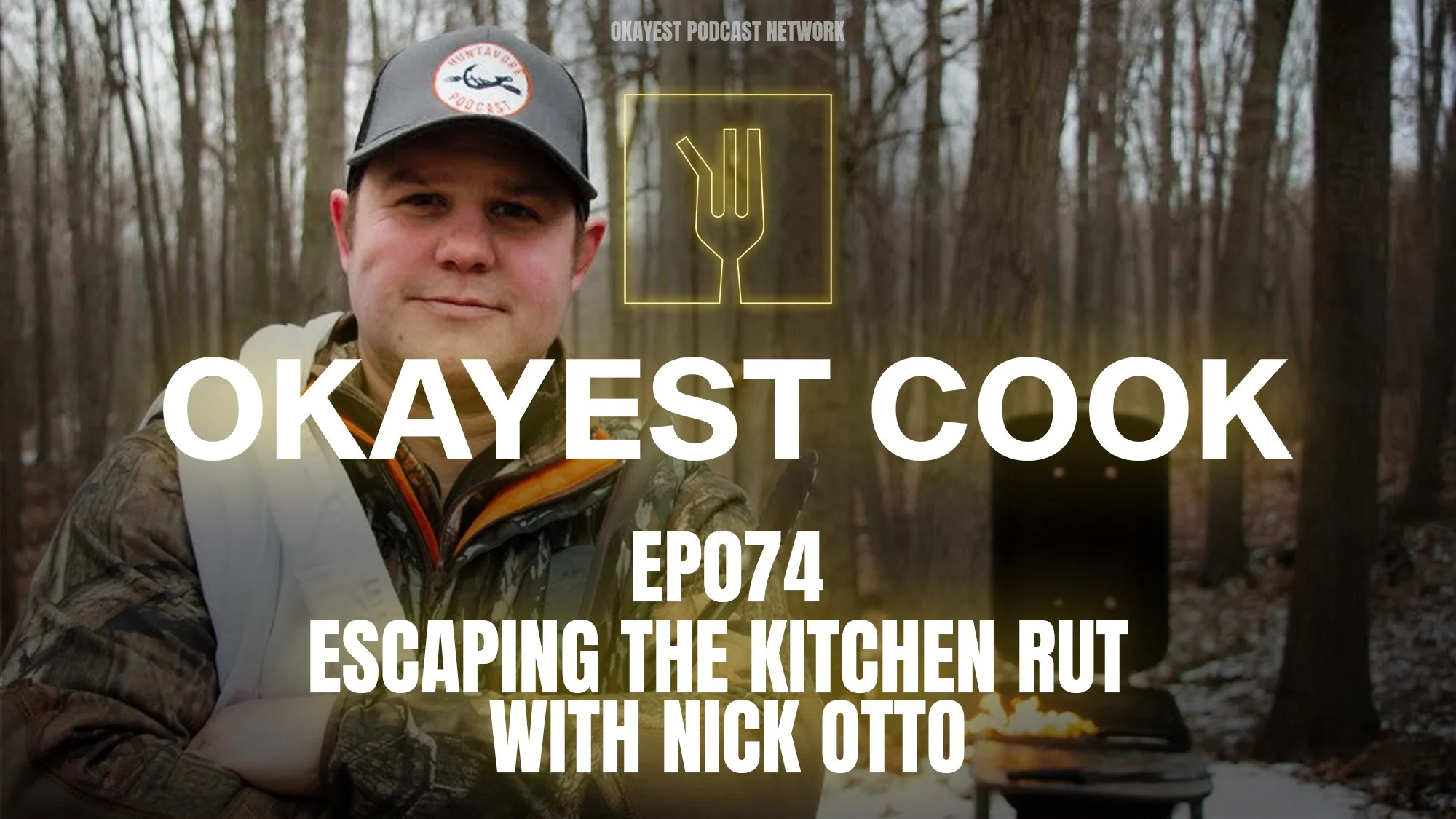
Ep074 - Escaping the Kitchen Rut with Nick Otto
In this episode, Chris Whonsetler is joined by culinary enthusiast and fellow food podcaster, Nick Otto, to discuss and share insights on handling getting out of kitchen ruts, from simple technique changes to over the top showstoppers. They explore ideas like making kebabs, pastrami, and regional favorites such as pasties and bulgogi. They highlight more adventurous culinary endeavors like tartar and carpaccio, emphasizing a balance between simple tweaks and elaborate preparations for venison and other meats. The episode promises to shift how you think about wild game cooking and inspire fresh ideas for your kitchen adventures. Packed full of tips, humor, and shared personal experiences, the episode ends with a promise of more to come in part two.
Help us keep the episodes coming by shopping our affiliate links. All brands we use and love! happy to chat about our recommendations






Chris: Don't look at that yet.
Nick: Oh, sorry. Sure.
Chris: All right, let's go
Nick: there. It's
Chris: cheers.
Nick: Hey, cheers, man.
Ah, thirsty Thursday, man. It's good.
Chris: Good. It is. It thi It is Thursday. It's Thursday, dude, this time of year. I never remember what day the weekend is.
Nick: Hmm. Probably should've saved that and just threw a piece of sausage in my mouth.
Chris: Welcome back to Okayest Cook. We are on location. I am up here in the great state of Michigan, hanging out with a buddy Eric College buddy. Shout out to Eric. Hey Eric, man,
Nick: that's awesome.
Chris: And I'm sitting down at Eric's work bench with Mr.
Nick Otto. How are you? I'm, I'm doing fantastic. The Vore Vore? Yes. Um, he's got a show as well that I'm sure you've all seen, you're all, we're all in the same industry, um, thought process. So Mr. Nick Yeah. You run a show. It just so happened that I was gonna be hanging out up here with Eric and I knew you were a Michigan dude.
Yeah. And so I was like, Hey, how far away are you?
Nick: I, that really, it got me very excited. Yes. Because like, I, I don't in this, in this industry, a, I mean, you know, cooking is very intimate. It's you're sharing food with others, you are. There's just a lot of, you know, blood, sweat, and tears and love and being together with it.
And I find that even like in our, our circle right now of being podcasters, the easy way is not going face to face
Chris: a hundred percent.
Nick: So getting an invite to say, Hey, I'm gonna be up. There's the potential, like I'm, I'm kind of kicking myself. I was like, man, do I take, do I take a sick day and it, mental sick day, mental health, sick day, and I come and cut deer and hang out with you guys?
I, I did the good thing. I went to work, I did, did what I need to do, but again, to like, to come and just commune. To have fellowship and to be able to hang out with people. Yes. I mean, thank you so much for the invite. Absolutely. Yeah. This is awesome. 'cause yes, being face to face and getting a chance to talk with people about what we love, about what we strive for, like this is just
Chris: awesome.
Nick: So yeah, I'm living cloud nine right now. Awesome. Awesome.
Chris: Sick. Yeah. Sup? Super fun. Yeah. So spoiler. Yeah, Nick mentioned we are cutting up deer. So yeah, we're up here. It's late dough season and Mr. Eric got a couple dough and we're just processing up here, you know, making, potentially making some sausage. Uh, we'll see how late it is when we're done recording.
Um, but yeah, we're just having a good time. Yeah. Making meals and hanging out and we'll talk about that later on. 'cause I've got a few questions. Absolutely. Um, recently we did an episode on, you know, breaking down some quarters. Mm-hmm. And we're just gonna like take that to the next level. Like, you got your meat now what?
Um, we'll dive into that later. Uh, before her. Let's talk about some notable meals, and I've got my notable meal sitting right here. Oh my goodness. So if you want to go first with the notable meal. Yeah. Yeah. Do you have any meals like that you've eaten recently that have like really stood out to you?
Anything cool you've seen online that you want to try really bad? Gotcha. Um,
Nick: um, can I do one that, that I, it could be something you made, it could be something you went to
Chris: a restaurant,
Nick: whatever. Um, so I found this guy online and I'm actually struggling to remember, uh, no. It was a, one of the, on YouTube, if you look up Chef John from food eats.com Oh my goodness.
Okay. Big guy on the YouTube scene, he makes a, it's called a poso. And it's Sicilian style, uh, short ribs, but it's done in wine and it's done with an insane amount of black pepper. In fact, you, you use, you crush up some black pepper. You gotta use your, either you got moron pistol or you can use, uh, like two, like your pan on, on a cutting board and be able to grind up.
Okay. So you want coarse ground, but then at the same time, the same recipe calls for putting whole, um, peppercorns into the braise liquid. Nice. And that's the whole idea is you take these short ribs, you cook 'em until they're literally falling apart, and then it goes on to, um, polenta, it goes on to mashed potatoes.
It goes onto whatever you want. Essentially it's a Sicilian version of ossobuco. We, a lot of us have all heard that same style, but it's, it's that. So I've just. Translated that into my deer shanks. And the reason I bring that up is that has been my go-to winter solstice meal. Like we get to the coldest, well, I, I would say coldest here we are in a heat wave it seems, but that
Chris: 40, 40 degree heat wave.
Nick: Um, but being able to. In, in that coldest, darkest evening to have some of the richest, warmest spiciest meals that are there. I know some people like to, like Christmas, you like and New Year's, you like to go out with like the, the crab legs and the citrus and the, the stuff like that. But this is just, it's, it's rustic.
It's homey, it's spicy. It's not like it doesn't burn your tongue. It makes your, makes your nose run. It makes your eyes like just like glisten up and it's like that when you're going through that dark period where I'm sure a lot of us deal with that seasonal depression. I know that's one of those, like if I don't see the sun or I don't see the sky for a while, it's just cloud cover, man, is that rough.
Just warms you up. So having something warmed up. So that's my notable meal is, yeah, sounds awesome right here during the solstice, poso basically wine and black pepper and a load of garlic. That's, that's what goes into it. Yes.
Chris: Dude, that sounds incredible. Like, I'm gonna try that. Um, a hundred percent. Yeah.
Polenta and grit. It's like I'm speaking my language, so Love it. Well, my, my notable meal is actually something that I have truly never had, but just crazy excited. A, a guest we had on the show a few episodes ago, Sena Sena Sea. Oh my goodness. Is like a, a wild Alaskan. Fish company and they have some of the most beautiful salmon I've ever had, but they just came out with this tinned salmon.
No way. So we're gonna crack this open and give it a try. I've also got one here from, uh, fish Wife and a big national company, I, I believe. Okay. But, um, uh, one of my favorite local bread places, Amelia's Okay. Sells stuff like this. Gotcha. Um, so I've got bread, local bread from Amelia's. Um, another former guest, um, favorite bread place in town.
Uh, so I've got their baguette that I toasted in the oven. And the goal here is just to put it on a cracker. Awesome. Um, again, I have never truly never had tin fish. So, um, Tinder Fish Review guy love your content. Um, you've inspired this notable meal.
Nick: Yeah. So now where did you get, did you have to order this online?
Yeah. Is it Okay, so it's online that you get, get order from the site? Yep. From their site. Beautiful. Look at that color
Chris: dude
Nick: that's coming out of a
Chris: tin. This co Is this coho or is this the sockeye? Sockeye? Oh, yes. Just, oh man. Just beautiful smoked salmon. Oh
Nick: my goodness. I mean, there's oil there, but it's not like, we're not looking in the tint.
It's not soaked. It's not completely saturated. Yeah. Like I'm, all I'm tasting or smelling is
Chris: the smoke. And it doesn't, it might say somewhere exactly what's going on inside of there, but Oh my gosh. I mean, it's just, it's salmon. It's just legit salmon. So, we'll, we'll, we will report back later, brown sugar, garlic, black pepper contains salmon.
So it might just be, I love that ingredient from the bam right there. Shoot, let's dive in here, see what's going on. So yeah, like I said, first, first ever experience with Tin to fish. Um, but again, I, I love seeing a seed, what they're doing. FishWise.
Nick: Yeah, I think like it's funny too, like, um. Like the tin fish is getting a real big comeback, like along with like the charcuterie Yes.
Stuff. Which I, I know we're, we're gonna ble a little bit into talking about that Charco charcuterie, but it's like, maybe it's a millennial thing. Like we just grew up with Lunchables. We grew up with cheese and crackers. We grew up with I've seen that post. Yeah, exactly. And it's, so, it's like now all of a sudden it makes sense like, oh, that we just associate with like snacking like that.
Like to gimme a lunch, gimme a, a meal was all about that. Dink little dinkin sink dink.
Oh.
I saved my piece. I lost a piece of fish. Wow. It's alright. Oh my mish. Wow. Again, you're telling me this came out of a tin. This is, uh, amazing stuff. You've, the flakiness is still there. The integrity of the fish is still there. It's not swampy. It's not, yeah. Mushy.
Chris: Amazing, amazing texture, amazing flavor. And honestly, the smell, the smell is just like, I mean, we've all been to those sketchy fish restaurants and like fishy is not the smell mm-hmm.
That, that you would say coming outta this tent, which is, it's just gorgeous, gorgeous salmon. Oh man. Tennessee get knocked outta the park. Home run, dude, you've been knocking it outta the park with your, your fresh salmon. But all the tin stuff and what I think, what I love most about the tins. The sell by date is November 20, 28.
So that's gonna be great for, you know, minimum three years. Absolutely. And that's just the sell by date, so, gosh dang man. Shoot, I'm a fan.
Nick: This is good stuff. Okay. I would say this is also, maybe you resonate with this, anybody who listens to our podcast, I'm sure you're already like, there they go, eating again.
Oh, we get this crunch and munch. I'm like, sorry, not sorry. Once while we're not sorry. Like every once in a while I'll get a comment on, you know, if I, I know my earlier ones, we did a lot more of that. We're like, yeah, if he would quit eating something, it's like, this is what we're doing though,
Chris: yo. Alright.
Since we cracked into the one, this uh, segment has already gone on longer than it usually does. I've got some Albacore tuna in spicy olive oil from Fish Wife. Mm-hmm. So yeah, we're just gonna crack into number two here. Gotcha. So this is going straight up tuna alba.
Yeah. Um, the shop has, yeah, Amelia's, they've got like all the fish wife stuff, so they've got, you know, sardines and all the stuff. Hold on. So I'm gonna try to spill Yeah. Try not to spill this all over Eric's nice table here. But
Nick: do you think there's also a correlation? I think they've sold more sardines.
I would love to see the data from this just out of a pure curiosity with pizza ovens being now home appliances like the uni. That's a good question. Yeah. And all that, because I've eaten since, since my brother-in-law got a pizza oven. I've eaten more sardines in the past five years really? Than I have my entire life.
Like, sardines were not a thing until like the pizza oven came about.
Chris: I'll be honest, I still haven't done the sardine on the pizza oven thing.
Nick: I mean, the sardine anchovy, like you, it's, I don't know, something about the ferment, the fermentation of it. The, the salting of it. Yeah. It really just has this, it's the desired funk.
I know people don't like that idea of like, enjoying funk, but like when you get into Oh yeah. Odd cheeses when you get into Oh, it's a thing for sure. Yeah. Now I'm not an olive person. I can't, I'm, I'm trying, I'm really trying. It's it's stew livers. Yeah. I just can't, I'm, but can't quite do it. Olive oil.
I'm all in. But if I can like an olive paste, like I'll, I'll still like, it just can't. Okay. I, I need to be a big boy. That's fine. And do more of it, but, alright. This is gonna
Chris: drip everywhere, so be careful. This is the drippy one. Okay. Don't, not the, we won't dink and sink on this guy, but, uh, yeah. Spicy albacore and spicy olive oil.
Mm. Move over Bumblebee. This is where it's at. All right. So y'all know I love my spices. I'm sorry, FishWise, but calling this spicy.
No, no, this is not spicy. Uh, my wife might call this spicy, but this is not spicy. I do see some pepper flakes in the oil though, so. Mm-hmm. Maybe it's,
Nick: yeah,
Chris: it hasn't, maybe I need to stir it up more. Yeah.
Nick: But you would think though that that oil's gonna percolate through that. It should have. It should have by now.
It should have two Midwesterners, two ranch eaters here, like are saying it's not spicy. That might be something they need to come back to. Very good. I prefer the salmon. Mm-hmm. Yep. I am, uh, yeah, I'm with you on that. The salmon really does a dang good job. Um, and I, I was jokingly saying like, move over bumblebee, but like my mom and I have a shared affinity with.
With tuna. 'cause we do like to the tuna fish, add the little bit of mayo, mustard pickles, throw that, either eat it with potato chips or eat it with, you know, two pieces of bread, toasted pieces of bread. That's like one of the thing that, like my mom and I really have together the rest of the house, my brother and my dad, like, it would just, they would run for the hills.
Okay. I hated the stuff, but like, that's funny again, like this to mix that with like Okay. Even add a little more spice into that. Yes. And then to have that with either a tortilla chip, have that on. Yeah. You know, just two pieces of bread like that is, that is a step up. Like yes. I know we were just picking on the, the si the spiciness of it, but like, dang, that's
Chris: some good tuna.
It, it does linger. So there's a lingering spice Yeah. That I'm, I'm picking up now. Mm-hmm. Which is nice. Mm-hmm. Um, it, it is a beautiful can of tuna. So like, don't get me wrong, like it's, if you compare this to any other canned tuna that you find at your grocery store, like this is going to knock that out of the park.
It's unfair that we tried the salmon. Before this, because Yeah, I'm, I'm just, I'm salmon guy, right. So Yeah. The, the, the stuff, the salmon from C to C Yeah. Top tier, like, it's, it's, it, it wins this battle.
Nick: I haven't done a lot of research or like, maybe just like I, I know enough that there's like the filet side of the fish, there's like the tail end of the fish and then there's the belly.
In my vast knowledge of hearing about canneries from the deadliest catch, that's like where I get most of my knowledge from the Bering Sea. Um, they would have small magnets segments where they were talking about, uh, these canneries and, you know, again, taking off the filets, they're gonna get the prime meat.
They're gonna try and upsell as much as they can, for sure. Yeah. Maybe in those, those store brought brands, the mega ones, are we just getting tuna belly? Oh, I'm sure we're versus bottom tier for sure. Like here we're finally getting like the creme de la creme, but now we're getting filet. Yeah. In the tint.
So I think there's, it could be, yeah, like you were saying, like that comparison's hard. But at the same time, like the product that you're getting outta this, like this is something I would definitely hands down. Yes. I'm going for this. Yeah.
Chris: And I, I could be wrong, but, um, but this definitely looks more like whole muscle versus like the, the chunked stuff that you get in the grocery store.
So, yeah. Um, a hundred percent. Yeah. This looks more like what I feel like tuna should look like. Um, and again, yeah, the salmon, I mean the salmon's got skin on it in the tin, so. Mm-hmm. It's, it's beautiful. It's gorgeous edible skin too. I just
Nick: sucked it all
Chris: down. I didn't pick anything off. So, so good. So good.
Alright. Yeah, we spent too long munching, um, we're still gonna be snacking, uh, through the rest of the episode, so apologies. Sorry, not sorry. Um, but yeah, I'm gorgeous. Yeah. I'm, I'm gonna buy more canned fish. Like these, these were gorgeous. Like, I love, I love this. Yeah. For just a quick, easy lunch fish cracker.
Yeah. Good to go. Buy some. It's good. So, uh, we are breaking down deer and I mentioned earlier, we did the episode on, um, tearing down some quarters. Yeah, we did a hind quarter. A front quarter. Um, it was funny, um, the, the comments you made about that episode, you can bring that up later on. Um,
Nick: no, it, it was all in good fun.
I, I love like anytime that somebody's doing something as far as breaking down their own deer, like, dude, hats off to you. You're doing something that's outside the realm. Remind me, remind me of the terminology that I said because, well, you said, uh, let's talk about, or Yeah, I was breaking down the rear hind left rear, and I was just like, I am so excited for the front hind leg.
Like, what are we gonna, what are we getting into? So that's, that was the term that you spin out. No, I was just, I thought
Chris: that was so funny. Yes. Yes. So, um, my thought process for this episode, um, we broke those down. I kind of mentioned what I like to do, like here, here's your steaks, here's your roasts.
Generalized. Mm-hmm. Often I'm finding myself getting stuck in, in what I call the kitchen rut, and it is not, not the fun rut. Mm-hmm. Um, like what we just had in whitetail season. But it is just like you are, I'm stuck in this continuous cycle of, I don't wanna say mediocrity, but it's just, I have some meals that are fast and easy and bulletproof
Nick: and you put 'em on a rotation.
I love 'em.
Chris: Yeah. Yeah. And when I get home from work, I find myself just, these are like these three or five meals. That's what I go to and that's what I do the most of. And, you know, my wife recently, you know, put in her resignation. Um, so she's a stay at home mom. I'm working more, you know, because of that.
And I just wait, she.
Nick: R resigned from the stay at home, or she resigned from No, no. Yeah. Oh. So she's like, screw you. I'm, I'm now going to get a job. No, don't
Chris: have job. Yeah. She, she had a day job. Um, but yeah. Oh, okay. Recently I stopped the day job and now stay at home to stay with the kids. Yeah. And, uh, congratulations to her by the, the way.
That's a big jump. Oh, it's huge. It's massive. Um, and she doesn't love it. So thank you, God, for dealing with our children. But yeah, I just, um, again, just my energies are all going elsewhere. Um, and not to the kitchen anymore, which is kind of sad, but, um, it's coming. Yeah. We're, we'll figure it out soon.
Speaker 3: Mm-hmm.
Chris: Um, but again, because of that, like I'm finding myself getting stuck in this rut, and I, like, I just don't have the brain cells, the brain power for like, kitchen creativity. And I know I've got a million cookbooks. I know the Internet's got a million things Right. But it's still hard to break out of that rut that I've, I've dove myself into.
Yes. So I, I did my own little bit of digging and. I just wanna pick your brain about like, like what else can we do? Like what, what are some of your go-to killer meals that you love to do, uh, just to break out of this cycle? Like how do you rejuvenate? You know, your, your kitchen.
Nick: Yeah. Kitchen funk. Kitchen stink.
Yeah. Yes, yes. Um, 'cause we're very much in the same boat. Um, well, my wife and I both work, uh, we got three kids at home. They're growing boys like shoot burgers and tacos and spaghetti. Dude, that's basically rinse, repeat, boom, boom, boom, boom. It's getting steak and eggs. Yeah. It gets to a point too that there's, there's some nights where they'll pick and then there's other nights where it's two pounds Yes.
To feed 'em. 'cause they're like, can I have another taco? Hey, are you gonna finish your burger? Like, I'm in mid bite and they're already like eyeing it. Like, I'll, I'll just make a couple more bud. Like, hold off. So. But that routine is it, it's nice, it's, it's comfort and it's comforting. But like you said, you can get into a rut and getting my boys to try new things is extremely tough.
It's, yeah,
Chris: we're getting to that age too. Yeah. In my house for sure. They
Nick: know what they want. They know what they like. And to, to bust out of that a, it's gonna have to come down to, I mean, yeah, like you just were saying like time something that, you know, something that inspires you. You're gonna have to be creative and you're like, I don't have those brain cells.
I don't have, I don't, I don't have that capacity to be creative. Um, simplest thing that you could do is do what you are doing. So you've got spaghetti night. Do not just put the ground into the pan along with the sauce and just have a meat sauce. Make it into a meatball. Yes, totally. Change the technique of it.
Don't change the dinner. You've got the dinner down. You know what, I'm gonna make a meatball tonight. And like you just said, quick reference fi. Like I'm at work, you're at lunch and you got 10 minutes. Oh, I got a recipe right here. Yeah. Biggest thing I heard, I actually tossed to, um, Chris Abigail, uh, she's down in Texas.
She's a wild game butcher down there. And like I was talking to her a little bit about curry 'cause I, again, I was trying to, I was excited about doing curries, but I was like, I'm hesitant about this and I'm, I'm nervous about this. And she said, listen, don't make your own like curry seasoning. Go get the store bought.
Like get yourself comfortable with it then do that. Be okay with taking shortcuts to help yourself out. I like that. So you get to a point where you're making a meatball. Like, don't go get veal and, and every, all these other bits to like make like the award-winning meatball. But take the, take the Vinny that you got that.
Okay, now I'm just gonna add some breadcrumb or I shoot, I don't even have breadcrumb saltines, I got saltines. Crack those all up into a powder. Have an egg in there, dab a milk, put those together, get a seasoning that you like, the same seasoning that was gonna go into your sauce.
Speaker 3: Mm-hmm.
Nick: Put that right into the, the, into the meatball.
Speaker 3: Yeah.
Nick: Sear that up on all sides. Then put some sauce on it. Throw 'em in the oven, finish 'em in the cast iron. When you serve that up, it's almost like it's a brand new meal. Like who? And now we have neat balls tonight. It's the same recipe. Yeah. But now you're presenting it different. It gets you excited.
Yeah. 'cause you're doing a new technique. It gets. It gets the kids to eat. It's the same thing. I just put it as a ball. And then when they say like, oh, I don't like it. Like, okay, now you gotta make a choice. You gotta step up to be, 'cause it's like, it's the same thing. You can do this, but that's a simple idea of just changing the technique that excites you.
Yeah. That can elevate you out of that rut. Yeah. You get into burgers, like if you're doing the same patty, you know, you make your patty, you put the dent in it, and you're putting on the cast iron, try the smash burger. Everybody's got a Blackstone, everybody's gonna switch to the, or. If you only do smash burgers, try like a Juicy Lucy.
Instead of putting the cheese on top, well make your two patties. Put the cheese in the middle. That's way to go and then stack it's way. So it's changing, changing little things as opposed to rewriting. Yeah. After you make a couple juicy loosies, you're like, Hmm, maybe I wanna step back into that meat low idea of it.
Like again, something super simple, but now it's, it's led you. Out of that funk. Yeah.
Chris: It brings back that excitement. I'm glad you brought that up because my initial thought when I was planning this episode and like a little bit of research was to just like, let's go like all the way in and just like change everything.
But I love that hot tip of just like, just tweak, tweak a little bit here and there. Mm-hmm. You know, the meat sauce makes make meatballs. Yep. Um, yeah, there's, there's a load. You a boatload of stuff you can do. Just like Yeah. Change your technique a little bit. Same recipe. Different technique. Yep. You're golden.
Uh, tacos. Okay.
Nick: Taco night instead of ground. Yourself a piece of skirt steak too. We were just talking about how are we gonna use some of these different cuts? Yeah. Maybe it's going with a, like a, a shredded or you know, change it up from a ground. So, but then at the same time, and I'm going through a little bit of this in my own personal life, so I'm trying to slim myself down.
I am, we were just talking about earlier, I was laughing 'cause we were sitting next to Husky over here. Um, that was the pants that I used to wear as a kid is the husky sizing. Um, so I've tried intermittent fasting and. It's come to, it's gotten to a point too that I'm not diving all in like, Hey, I'm just not eating for 24 hours.
Like that's an instant. Like, Hey, I made it for 24 hours, now I'm gonna go shove my face full of food on the opposite end of it. But I'm taking these small incremental wins. Yeah. So yeah, doing like, okay, I'm gonna do it again on the 16 and eight and I'm just gonna see where my weight leads from there and I feel better about myself.
You know, I feel better about myself. I actually physically feel better. Nice. And it was one little step. I applied that to my, my tacos, or I apply that same idea to my, my meatballs. Now the kids are like, oh, spaghetti, are you gonna do the meatballs again? So they're asking about it.
Speaker 3: Let's go. And
Nick: the reason I brought that up first, 'cause I know you did really want to, and we still are, we're gonna dive into some of this deeper stuff, but getting out of that rut, if you jump from.
Doing something that is mundane. You're doing something that's a routine and then you jump off this cliff of I'm gonna learn a whole new No, do whole new cuisine. Yeah. How many times are you gonna wanna do that? You're gonna be exhausted by the end of it. I, yeah. I see that. You may or may not even really enjoy it because you are like, oh, and now I got all, I got enough dishes here.
I had to get a new piece of equipment. I don't know how to wash this. And so it's another thing that if we do things a little bit of a time, we take Chris's baby steps. Yeah. Her when she's, she's ringing in my head right now of like, make a couple of those changes and then it makes the next steps forward.
You've already made a meatball. Yeah. Well now we can step forward and now we're not, we're not doing spaghetti. We're gonna do linguini or we're going to try something completely different as far as a pasta shape. And then that leads you. To, I mean, that, that starts, that, that progression to the next, I don't wanna say snowball, because I feel like snowballs are going downhill.
Like I feel like we're getting momentum. We're going flavor town's down the hill. Flavor towns is down hill. Yeah.
Chris: Snowball's. Okay. I like it. Flavor town is downhill. Yes. Well, let's, let's take this, uh, to the other side of the coin. Um, let's go to the, that's my personality. Like, like let's dive in head first.
Let's just, let's just go all in. Um, so, um, I talking to a few different friends mm-hmm. And, you know, I just did a quick little search, uh, you know, flip through the cookbooks, like what sounds cool to me. Um, 'cause I'm not a planner and I think a lot of, uh, this kitchen rep could be fixed if I could just plan ahead.
Mm-hmm. So let's thaw out some meat, you know, let's get it ready for X, y, Z down the road. Um, but my job is so like chaotic. Like I don't really have set hours. Like I could be here today and there tomorrow and like, who knows when I'm gonna be home. Absolutely. So if I thaw out some meat. I might get to it tomorrow, but it also might be a week.
Yes. So I feel like the planning ahead for me is really challenging. Uh, but I need, if, if I can figure that out, I think all of this would go a lot smoother. Um, but I've kind of got like some categories from a little bit of research I did, and then just other friends I've talked to like, Hey, like what do you, what is your, some of your go-to meals that are kind of, you know, outside of the norm?
And I kind of broke it down into like, like I've got a general list. I've got some soups and stews, excuse me. I've got a deli meat category. Um, I call it steak adjacent. Um mm-hmm. Because like steak on a plate, like everyone loves that. Oh yeah. Right, right. Um, most people like that. And that's, again, that's what I default to nine outta 10 times.
Like, I got this hunk of meat. Throw it on the smoker. Sear it up. Yeah, it's good. Um, so stick adjacent is, you know, similar to that, but not quite. Um, and then I got my ground stuff, so anything I can just use with, with my ground meat. Mm-hmm. Um, and we can start anywhere. Um, top of my list is general, which probably should be at the bottom 'cause it's all the stuff that we didn't think about.
Um, so let's skip that for now. Okay. Um, let's start with putting general on the bottom. I like this. And we'll also, um, skip soups and stews for now.
Nick: Oh, that'll be, I would say that's the teaser right there. Throw soups and stews if you enjoy what you're hearing right now. Yes. Stay tuned. 'cause on the flip side, Vore is gonna be holding onto soup and stews part two.
Tune into part two. There's your, there's your Easter, Easter egg. You gotta tune in if you like. Soup and stews. Soup and stew soups and stews in general. Yeah. We
Chris: can save that for, for part two. Yeah. We'll see where it leads. I like it. Look at it. We're planning on the fly. We're planning. Look at us. Um, so deli meats, I guess let's start there.
Um, I've, I've dabbled in the deli meats. Mm-hmm. And it stops at pastrami. Mm-hmm. It starts and stops at pastrami. I've done pastrami. Gotcha. Um, but I love, I love the pastrami. Like it's dynamite. I love Yeah.
Nick: And that's, I mean, you can even go so pastrami, you know, you're getting your cured side. Um, when you, when you get into that like cur the pastrami, it's absolutely golden.
Yes. Um, I, and even I wanna throw like a roast beef in there as well. Yeah. Um. I was in the store, I saw I didn't get anything from the deli counter. Um, I normally, we don't really get roast beef from the store. We, we try a couple other different things. Uh, being that my family owns a Turkey farm, the Turkey meat there, the deli meat that we make there, that's usually our sandwiches.
So it's rarely that I ever have a roast beef sandwich. Um, I've recently gotten into making roast ven sandwiches, mainly because of the sticker shock that I saw Boar's head, uh, roast beef was $15 a pound.
Speaker 3: Jeez.
Nick: And I, when I make a sandwich, when I need to, like, I need to chew on it. I want a nice tall sandwich if I'm gonna make something.
Especially if you eat a seven sandwich right there. Mm-hmm. Absolutely. Like, shoot, I don't know what everybody else is gonna eat, but that's what I'm gonna have. And just the money invested into delis. Like if you're picking that up, I know if you go at like our local Meyer over here does a deal where you can get like the already pre-sliced stuff up.
You can get a deal on it at, you know, at eight o'clock at night or whenever, when they're finally closing it down. But at the same time, like you can't always rely on that. But to like, shell out that kind of cash for something that again, has potential that's sitting in your freezer. Yeah. If you, if you're a domestic meat eater, I know you have a beef roast just sitting in there, literally getting it medium rare on the inside of that sucker.
Giving the good crust on the outside. Slice that thin. If you've got a slicer, great. If not, work on your slicing skills with your knife. Like, this is a great time to practice. No, get it, get a slicer. Get just get one. Just get one. Um, but at the same time, like, boom, that is, that is meat you already had. That is.
A skill that you're, you're developing. Yeah. You're getting outta your funk. 'cause now you went, instead of just making a roast beef, now you're making Sam's for it. Yeah. You're gonna start, it's not just dinner. No. You're doing lunch, you're thinking aju. Now you're gonna step into the consummate world like it again.
Those little steps. Yeah. But I also love how you said snowballing. Snowballing the pastrami. That is a great way to get into using cure. Yes. Getting a chance to then play with flavors there. People love and hate, it's a very polarizing, using cure. Some people are gonna say, Hey, go with the, the salary carrot alternative.
Um, they've got one that's that's made that way. But at the same time it's like, you try that. I, I haven't dabbled a lot with that. I have friends that have Okay. Results with it.
Chris: At the same time, I've, I've only done like the Instacure and uh, right.
Nick: Insecure one and insecure two or whatever, whichever one you're using.
Um, each of them, you gotta check that. You gotta check out your labels and stuff and percentages, make sure you're playing with your percentages. Yes, it ain't gonna kill you the first time, but if you keep on eating the stuff, stuff, they don't eat it every single day. Right. Um, but that's, that's a great way to get a chance to work with measurements, to get, to work with percentages to where you make, you make one and you like it, and then pretty soon it becomes a batch deal.
Yeah. So. My bottom rounds get a, like, almost a certain pass to pastrami. I just, the, the grain of it works out super well. I really like that texture. It's kind of a little, is the football,
Chris: um, which one is that? No,
Nick: that would be the outside round.
Chris: Eric's working on 'em right now. I need to see, see the bottom round.
I'll look at a chart. I
Nick: was gonna say referring back to your recent episode, I believe you were calling it the outside round. It is the of it's what? The one that the, it's the big flat stake looking thing. The flat one or, okay. Yeah, yeah. Uh, our, our friends across the panel call it silver sides because it's got the really thick silver skin on the sides.
Yeah, yeah, yeah. Um, that piece works out. Dynamite for, yeah. Pastrami for cure. I mean you can stake it out. Uh, but man, those all, I think that's one that I flag for jerky most
Chris: of the time.
Nick: Yeah, for sure. That green works out. Goody. Oh yeah. I'm a big chew, like, I like that little bit of a chew to it and so I like jerky would work out awesome.
Yeah. For that. Yeah.
Chris: Yeah. A hundred percent pasta. Yeah. If you haven't done pasta, you, you got it. Um, and my, my pastrami recipe kind of started with meat eaters. Mm-hmm. So in their cookbook, they have got awesome, awesome recipe and I've kind of spiced it up a little bit since then. So, um, phenomenal. Yeah, definitely, definitely top of my list is, uh, a pastrami, but I would love to get more into like the different types of cured meats.
And if I'm not, I'm not mistaken, you've dabbled a little bit right? With like more salamis kind of aging. They, the mold aging type Yes.
Nick: Type type meats. Um, shameless plug, I'm gonna actually plug one of the folks that have made hunt devore possible. And that's Umai dry. Yeah. Um, it's essentially a gateway for folks that don't have a ton of specialized equipment.
Like that whole, the whole aging, the whole curing, the whole fermenting side of meat is, it's, it's an art form.
Chris: It
Nick: is. You go to a scary, scary art form, then absolute scary art form. But at the same time that art form, you go into an Italian deli and you just, you see the sausages, you see the links, you see the logs hanging, and they're in open air, and it's because they know what they're doing.
Yeah. Umai Dry has essentially made a, a membrane that you can, you basically, you can pump meat into, just like with, with linked sausage, you put 'em into these links, you can seal up the ends. It provides an air, it's a membrane that allows air to flow back and forth, but does not allow, uh, bacteria to flow, flow back and forth so you can get the drying effect of.
Of your meat while sealing it and using a residential refrigerator. Okay. You don't have to have any sort of specialized equipment. Nice. Um, I, when I first played around with it, I have a garage fridge. It's for deer and beer only. Yes. And you, if you get a deer, then you gotta move the beer and drink warm beer until the deer is gone.
Um. But I used it in that and I happened to do it over winter break kind. Kinda like what we're coming up to now. And what I learned is that a residential refrigerator that's supposed to be in your house does not work as well in the wintertime. In your garage. Yes. Because I'm battling that too. You gotta heat your garage, but it's like the same, the compressor doesn't turn on so there's not the moisture.
So my, my drying took absolutely forever. It was an eternity. It turned out maybe
Chris: it's a
Nick: summertime project. It's a summertime project or it's something to do inside of your, you gotta have a conversation with your significant other that Hey, I'm gonna be putting a lot of logs of meat in our refrigerator thing.
Just hang in the back
Chris: for a little bit.
Nick: But through them, um, just getting, getting an idea again, I wasn't remaking the re the wheel. Yeah. I was using their splice blend. I was using their bacteria. It's a gateway. Yeah. Um. Spore and it, it opened that up to, again, a ton of possibilities. Yeah. That's cool. I shared so much of that salami.
I shared so much. The sujuk was the one that I really liked. And it started out, it's a Middle Eastern it flavor of sausage. Okay. Cured sausage again. Um, but I, I used the bacterium that you get, it was in a bag and you use it very much like you would cure. You actually, uh, use a little bit of warm water.
You get it to basically bloom inside the water. You pour that into the meat, you put the, you mix the meat up either by hand. I used a mixer just because it was quicker and easier at that time. I was trying to keep my hands out, not for contamination, but for temperature. I wanted to make sure that it was staying as cold as possible.
'cause then at that point, once you get into your casings, the bacteria's gonna take over. That's gonna do the job of basically making it inhospitable for. Bad bacteria to grow. And then at the same time, that's where you're gonna get your, your texture. That's where you're gonna get your flavor enhancement.
That's where all the fun stuff happens. Yeah. So they said like, Hey, take it. And now you gotta put it in your, put it in a basically non interrupted space. They suggested your off oven. You could turn the light on for just a little bit of warmth, but you need to let this continue to bloom. Okay. And it needed to work its way all through the meat.
So I put the meat in and I, normal, normal ground meat has a red hue to it, especially when you've worked it for a little bit. It's been oxygenated, it's, it's in there. You put it in your casings. And so it's got this little pinkish, I put it in the there, closed it up, went to bed. You're supposed to leave it for 72 hours.
Okay. Which I'm like, dang, three days. That's
Chris: a
Nick: lot. So I come back and I open that thing up and it is cherry red. Okay. And that is what you're looking for. So you're looking for these drastic changes. Looking at those instructions will definitely help out whoever's gonna be using this. But these step-by-step and these, these things that you're, you're like, oh man, how's this gonna come out?
And then you get to your drying process and it's, if you are not a person that's into delayed gratification, I would say don't even go with this, because all you have to do is I, I, I made a, I made a journal of it and I literally each day was checking the amount of moisture loss. Yeah. And it took me forever.
The second time that I did it, I used my indoor refrigerator, went much smoother, went much quicker. But to then have that sujuk sausage and I made 'em into a smaller, smaller diameter, much kind of, a little bit bigger than our, our snack sticks that are in front of us here. Yeah. And it started out with like this sweet nutmeg size of dime.
So like that, yeah. And finished out. With spice heat, something that we were hoping from, from the, from the tuna. From the tuna. But you would be like, oh my goodness, you needed to have a drink. And so to like slice that up, I served it at, what was my, I think it was just a, a New Year's Eve party, I think. I don't, we had a gathering of people and I put it out there just like as a, Hey, let's see if this hits.
And I came back with a clean plate because people just kept eating and eating. And then again, everybody was just socially loosened up because it forced you to like, Ooh, I need a drink after this. So that win alone made me like, oh, this is something I want to keep doing, dude. I'm gonna buy some of that.
It sounds incredible. It is. And shoot, um, i dry.com. I think it, it is. Anyway, if you, I mean, check any of my stuff, link it below. Yep. They do an incredible job of doing, they ship it right to your house. It's a great way to get started. Yeah. Get on YouTube and also check out, uh, there's a couple other, I mean, salami guys that are doing this.
It's definitely an art form in itself.
Speaker 3: Yeah.
Nick: I, I, I think of it as kind of like almost a season. There's a season that I would do it because it takes so much effort on the front end of it. Sure. Sausage banking general is very labor in inte intensive, but at the same time, like the satisfaction of that and then being able to like, oh, is this a, is this a salami event?
Do I grace the people that I'm gonna go see with this? Yes. And then at the same time, like when you do get people that are all about it, like, oh, it's something you made. Yes. And it's something that gets you excited. It's outside the realm of what we've done with our wild game. It's not just smoked.
Absolutely. It's not just fried up. It is completely some sort of art form that you've created.
Chris: Yeah. One, it's, I, I feel like it's, it's close enough to summer sausage, which to me is another. Stuck in a rut kind of thing. Like every time I get a deer, I'm making some summer sausage, like mm-hmm. Because we just love it that much.
Nick: Yes.
Chris: But take it a step, not a step higher. Yeah. Do some like cured meats. Um, yeah. The pasts. But yeah, some salamis. Pepperonis so much. I would love to make all of it.
Nick: I was gonna, like we were just talking earlier about the like, so, or, um. The anchovies on the pizza ovens. Like I'm thinking like how much, how much more pepperoni seasonings have been sold.
Because now we're gonna be talking about making pepperoni. Like is somebody gonna legit make Vinny pepperoni? Pepperoni? You, you bet. Even let's even wild boar pepperoni. Ooh. And then get that on your pizza.
Chris: Let's talk, let's talk Chris, at the next, uh, Roman event. We're gonna be be doing, we're gonna be doing some stuff.
Um, yes. So, uh, let's, let's put a pin in deli meats right in. Tell us if you've got some cool, like deli options. I think that'd be cool. Tell us what you've been doing. Uh, let's talk steak adjacent. And what I'm thinking here is when I break down a deer, I like to keep it whole muscles, just chuck it in the fridge, freezer, and.
Again, most of the time when I pull it out, either it's going in a crockpot with potatoes and onions. Mm-hmm. Or it's going on my smoker and I'm just gonna cook it like a steak. So how can I take that whole muscle and just do something different? Um, I put kebabs down mm-hmm. Because I love kebabs, but I just don't do 'em that much.
And I think that would be a great intro into doing something different like you mentioned earlier. Right. Instead of staking it just, yeah. Let's do some kebabs. Um,
Nick: I find the kebabs too is and we always, it comes around. I feel like if you're gonna go stake adjacent, when I'm thinking into kebabs, I'm always thinking of it's a gathering.
It's a barbecue.
Speaker 3: Yeah.
Nick: There's gonna be a lot of people around having, so, like the unsung hero is that middle ground. And I, I think I was talking about this on a podcast that I was, that I just made rambling, but I found that diced. Diced venison or diced boar or diced beef it. This element between the world of ground and whole muscle
Speaker 3: mm-hmm.
Nick: Offers a lot for us to play with. Yeah. A lot of finger food, a lot of chances for variety. So if we're talking kebabs, I'm not, I'm not basically taking that piece of meat and grinding it, but what I'm gonna do is I'm gonna cut again, you know, basically make sections of cut, cut against the grain, cuts with the grain, end up with some, some cubes here, a lot of surf, a lot more surface area opened up for marinade.
Mm-hmm. Because they're, again, they're not big, they're like bite sized, adding a marinade into those, throwing those on a stick. Have two or three marinades, have, have some variety, have a few other veggies up here so people can make their own. And eventually there's your, there's your whole like night is, hey, come in, you know, make up two or three kebabs.
One can go all meat. Some guy's gonna put onions on his, they're gonna do the cherry tomatoes. But it's one of those things like we all know what a kebob is. Yeah. We all know. We can basically say it for you, but why hasn't it made it back into our every day? Well, it is, it's a little labor intensive as far as you gotta make your cuts, you gotta make your marinades.
Speaker 3: Yeah.
Nick: But at the same time, what, it doesn't have to be that complicated No. As well. Yeah. But at the same time, that's take a Saturday night or take a Sunday night, you know, after we're shoot, after we're done watching our lions wamp on those packers. Woo. Although I can't say a whole lot right now 'cause we're, we're not sitting pretty with pack right now.
They're, they're whooping us. But after that first game, you know what, maybe it's, I'm getting, uh, the charcoal getting outside and the boys are putting something together. Granted, it's gonna be super basic for the boys, but if you've got a bunch of people around hanging out. That's an awesome time to be able to use that kebob.
Um, yes. The same thing with the dice that I was thinking is my, and I'm thinking over more home world, you know, back to the, the old world, I should say back to Europe. Um, hand pies are very popular in, in Scotland, in Ireland, and shoot. Um, actually when I, I had a discussion with Jess Les, um, the, she's, she's from Australia and she talks about how like, that's like their big fare down there.
Like burgers aren't as big, but it's hand pies love and using some hand pies. Yeah. Using a, what was it? A warm dough. Where they actually melt the butter. It's not like a pie pastry where you're trying to fold it in, but you actually use a, a hot pastry and it stands up better. It's, it's firmer. Um, I've heard of people doing than a puff pastry on top.
The real, that's what I do.
Speaker 3: Yeah.
Nick: Yeah. The real thin stuff. But to have like a hand pie, essentially a pot pie that you can take to work. Yes or yes. My, my thing that I wanted to do is if we did a whole day on the ice, I was really hoping there would be a lot more ice for ice fishing. Mm. But to like. Make up a whole batch of these hand pies and heat 'em up in front of the, the space here that we have.
I mean, they're already pre-cooked on the outside, you know, the, the pastry's done, the's already done the inside. But literally just to add heat into those things because now I've, you know, I've got a glove on or I've got, you know, the fingerless where I've, like, literally my fingertips is all I have. And to hold that hand pie to even go even more traditional and do, uh, pasties from, from the upper peninsula to just even do hand pies where I'm, you know, folding it in half, having my, basically my half moon there.
Yeah, I could stick with all the same traditional stuff in there, but it's like that's been. I know people have considered that to be tired, but at the same time, how many of us have made pasties this past year? How many of us have made pasties the, the previous year? I know in the, it's been a long time since I've done it.
I haven't, yeah. It's been a long time for me. So to incorporate more of a diced being a steak adjacent, I'm taking my, like that, my bottom round instead of doing just pastrami, because that's what I do every year. Hey, now we're gonna dice it up. We're gonna make these, make these hand pies. Yes. Did I invent it?
No. There's a million different recipes out there. Is there probably some shortcuts I could take? Yeah. Pie pastry would be an easy way that I don't have to make anything. I just use it. But now I have, again, the snowball effect as I'm going along here, I've got some, something that makes me excited, something that I want to share with people.
Yeah. It's not something I'm like, oh yeah, we had tacos or we had, uh, we had stew the other day. No, no. Hey, I brought Stew. In a pie. Yes. And then be able to serve that up. Yes.
Chris: So that's where, and honestly, from an Indiana guy, if I offer someone a pasty, the most of my people will be like, what is this? Yeah. I don't know what this is.
So, you know, a chance to educate is super cool. I love that. Um, to be honest, I can't remember what I put in mine last time I made it, but the recipe is on outdoor edges Wild game Wednesday page.
Speaker 3: Mm.
Chris: So, uh, go check it out there if you wanna see what I did. I wanna say I used, um, like a roast, like some kind of a shredded Oh, okay.
Leftover, um, in mine, but, um,
Nick: yeah. Even not even going to the geist, but even getting to the point now where you've already Yeah. It's already cooked through. Yeah. A stew that's not gonna make it into somebody's lunch bag. Lunchbox, shoot. Just put that in a some pastry. Make pot. Yeah, let's go. I do appreciate, um, as long as you were giving tips as well.
I have an affinity between venison and parsnips. I think that is an unsung pairing. Everybody's like, what? You know, a boring white carrot. Oh, an Irish stew. Yeah, man. When you get those things cooked all the way through, not so they're soft. Just a little bit of toothy and with a crunch. Yeah, man. They're sweeter than what you think.
I think they're sweeter than carrots. So parsnips and vennie 100, that's where it's at.
Chris: Yes. Yes. The next thing on my list is going viral right now. I'm sure you've seen it. I don't know what it's called, but um, I put euro in quotes and it's basically like you take a sheet pan. The parchment paper. Yeah. You put your ground meat real thin.
Have you seen this? I have seen this. You put another piece of parchment, you just. Quish it real flat. You cook it and then you Yeah. You roll it up, you cook it, watch the videos, you've seen 'em on. Um, but I wanna try that.
Nick: Yeah.
Chris: Um, I love, and I know this is not how you make Euro meat, but um, the finished product, just a flat strips of meat.
Yeah. Looks like what you put on a Euro. So that's why I call it air quotes Euro.
Nick: I've seen, I've seen, like, again, I think it's the kebab where it's the, they've got the, it's with the ground and the same thing, and they literally like grab a ball of it and put it around the skewer. Yeah. And so I've seen them like, do that and then from there, slice it off there.
Yeah. Only once have I seen them where Yeah, they put the piece of parchment down. And then basically just push that out. Yeah. Almost like again, we were just talking about pastry dough, pushing it at dough all the way out. Mm-hmm. That surface area. Like again, shoot man, hit that with a little bit of oil.
Yeah. And throw that into a broiler and just like sizzle one side of that thing to get a crunch somehow. Either, either flip it over or if like, just let that one side get hard cooked and the other one just kind of be soft done on that point. Oh dude. Well, the ones
Chris: I've seen, um, like you roll it up in the parchment, so basically it's more of like a steamed product.
Oh, okay. And then, yeah, you would unroll it and then dice it up. Gotcha. Like strip it up. But it's still ribbons. Mm-hmm. Oh, okay. It still comes out in ribbons. Oh my goodness. It just looks gorgeous. Mm-hmm. And I don't really know where this recipe comes from, like what part of the world. Um. But it's in my mind.
Yeah, it's, it's very similar to like, like how you would present a euro. So I think like that, that Euro flavor Yeah. Would be top tier. I, and I don't know what goes in, into a Euro, but um, isn't that like sauce on top? Yeah. Yeah. It's a Greek thing. I think it's a Greek thing. Like in that whole
Nick: Mediterranean zone.
Yes. Isn't that so funny too that we're mixing like longitudinally latitude anyway, the one that goes horizontal, like we, we almost line up with the Mediterranean, but we definitely don't get the heat that they do. But like a critter literally on whatever the longitude halfway around the world. Yes. Mixes so well with a dish that's on the opposite side of the world.
I can't imagine. Why not?
Chris: I mean, I wanna say it's, it's lamb. It's lamb, right? They do euro, euros with mostly Eric's giving us a head nod over there. Eric's
Nick: been here. He's looking at him working. Eric's working at his. He knows. He knows stuff. That's right.
Chris: He is. Yeah. You are his cheap guy. Cheap guy. So he knows, he knows this stuff so well.
Bad dude. And it's. And we, Eric and I were talking earlier, like, it, it's very similar to venison, so it's a very lean meat. Mm-hmm. Um, flavor's obviously very different, but we both think it could transfer very easily
Nick: and shoot in this application of a euro Absolutely. Seamlessly.
Chris: Yeah. Yeah. Well, uh, somebody has who's gotten, um, experience making the proper euro, like, and that's just like a stack of meat, I think.
And then they cook it in that thing that, that it's got the heater on the one side. Right. And then the meat spins, like on spin. Isn't that like, well the, and then they just shave it off on the pita. Yeah. Because
Nick: that's also Pastore in Yeah. Mexico again, two completely sides. Yeah. Learning the same cooking technique of like stacking meat.
Yeah. So that's how
Chris: spices Yeah. Pineapple. No pineapple. Yeah. It's, yeah. Totally different end product. Yeah. But very, very similar process and technique. Super cool. Um. That's what I wanna try. Um, the next thing on my list is something that I have never heard of, but Matt Morris from the Boyer PO Podcast.
Okay. Also on the Okays podcast Network. Said he'd likes to make, and I'm probably saying this way wrong, um, bulgogi, have you heard of this?
Nick: Ooh, it is familiar to hear the word.
Chris: It's, I had to Google it, but it's like a Korean, um, it, it, it was similar like strands of meat, like little strips of meat. Um, I was hoping you knew what it was.
Um, 'cause I didn't do a lot of research on the bulgogi. Um, you need to write it match. You got a picture of it
Nick: here?
Chris: Uh, yeah. I just Googled it. Gotcha. Um, so, whoop, if, if it sounds cool, it, it sounds awesome. Like I, I looked at some of the ingredients and whatnot. It's a very, it's a very Korean, yeah, a lot of Gotcha.
Pear, soy, brown sugar, sesame. Uh, so it looks amazing. Oh, but you'll, yeah. You'll have to write Matt at the Boyer. Gotcha. To tell you more about this dish. Um, but a hundred percent it made my list of new cool things that I wanna try.
Nick: Absolutely. Like, yeah. Served up by a better rice. Looks like I'm looking at, you know, you got a soft boiled egg that's sitting there.
The Korean thing that I was thinking of, and that's where I thought this was going. Um, it's not called bulgogi, it's called kimbo. And it's, it's the cook version of, uh, sushi. Okay. Korea has really jumped in on that. I think that's traditionally where it's from. So there'll be like a strip of, there'll be a strip of, um, scrambled egg, then there'll be like a.
Almost like a sriracha again, like tons of spice difference, uh, or, uh, spice sauces that are put in there. Then they'll put in either like a long formed, almost like a hot dog of meat, whether it's in a casing or just the ground that they've stacked in there that they've pre-cooked. And the whole idea is like, this is the street food that's already cooked, already hot.
You're not, sounds cool. You're not using, um, like any raw fish or anything. There's nothing raw about it, but it's literally like a street food that you then dip into whatever you want. Nice. Sticky rice is the big thing. Uh, seaweed on the outside. So it's that idea of just being able to now use, like again, finger food is universal here.
We, we've got our charcuterie here. Yes, but if we can take venison and I'm making it in some sort of link and I just want it. Not in a hotdog bun, but I want it with, you know, scrambled egg and I want to add a bunch of Korean sauce to it and then I want to have a dip it and eat some yum. Yum. After that.
Like, yo, that's where we can go with that and really get an Asian inflation there. Sounds gorgeous that we, you know, you, it's hard to, I don't know. We can do a stir fry. Stir fry again is probably, I would put under one of those traditional, mainstream, everything else. But now you come home, it's in there.
Yeah. You come home and there's like log little, like sushi rolls in front of you. You're like, wait a minute, what are we doing here? And that excitement level jumps.
Speaker 3: Yes. Do
Nick: you have to learn how to make sticky rice? Do you have to learn how to roll sushi? I'm pretty sure your first time. 'cause Adam Berkman's, uh, he's up with the harvesting nature guys.
Mm-hmm. He talked about when he was making his kimbo, that his first couple just turned into more of a rice bowl because it just would fall apart. You know, very tasty bowl. Sounds like omelets
Chris: that, uh, just turned into fancy scrambled eggs. Yeah.
Nick: But at least at that point there's an attempt. Hey. And you know what, if you attempt it still tastes amazing.
Yes. You just have it in another form. Try it again with the next one. Yes. And that's the whole idea is we're trying to get out of a rut. We're trying to do new things. Yes. We can't hit home runs all the time. Baseball wouldn't be fun that way. So you gotta strike out. But at the same time we, we take something from it.
Chris: Yes. Well, John Wallace, you follow him? Wild game cook. Yes. He's got an awesome dove popper sushi recipe. Ooh, that is so good. You have to try it. Confident that would work with anything. Absolutely. Strips of innocent, like you can make poppers out of anything. So Yeah, a hundred percent. Anything could go.
Don't
Nick: poppers, just in log form. So good. But
Chris: sushi roll, like look it up. It's so crazy. Crazy good. So crazy. Good at a boy, John. Yes. Well, the last thing, honestly, we're coming up on time. Um, it's gone like fast. The last thing on my steak adjacent list, and we might stop it there and just pick it up on part two.
Speaker 3: Okay.
Chris: Um, tartar and carpaccio. Do you do a lot of this? Any of this? None of it. I
Nick: used to do. I used to. I've done, I've done my tenderloin. Tar. Tar. Mm. And I did it when I was doing, I tried to do like mini date nights with my wife where I would make the mo, the boys, their mundane, whatever this is when they were super young.
So like getting out for a date was not possible. Yep. I'd literally make chicken nuggets, mac and cheese, like distastefully and throw it at them sometimes on a plate. Sometimes, you know, the one was still in his like high chair and so it was literally like, just like scooping on there. Slop it on the tray.
Yeah. He's just gonna shove it all over his face. It's just these cretins that I have, they've made these, so they're over there eating that. And then I would have something for us. Yes. And I've done the tar tar. It, it works out well. But it's one of those things that again, is preparation. This is gonna be hard for you.
You gotta plan and you gotta prep. Yes. Prep that starts in the field. Oh, absolutely. Absolutely. You do your research
Chris: like
Nick: you wanna do it, right?
Chris: You gut shot a deer. That one you're not doing tartar if you Yeah, if you don't handle it properly. Like from the very beginning.
Nick: Yep.
Chris: Yeah. You got issues. So,
Nick: yeah.
But I did a plan head, I smoked a dough double long. It was one of those where I pulled, I opened up the, the belly and there was like, I mean, shoot, there wasn't anything wrong. Suck was still, she dropped right in front of me. So it was like one of those things, like again, like I'm on her within minutes.
It's like, this is the best time. Yes. So the cold fat got saved, the liver got saved. At that point, I wasn't worried about kidneys. Now I'm, I'm excited about trying to save kidneys. Haven't had a chance to do that yet. But anyway, uh, pulled all that out. And was able to take those tenderloins. Uh, and I took those out the day that I got her knowing that I wanted to do this tartar.
Yes, I'd really let, I normally let 'em hang in there overnight while everything cools. But this one was specifically like, yeah, surgery. Take these things out, get these in a bag, then get 'em chilled down. So they got chilled down really well. I think I did an overnight in our freezer on the fridge, but I didn't have them go to a hard freeze.
But I really wanted it to be cold from that. There does have a, to have to be a lot of action into, 'cause I went to the, the full extent of like making my own aioli at this point. Like it was one of those, like, I'm going full tilt on it. Yeah. Um, oh, the Salt Bay guy. What's his restaurant? I couldn't tell you anyway.
Yeah, he does. Yeah, he's got the guy that comes around with the cart. You can order a la carte. Uh, tartar and they just make it right in, in front of you. Make it in front you. Yes. And that's what I was doing for my wife. Yes. You know, she's, she's like half watching, like I'd slip, I'd splash a little bit and like, you know, definitely unprofessional.
My whisk game, my wrist game was definitely off. Like I was trying, like, I'm almost sweating, but I'm like, no, don't get it. So I got the little ice bath to get everything in there like it was coming together, but capers went into it. Once I got that oil aioli formed up, capers went into it. Salt's a big player into that as well, because again, that's gonna help keep that bacteria down.
But it also enhances flavor at that point. Hand chopped all this meat rather than run it through the grinder. Definite labor of love. But then to That's so good, to separate the yoke off that egg and to present it with that yoke on top. Mm-hmm. And then we hate it with crackers. Her first bite again, she was like.
I don't wanna say smug, but like very like, okay, like I'm doing this to like, to make you happy. And make you happy. Yeah. Yeah. And then like to see her like eyebrow raised and be like, dang, okay. Like, I see what we're talking about here. I'm like, all
Speaker 3: right.
Nick: Yes, yes. So it's, again, it's not something I do once a month.
It's not, it's something that I do like when it's called for on the special occasion. Yes. If I have the means to do it, could you do it with a different piece of meat off the hind quarter, off the rear hind quarter? You could do the inside route. Off of You could do the heart. I think it, I think again.
Okay. Yeah. John, again, I think he's really one that has, he's done the one with the heart as well. Okay. Uh, just sounds better's. Heart tartar. There's heart tart. Heart tar. Um, so you could go with that route too. But those, you know, those tenderloins again, they seems to be the, that perfect size. Yes. So if he, if you get that glorious sensation shoot, like Eric, Eric, you should have, when you shot it right out here, went and got it with the bucket and drove it here, it was still warm.
That's the moment you strike on Macon Tartar. Tartar. Yes.
Chris: Well, Colton is our. Wait, I'm mixing 'em up with Tartars. The diced carpaccio is just like, carpaccio is the one, yeah, that's the sliced. And then you pound that one
Nick: out.
Chris: Carpaccio. Yeah. That's what Colton's, yeah. Colton's in love with that. Yes. He's got, he's got that process just dialed all beautiful.
Um,
Nick: I have not done that one yet. Yes. Because again, I'm trying to think like, again, it's super cold. Um, yeah. I'm trying to think. Basically frozen,
Chris: I think is what he recommended. Yeah. And just, yeah. Slice it. Just razor thin.
Nick: And then you even beat it out on the, and then you sprinkle it with the oil. Yeah.
Then you hit it with, yeah. Capers. Arugula. Several arugula. Make it into, yeah. Just gorgeous. A meat salad. Salad. That's where I like this going. And dude, I shoot Colton, next time you make that up, I gotta meet Colton. Yes. And I want his, his dish at the same time.
Chris: It works. It works real well. But again, it's something that.
It, you need to plan for. Absolutely. And like, it, it's, it, it, it can't it. What am I trying to say? It's not, it's very situational. Like you can't just decide I want cio. This will not go to your Yeah.
Nick: This will not get you out of the rut. Yes. This will, this is again, this is down in Flavor Town that we're talking.
You've already been rolling with that snowball. Yes. You got a few winds under your belt. Yes. That's when you bring that out. Yes. So when you frequent flyer in that kitchen and you're looking for that adventure. Yes. That's what you're going be tartar, carpaccio. Everybody wants the back country adventure.
Like again, tartar, carpaccio. That's as deep back country as you get when it comes to solid, the culinary world. Yes. But it's fancy.
Chris: It's fancy as hell. Oh yeah. It's so good. So, well, dude, unfortunately we're right about time, so I tell you, time flies when you're having fun. It flies. It flew. So we're gonna pick this up on part two.
So head over to Vore. And check out part two?
Nick: Absolutely.
Chris: I don't know when soon.
Nick: Hopefully I don't have anything in queue. So it'll be soon. Yes. Come back soon. It'll be very soon.
Chris: Uh, so yeah. And, uh, just to, to to pre or, uh, to, to drop more hints at that. Well, we're gonna talk more about, like some different stuff we can use for ground.
Mm-hmm. Ground meat. I'm gonna dip into some soups and stews. Pun intended. Yeah, man. Oh my goodness. And then a couple just general, general thoughts and ideas that I had. Absolutely. Well, at least one, I'm hoping you have more.
Nick: Oh, gotcha. Love for general. I'm
Chris: always full, I'm always full of tidbits that we can expand on.
Yes. Well, we'll catch you there soon. Awesome. Hey, thank, thank you so much. This has been an absolute pleasure, sir. Sir, no recipes tonight. 'cause we just talked about a ton of 'em. So write in. Yeah. Tell us what you're doing to get out of the ruts and talk to you soon. Cheers,
