
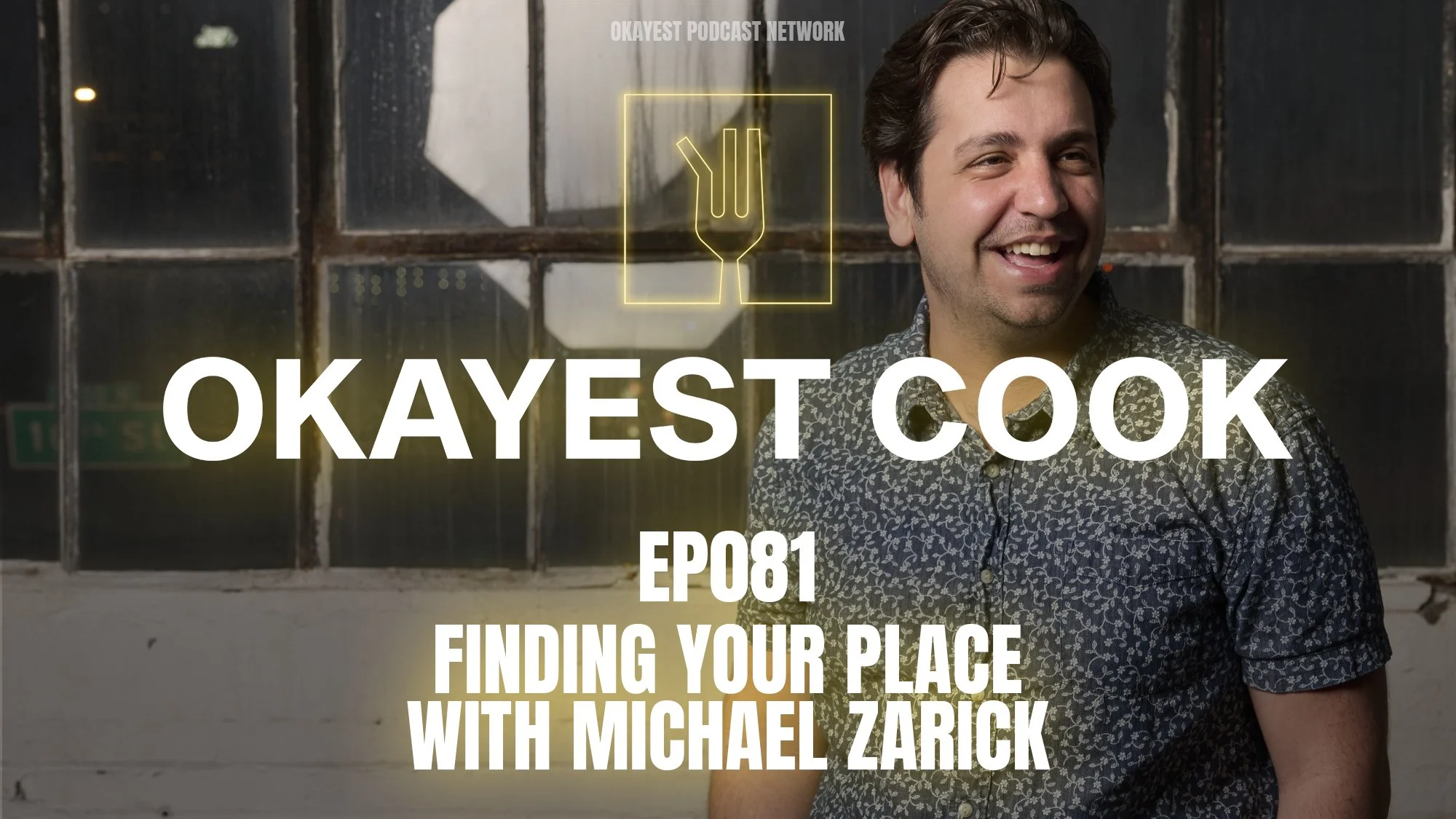
Ep081 - FINDING YOUR PLACE WITH MICHAEL ZARICK
Host Chris Whonsetler welcomes Michael Zurich of Third Space Indy to the Okayest Cook podcast to continue a conversation on community and “third spaces” as places outside home and work that foster consistent connection and conversation. Michael shares notable meals from a new food-focused project with Amanda Gibson featuring Indianapolis restaurants Macizo and Wisanggeni Pawon, emphasizing owner stories and kitchen access, while Chris highlights a Greenfield coffee shop, Hitherto, filled with board games and game nights. They discuss why third spaces matter amid isolation, COVID-era habits, and phone-driven convenience, and how car-centric infrastructure, zoning, and suburban design discourage spontaneous community compared with pub culture and transit-rich cities. Michael describes merchandise plans (locally made mugs) intended to get people into local businesses, recalls Pizzeria Ruby in northwest Arkansas as a personal third space, and cites Flanner House’s Flanner Farms and Cleo’s Bodega addressing food access. They also touch on roller rinks, walking, bus riding, and Michael’s ideal model: Abby Reckard’s forthcoming Lille Bønne community space in a rezoned Dutch church.
Help us keep the episodes coming by shopping our affiliate links. All brands we use and love! happy to chat about our recommendations







Chris: Any other burning questions?
Michael: No.
Chris: Let's go
Michael: fire it up.
Chris: See if I remember what I'm doing here.
Michael: I, when I first listened to this podcast, I thought this was like Diegetic sound, and it was like you were cooking a steak in the scene.
Chris: It is, that's what we wanted, like that sizzling, cooking steak forks, clinking and whatnot.
So a hundred percent part of it. Welcome back to Okayest Cook podcast. I'm your host. Chris Whonsetler coming at you from the studio Kitchen with a really cool guest. All my guests are really cool. This one is super fun. I'm gonna love, love, love what we're talking about today. We are continuing the community commensality Talk, and I've got Michael at the table and you have a show.
Michael: I do have a show.
Chris: You have a show, it's called The Third Space.
Michael: Third Space Indy,
Chris: third Space Indie.
Michael: I think some people showed into the third space, but I personally, I'm a you're,
Chris: you're our third space
Michael: here I was gonna say whenever I address people, I always address, almost always address them by first name, last name.
So Patrick Armstrong, Michael Zarick, stretch. Thy I always, I'll just call him Stretch, but I'm a very full name person, so I always say Third Space Indy. Yes, absolutely. But I think it's cool to call Third Space.
Chris: If you're gonna find him eventually, again, the links will be below. But yes.
If you Google third Space, you might not find Michael, but Third Space Indie. You will.
Michael: That's true.
Chris: Have you eaten anything really cool lately? Any notable meals to speak of?
Michael: So I did, I was texting you about this. I did go to Tinker Street on Friday, but yes, I know Tinker Street is a common topic on this show.
So I'm gonna,
Chris: lately yes.
Michael: I'm gonna move past it. And talk about what Amanda Gibson and I have been doing, which is starting our sort of food show.
Chris: Yeah.
Michael: In a lot of ways. And the reason, 'cause you said it's something interesting or. Memorable?
Chris: Yeah. Notable. Anything notable?
Michael: Both. We've only done two so far, and we're doing the third this week.
Which I won't say what it is. Oh, suspense. But we've gone to Mazo, which is now a James Beard awarded
Chris: Yes.
Michael: Restaurant. We went prior to that, so we're cool. Before it was cool. And then we went through Wes Giddy Powan on Yeah. On Keystone,
Chris: which I have not been to, but upon seeing that episode, like I'm trying to make a plan to get there.
Michael: Yeah. And both of those are really memorable because not only are we getting some of the most beautiful food available in Indianapolis, but we are sitting down with the owners of these restaurants in Wi San Guinea's. In Wi San Guinea's case, we took a walk through the kitchen, saw them actually cooking.
That's awesome. Which we'll probably continue to do and request if they're comfortable, obviously.
Chris: Yeah.
Michael: And just sitting down and listening to the story of. And if they're, if they're immigrants, like how do they get over here? What drives them to want to make this food? What reason is this thing on the, for Wang Guinea was so funny 'cause they, she was like, we have crab rangoons on our menu.
And I was like, is that Indonesian? And she was like, no, people just like it. I was like, she goes, I, she goes, I love Panda Express and I wanted cranberry, so menu,
Chris: it's here for me.
Michael: Yeah. Just those like small, very personal stories that's beautiful are very much a driving factor behind a lot of the reason I even have my podcast.
But yeah, I'm so happy to be able to do that within food. And I think that's. What I'm really excited for is just working with
Chris: Yes,
Michael: Amanda. Shout out to Amanda and Indy if you are local here. She's super
Chris: cool.
Michael: Yeah.
Chris: Yeah. Link below. Yeah. Give her a follow. That I always have to prepare mine as a segue, but you, you hit it outta the park.
That, we could just go straight into what you're doing in our conversation from your notable meal experience. Mine was also an experience, not necessarily a meal. I had a coffee meeting the other day in, oh gosh, correct me. Which Green is east of Indie.
Michael: Oh no.
Chris: I get all the greens mixed up.
It's, I'm
Michael: too recent for that.
Chris: It's Greenwood, south Greenfield, Greenwood Green, green Town. I think it's Greenfield. Greenfield is east of Indy. I had a meeting there.
Michael: There's gotta be a moniker you can use.
Chris: There probably is, but yeah, it words, words are hard. The green, that's east of Indy. I went there for a meeting and we met at a coffee shop, hither two.
And I'm probably saying that wrong. I apologize. I had to call 'em, I called them just to hear them say the name of the coffee shop.
Michael: Is it Hither two?
Chris: Hither two. Yeah. Hither two.
Michael: You gotta do the soft tea.
Chris: Like I said, words are hard. Hither two. Hither two coffee is spectacular. It is just beautiful coffee.
So you want lattes, specialty drinks, stuff like that. They got some gorgeous, just pure black roasts or just pure black coffee, which is, I do, which it's hitting really hard right now at the moment, so I can't talk. I like just straight black coffee and they had all the beautiful regions.
They had Ethiopian Brewing, which is my top tier coffee, but it's also just decked, literally floor to ceiling with every game imaginable from like settlers of Catan to Cards against Humanity and like everything from little kids to, fully grown adults, just like. Crazy cool. Just experience.
And they have game nights, which I'm really excited to take my kids.
Michael: Do you live in that direction? I live north.
Chris: Okay. So north of whatever green that is Greenfield. But my in-laws live in that town.
Michael: Okay.
So it'll be a sort of semi frequent
Chris: Yeah.
Michael: Type thing.
Chris: Yeah. We'll be around, around the area as soon as the kids get old enough to trust in a public space with a game.
We'll go there for sure. But that's what it's, but just it's that, it's exactly what we're gonna talk about today. Just I think another really cool third space just to be somewhere to be that's not your home in New York. And you'll elaborate on that here in a second. Listeners, if you have not followed Michael and are fa and are familiar with what he's talking about, but just, yeah, a really cool, just environment to just be comfortable, to be yourself, to do something different, experiment with a new game. It's a coffee shop, so it's a comfortable place just to hang out. A neutral environment, if you will for new meetings in west, A coffee
Michael: shop is the premier example of a third
Chris: space.
Would you call that like the OG third space?
Michael: I, it's funny that you say that because so I'm gonna get into the definition now. So
Chris: I guess the watering hole might be
Michael: the og the term third place was coined in like the nineties, 1989.
Chris: Okay.
Michael: By a sociologist. So if you were to be, like, if you're saying third places only existed after the coining, I would say yes.
Coffee shops were probably the og, but if you think about coffee in America I feel like, no, because. Coffee I think had a boom in the nineties. Okay. I don't know the history of that necessarily, but I think, coffee, I was too
Chris: young then. I didn't like it.
Michael: I couldn't tell you. Yeah. I was born in 1995.
But I think when you look at like the history of the US things like men's clubs, back rooms of men's clubs where women were allowed, like places where churches, obviously America has a history of religion and things like that. Places where people would gather that aren't necessarily focused on the commerce aspect.
Like coffee shops would be Sure. I think are way more of original third spaces. I see that. Yeah. If you're using the term of, place outside work and home yeah, that's what I would think.
Chris: Yeah. Yeah.
Michael: But coffee shops, I think are what I think of very much archetypal. Yeah.
Chris: Yeah. It's I love the on, and again, I'm just kinda speaking from my own personal viewpoint, but just, yeah, the beauty of, third spaces is, being regional and cultural and it's just, it, I think it's such a cool project that you're dipping into even here in Indy, relatively small city compared to most other capital cities.
And it's just the amount of diversity in your conversations is just brilliant from, yeah, going from here to there a little bit of everything going on.
Michael: It's and I also want to emphasize like, I don't, this is one of the key points of what I do. Is that I'm not necessarily seeking out third places.
I'm I think of it as a research project. Yeah. About what it means to create a community space. So one of my first, within the first 10 episodes, I had a bus driver and a city planner or an architect, or that's not the word. Jeffrey Tompkins, that guy
Chris: whatever his job
Michael: is, but somebody who doesn't, he's not owning a business that is a third space or place.
Chris: Yeah.
Michael: But he is guiding how and at some level, like how places are made.
Chris: Oh yeah.
Michael: And I think that's what I think about is. How do these things come about? Because I think there's a plethora of content creators who are showing you these places. Amanda being one of them, and she's very good at it.
But I'm more interested in the process and the thought, the thoughts that go into a place.
Chris: Yeah.
Michael: That's how I think about it.
Chris: It's, you could almost look at it like, like food deserts, if you're in a part of the city that's just nothing but residential. There's no parks, there's no this or that.
Like where do people go?
That can't drive anywhere they want to.
Michael: Definitely.
Chris: Like we need third spaces everywhere.
Michael: Yeah. Because I, if you're asking about like, why I think these places are important necessarily, it's because like when you look at, I, I think when you look at our current moment that we're in, like with.
I think we have a vast feeling of isolationism. Yeah. On ourselves. That's what, this is how I feel and I'm just projecting it onto to other people. But I've heard people reflect that to me. We feel isolated. We feel like we're disconnected from other people. We feel stuck in our little dopamine machines.
Also known as phones. And the purpose of a third place or space is to be a consistent place where you can go and be with others in a moment. And also one of the key definitions is conversation.
And I think when you talk about conversation, like a lot of our political divides, a lot of our misunderstanding of others comes from a lack of being in community with others.
Chris: Yes.
Michael: Existing in space with others. So I think the reason, I believe third spaces are important. And we are lacking in them is to help solve a, an issue we're having.
Chris: Yeah. Oh yeah. That is, it is a major issue. And we're gonna talk a lot about Stretches episode because a lot of this, is stemming from that conversation with him and what he's doing with the Sunday dinners.
But yeah, a hundred percent, yeah. Social media on top of just, the pandemic and just like that totally just shifted everyone's mindset of, it just exacerbated that isolation because it was forced and a lot of people it doesn't take long to form those habits. And it was long enough that, new habits were formed.
Michael: Yeah.
Chris: I
Michael: don't think we fully understand the ramifications of COVID.
Chris: Oh no. We won't. It's, it'll be too late. But it's, like I said, those new habits were formed and because of social media, because of the internet, because of all these things, it's. Made it easy and it's easy to stay at home and it's easy to just zoom everything and, tweet everything and do this or that, and we're missing this.
Yeah. Which is needed because you can't just talk through social media about these important topics. Yeah. And actually get good, honest, good feedback and research. And
Michael: I was just invited to Macau. Do you, you know that? Yeah. Oh yeah. That's the Cho Coffee and Chocolate Epicurean event.
Chris: Heck yeah.
Michael: So they invited me to have a table. Yes. One, the thing it says you can sell merch. And I was like, oh my God, I really don't wanna do that. I am very the idea of selling t-shirts just drains the life from me.
Chris: Yeah.
Michael: But I have been in conversation with the owner of AllCat Ceramics, her name is Alexa, and she's like, Michael, I really wanna support your podcast.
I think what you're doing is really cool and she's I'll make you mugs with stuff on it. So what I'm planning to do is have mugs with Alexa. So it's like supporting her and supporting me ideally. 'cause they also claim that every booth at Macau sells out, which is a funny claim. But what I like about this idea of mugs is that if I were to extend this merchandise run with Alexa, 'cause we are, we're good friends is that I could now form a relationship with local businesses here and be like, Hey, do you want to like stock my mugs?
Yeah. Third, I could have it them in third places around town.
Chris: Creative mornings. Yeah.
Michael: Stock out. I don't want, yeah, literally
Chris: bring your mug.
Michael: But this idea of I don't wanna sell these mugs on the internet and just ship it to you. I want to force you out of your house. Go to, you must
Chris: meet me in
Michael: person, go to Gold Leaf and buy a third space indie mug, and then you're in Gold Leaf.
If you're buying coffee there ideally, and then maybe you sit down and talk to somebody.
Chris: I can
Michael: Rather than I send you, I ship you a t-shirt. Who? I don't know. That's,
Chris: It costs a decent conversation.
Michael: Yeah, exactly. Go out. And that's my goal is to hopefully inspire people to I love that.
Leave their house.
Chris: Yes. Yes. And on your website, like you need to have a merch tab.
It just a
Michael: map.
Chris: Here's all the locations. You can find this mug. Actually
Michael: that's a really good idea.
Chris: Yes. Go talk to this person, go talk to that person. And you can unlock your mug.
Michael: I like
Chris: that. That's beautiful.
I love it. And I suppose on that note, let's, we could talk about food and, the importance of, I mean we're, we got food in front of us right now and I'm trying real hard not to dive into it. It was very good. Yeah. So food and third spaces and places. How does that impact.
In your opinion, I know Stretch had his own opinion on the topic.
Michael: Yeah.
Chris: Go back a couple episodes and listen to Stretch if you haven't.
Michael: Was, did you have Sierra on as well?
Chris: Yes.
Michael: Okay, cool.
Chris: Yes. Unreleased at this point in time. Okay. As of this recording,
Michael: I will listen. I love Sierra. Anyways, I,
so a couple things. I have a lot, I have a lot of thoughts on this as I do with most things.
Chris: We're here for it.
Michael: In college I took a class called the Anthropology of Food. This is one of, I, I have a couple of classes in college, I reference a lot, but this is one of them, anthropology of food. And if you don't know what anthropology is, this is a, basically a study of human culture.
Different from sociology. 'Cause it's more about like history and like the development over time versus sociology, which is now in like human dynamic type stuff. So anthropology of food focused on how food pervades. Human life in all ways. In every aspect.
Chris: Yeah.
Michael: And I think it's so funny, this is actually, I don't know if I wrote it down in there, but there's this funny thing that people do where they go, Ugh, I'm Greek.
My, I, we are so committed to family, and our family loves food. Oh, I'm Italian. We're, we love family and we love food. Oh, I'm Lebanese. We love our family and we love food. Everyone does that and they think they're so unique, but that's just humanity,
Chris: right?
Michael: It's like you humans like love their, the collection of people, their tribe or whatever that is.
And then they also love food because that is what you need to survive and push yourself forward. And anthropology of food. The class. Shout out to Aaron. He has disappeared somehow, but I would love to talk to him again. The guy who taught the class just really highlighted to me the way that food.
Is so important to humans. And there is a, there's a cost to the beyond, like monetary cost to food creation. In the way that it's produced, in the way that every, like if you were to make cookies, your flour probably is not coming from the farm down the street. It's probably being flown from another country.
Your chocolate is not coming from America. Definitely. All of these pieces of food flies in from elsewhere and like that is the collection of humanity, like working together to create this beautiful pastry in front of us.
Chris: Yeah.
Michael: And I really appreciate that class for giving me a lot of that perspective and That's awesome.
Humbling me about humanity in a way.
Chris: Yeah.
Michael: The other thing I've been thinking about because you, at the very top of the notes you wrote what is a space? That you really enjoy. Yeah, I moved from you guys. I skipped that one. That's okay. That's okay. I'm tying it in.
Chris: Yes.
Michael: When I lived in northwest Arkansas prior to living here, so I moved to Indianapolis in October of 2024.
There was a pizza shop, and I am shameful to say that in 2023, I believe it's 2023, I spent like $1,400 over the course of the year at this pizza shop, it's called Pizzeria Ruby. It's in Johnson, Arkansas. I lived in Fayetteville. It was probably less than a 10 minute drive from my house. This pizza shop is run by a very large Boston man.
Chris: Okay.
Michael: Named Mike the largest Celtics fan of all time. I watched Game six of in 2023 in the pizza shop, and he was, they were like back and forth with the other team. It went to overtime. Ooh. And every time, I don't remember the teams, but I just remember the Celtics and someone else. They were it was back and forth the entire time.
Like one, if they shot a three, he would be like, yes. And then if the other team got it, he would say, fuck, sorry. And then he'd go, sorry. Yeah, he do, he did it over. He go, fuck, sorry, fuck, sorry. And then he goes, I hope there's no kids in the restaurant. And then you look over and there's a whole table of kids.
So he's just this large passionate Bostonian man who committed like six months of his life prior to opening this restaurant, to cooking a margarita pizza over and over again. And it was, it's. Still, I think the best pizza on earth. That's awesome. And they only sell it's either 18 or 20 inch pies, like big pizza.
And when you talk about a space that I am committed to be, I spent $1,400 there, so I spent a good amount of time there beyond the money. I didn't have a ton of friends in northwest Arkansas just by way of the stage of life I was in at maybe. But what I did have was I went to Pizzeria Ruby, I talked to the bartenders, I talked to the management and the owners, and I was there a lot.
And one day they invited me. One of the bartenders goes, Michael, do you wanna come to music? Bingo. And I don't think he expected me to show up. So I showed up to music Bingo. And I think from that moment on, they're like, oh, this guy like shows out for stuff.
Chris: Yeah. And
Michael: so I became good friends with a lot of the they've become your
Chris: people.
Michael: Yeah. Literally.
Chris: Yeah.
Michael: So I got a lot of interesting food opportunities just because that, I think Pizza, Ruby, in a weird way, was a third space for me.
Chris: Oh, a hundred percent.
Michael: Yeah. And I, we. My wife. I don't really follow them on Instagram, but my wife does and she'll send me their posts sometimes.
Chris: Okay.
Michael: And it's like painful to look at this beautiful food they're making.
Chris: It's not that far away, is it?
Michael: It is like a nine hour drive and there's not a good airport in Oh, come out. Really? It's hard to reach. But I told them I would manage a pizza shop if they ever wanted to move to India. But that's not happening.
No one wants to come here.
Chris: No. Maybe someday we'll see.
Michael: But Pizzeria Ruby, that, that is just if you're ever for some reason in Northwest Arkansas, like that's a must go I think. Yeah. Personally.
Chris: That, that is beautiful. I love that story. It just, it, that's, that's community in a nutshell.
That's just supporting what you love and just like the fact that you're there, like during that game is like that's super special. It's there's,
Michael: there's a lot of moments like that where, 'cause he's just like a loud dude. He's just what a interesting
Chris: guy. Yeah, it's beautiful. But that's it's that cheers moment or that cheers experience where like you walk in and they know you and it's friendly, it's family.
Like you love being there. They love having you there. And that's what my buddy and I were striving to do in college. There was a local breakfast joint that we tried and we didn't quite go enough. We were on the, we were on the verge of, the waitress knowing our orders and whatnot.
Michael: But I I'm really bad about that. I think it's undiagnosed A DHD. But I'm a regular at a lot of coffee at a number of coffee shops enough where the people know who I am. But I never order the same thing twice. Okay. Almost ever. It's difficult to have them know my order. There was a coffee shop in Arkansas and I would go there almost every morning old Pine and they, for other regulars, they would go, oh, there he is.
I'm gonna get a, cappuccino going, I'm gonna get whatever going. And they would be, I would come in and Hey Michael, what do you want today? What's it gonna
Chris: be?
Michael: Yeah.
Chris: Okay. Busy street right here.
Michael: Drama outside
Chris: a little bit.
Michael: Yeah, so it's funny, but I do, you're definitely correct about there's something special about being welcome in a space and, I don't believe that you can form a good relationship with people through transaction.
If you're a regular buying something from somebody, you're not. Existing in community with somebody, but if you are there and you are in conversation and you are talking to that person trying to understand their experience, that's a completely different thing. It's okay to be a patron.
Chris: It's it's a, it's, I see that as like a grad, it's a gradient.
It's like you're a patron and then you're the regular. And when you're the regular, like that, in my mind, when is, when it shifts over yeah, definitely. I know your name. And I'm gonna address you by your name when I show up. Or vice versa, if they say, Hey, Michael.
Michael: It's I think Calvin Fletcher is the best coffee shop in the city.
That's my, it's out there. I love's going down there. And I've gone there a number of times, but I wouldn't call myself a regular. I, they don't know who I am.
Chris: Yeah.
Michael: But it's, I love that place. Yeah. I don't know.
Chris: Yeah. It's gorgeous. How, so how do you think like a non-food space compares, I don't wanna say competes, but if you had your choice like finding a space that's not food oriented.
Let's just say like a game shop. There's a game shop down the road where it's literally just games.
Michael: Yeah.
Chris: Do you think,
Michael: I wonder, I here's a question for you. Is any space a non-food space? I'm interested if you think,
Chris: If they don't offer food, you Yeah. But I, you can always bring your own food, but I'm thinking Yeah, like coffee shops places that you would go and gather and you share a meal and have a conversation versus a of a venue where it, like a hookah bar or an actual bar. I know what you're saying. Or just sitting in the park. So it it's physical conversation minus the food.
Michael: Yeah. One of the,
Chris: Do we need food to have,
Michael: there's a couple of spaces that I think fit the bill of what you're talking about.
I, we don't
Chris: need specific,
Michael: I have yet to broach. Yeah. Yeah. But I think it's fun to think on.
Chris: Yeah.
Michael: I have yet to broach the subject of a couple of places on my podcast specifically. Gyms like fitness.
Chris: Yeah.
Michael: The YMCA, obviously
Chris: a hundred percent. That's a beautiful third space. We'll, talk to Andy. That is his community, like his people are those gym people.
Michael: Yeah.
School for children, but also, if you consider schools college age, people are also children. In my mind now they are.
Chris: Hundred percent. They're,
Michael: School,
Chris: school is work.
Michael: Ah, I don't agree.
Chris: No. In my, I would categorize school as work. Like you have to be there. So there are portions of recess.
That's, in my mind that could be a third space. That's an interesting
Michael: perspective,
Chris: but the act of being at school, in my mind is equal to being at work.
So in my mind, I can't classify school as a third space.
Michael: Yeah.
Chris: I think it's a fine perspective. We're scratching. Yeah. I say school, like you're in class.
School Like college like, yeah. There, there are opportunities for third spaces there.
Michael: Okay. Okay.
Chris: Outside of the classroom. But again, you say school I have toddlers or a kindergartner. So when he's at school, like Yeah, it's just he's at the desk.
Michael: I think there's a, an untapped third space that is also at someone's house, which is like
Chris: the backyard,
Michael: I was gonna say like a dank basement or a garage like
Chris: Yeah.
Michael: For a teenager. That is your house. But also if you have, three, four friends that come over regularly and you're hanging out in the garage, I think that is like, something about that feels separate. It is, it feels like a different space. Especially 'cause you like, if the three, four people are coming over there, they don't live there.
So I think that's funny. Yeah. But on the topic of but I also think it's the reason I asked the question of do you think any space doesn't involve food? Because I think of as an extension of gyms or fitness places, like a lot of that is. You then, maybe you go to your morning workout and then you go get coffee or you have conversation with someone else about their meal, what's the word?
Their, like meal prep, that type of thing. Yeah. Or school, if you're, if I'm using it as a third space, like lunch is a key part of the day. Or any of these pla like a park, like you can have a picnic at a park. Like I feel like, yeah, food is it's almost this isn't within the definition of third spaces, but I think by extension, just 'cause I've been thinking about this, like almost food is so pervasive to human, the human experience, that there is no space, that food does not enter in some capacity.
And I think that's interesting to think on.
Chris: Yeah. I guess I'm like gearing towards, how do you think conversations take place when there's. Bread present when you're sharing something. Food is pseudo intimate. You're,
Michael: yeah,
Chris: I you're vulnerable. Being vulnerable by eating in front of somebody.
But
Michael: There's something I've been thinking about. I really appreciate you inviting me on because it's actually unlocked some thoughts in my mind that I think have been, I've been held back because I haven't actually broached the subject of food so deeply. But you're starting to, I'm starting food is like the only way.
So you have five senses. I don't wanna list 'em off. Touch, touch, sight. I see. I don't even know what they are. Like hearing,
Chris: smell,
Michael: taste, and taste.
Chris: What's the last one? Eyes, nosey, ears and mouth.
Michael: There's five, right? Dang.
Chris: Yeah, there's definitely five.
Michael: What are we missing here? What are we missing here? But the important part here is that I feel like food is the only way to communicate through taste.
Chris: Yeah.
Michael: And you can tell so many stories through the food that you're eating.
Chris: Oh, yeah.
Michael: Using the cookie idea, it's oh, there was a journey that this cookie went on, but we're gonna talk about a cookie later on. Yeah. That, I think has a history that there's a lot of stories being told. I don't know that history, but I do believe that.
And there's so much communication you can do through taste when you're dealing with food in front of you. And there's a, you talked about intimacy in a way, like you are, if you are the one who cook the meal, or you we're both deeply familiar with, like Tinker Street. So much of the food on the menu at Tinker Street is a communication from Chef Tyler about his personal experience.
Chris: Yeah.
Michael: And if you talk to him and ask him about why each dish is on the, this is going back to what Amanda and I are doing, but if you talk to him about why each piece is on the menu, you can learn. Okay. Because of his lived experience, like why he made each decision. And I think that's really a beautiful thing.
And that is true of Chef Tyler. And that is true of a random mom who cooks for her children.
Chris: Yeah. Yeah.
Michael: And I think that's the beauty of food.
Chris: When you cook for somebody, let's think about it. You don't just reach for the blue box and make 'em some mac and cheese I'm trying to impress you. So I'm like, I'm gonna do my best.
I'm gonna pull from my food archives, my food history, my food memories. And I'm gonna share, something that I love with you or stretch with say, and I'm gonna cook something that you are familiar with so you can be a little bit more comfortable. Yeah. Sitting down.
Michael: But I already have think you have to go that far. I like when I,
Chris: but I think it's like it's like subconscious.
Say, we're not just gonna pull out a box of crackers. Like we're gonna,
Michael: there's a dish
Chris: that if you really, I guess if you really care about somebody, like you don't care.
Michael: Yeah. There's a dish that I love and I shouldn't love it. It's box mac and cheese. Canned tuna and peas.
Chris: Okay.
Michael: And frozen peas.
Chris: Yeah.
Michael: And
Chris: that was a bachelor meal. Bachelor staple. Yeah.
Michael: For sure. This is a meal. My mother fed me like a hundred times when I was a kid, and I still like it now. And it's gross.
It's, I genuinely, but it, remember, it's reminds, it's the memory that makes it delicious. Yeah.
Chris: Yeah.
Michael: And that's why I say eat food doesn't have to you don't have to whole asset every time for it to be special because it because it evokes something from you. Yeah. And I think that's beautiful and like in a really unique about food specifically.
Chris: Yeah.
Michael: And I think that's cool.
Chris: Yeah. So polling from your third space archives the places you visited the places that, that you consider a third space. How do we have these beautiful, intimate food conversations when there is no food? So we're at a food desert. We're at a spot where like food is hard to get.
Like maybe financially we just, we can't have, good food at the table. But we still need to develop these, comfortable third spaces, to keep people outta trouble and to keep healthy communi communities just building and forming. So again I'm just trying to think like out the, out, I'm just talking random here, but again, we take away food 'cause a lot of people don't have good access to food.
So how are we still building these awesome spaces when it's just like minded people sitting down, hanging out, doing cool stuff together?
Michael: That's a really hard question to answer. So it's
Chris: a weird question.
Michael: Yeah. There, if in a lot of these cases though, like there is a reason, there is no food in those spaces and there's, historical.
Proof of that, redlining and all of that stuff.
But and I also think it's important that we are able to face those conversations about like, why things are that way so you can then fix it.
And when I think about beautiful spaces here in the city, there's a nonprofit. It's the oldest black nonprofit in Indiana. It's called Fletcher House.
Flanner House, sorry, not Fletcher House, Flanner House and Flanner house about 15 years ago, asked that same question, how do we make a beautiful space without food? And the answer was, they don't, basically. Flanner House is a non-profit that supports working class black and brown families on the west side of Indianapolis.
And about 15 years ago, they realized that there was there was such a lack of food in this space that they worked to develop what is now known as Flanner Farms. Okay. And they have a place called Cleo's Bodega. And that these are center points for that part of the city out on MLK. Is that right?
MLK, I don't know. I really should know the address. But
Chris: it's a road. It's
Michael: close by.
Chris: Yeah.
Michael: And these spaces are there to help alleviate the lack of food because Flanner Farms, they work to help not only provide, 'cause they, when they grow food at Flanner Farms, they also provide it to Cleo's Bodega, which is on their little campus there.
But they're also there to educate about what it means to grow your food, what it means to have fresh food on the table. Because a lot of people who. They're serving only have experience with box mac and cheese. Or frozen meals. And that I think is something that when you have a Kroger or a fresh thyme, like right around the corner, you don't really understand you don't know what to do with a fresh tomato.
Like how that doesn't compute to me because I don't have that experience of lack of experience. Yeah. And so when you ask about what, how do you create space without food? I think that broaches into what I was, I keep saying in the word brooch. I think that go is veering into what I was saying earlier.
It's like, how do you, I feel like food is so important to humans. That it's almost impossible to do that. But, oh, sorry. I've had another revelation. Third spaces are like, are places to me this is not like within the actual definition, but I do think of this. There are places of advocacy.
Chris: Yeah.
Michael: Because I think when you truly sit down with somebody else and you begin to understand them you find that your struggles are not that dissimilar in most cases.
And so when you form that relationship with someone, you go, oh, your struggles are not that dissimilar from mine. We should work on that. Yeah. You know what I mean? So I don't have a, a perfect example of what it takes to build that space. That's still what I'm researching.
But I think the importance of that, I say research is if I'm actually, getting a degree or something. But the importance of that is that when you have a space that you feel comfortable in and you find understanding with other people, you can then. Reach the things that you do need collectively.
Yeah, that's what I think.
Chris: Yeah. It's what you make it. And I guess I'm in city planner mode right now, thinking about those areas of town that may not have awesome spaces that people can just hang out and be safe and be comfortable and be welcome. So in my mind, I'm thinking like, okay what are some easy action steps that, the average person can take just to
Michael: yeah.
Chris: To find these communities.
Michael: Are you familiar with Skateland?
Chris: No, I don't think so.
Michael: There's, I think it's on the west, a
Chris: skateboarding,
Michael: it's like a roller skate rink.
Chris: Okay.
Michael: I believe, but those
Chris: exist.
Michael: Yeah.
Chris: Growing up it was like, that was the thing.
Michael: This is
Chris: a, I haven't seen one in ages.
Michael: That's the white boy in you talking.
But so Skateland is a pretty popular roller skate rink, not with you and me. But I don't think. They have food, but that building is, oh,
Chris: they gotta have food at
Michael: skating
Chris: rink.
Michael: I'm actually not sure. I haven't been there. My wife really wants to go. I think she wants to go for her birthday. But
like that building is like next to the highway and in the middle of nothing,
There is not a grocery store. There's barely housing around it, I think. And that is a space for families.
Chris: Yeah.
Michael: That I think is really integral to somebody's experience. Wild style Pelle here locally is a huge skater, roller skater, not like other skater.
Chris: And I need to look at this Up. The Idle Wild is what we had growing up. That was our,
Michael: oh really?
Chris: That was our skate skating rink.
Michael: There's a number of them, but I feel like Skateland is the one that I hear about the most. Okay.
Chris: I'm just nervous about my coordination here. Now that I'm over the 40 humps,
Michael: so I, we try to go ice skating every year.
That's
Chris: bad. That's bad.
Michael: We try to go ice skating every year. I need to take like a tutorial or something that Yeah. I
Chris: stay off the ice unless
Michael: I'm
Chris: fishing.
Michael: And roller skating is just the, it's exactly the same. Just on wheels.
Chris: Yes.
Michael: Not cold. And skiing is the same too. Like I, I need to do some, like foot sports are not there for me.
Chris: No. I swam in high school because I don't have that coordination.
Michael: Yes, but I don't really know where I was going with this. But like, when you talk about, a space where I think a lot of what happens at Skateland, 'cause I actually talked to Wild Style about this, is like he's been going there for so long that he's seen people his age grow up, have kids, and then their kids are skating at Skateland.
That's
Chris: awesome.
Michael: And it's that is what a true third space is. It's intergenerational.
Chris: Yeah.
Michael: Yeah. It's. A place where you're having fun with other people and a lot of times, like once you're tired, you're sitting down and having a conversation.
Chris: Yeah.
Michael: And I think it sounds like those conversations lead to having children.
So I think that's really nice and cool. And that is not a space that to the, maybe they have like mozzarella sticks or something, but it's not like a food space. Yeah. You
Chris: don't go there to eat. The eating is after you're tired. Yeah.
Michael: Yeah. I think so.
Chris: Yes. That's beautiful. I love that. Yeah, man, I haven't thought about skating rink in ages.
Michael: You gotta hit
Chris: it up. We've gotta go. We'll go
Michael: watch see you have to go confirm if there's like mozzarella sticks there and then do a review. A hundred
Chris: percent come a hundred percent. There are mozzarella sticks at all. Skating rinks. I'm gonna put my foot down. That's my stance. Getting back to our bubbles.
So with stretch we talked about getting out of your bubble, getting outta your comfort zone having hard, beautiful conversations. How do we get people off of this? How do we take digital away and encourage more in person? Because social media is not a third space. I know. Like the ai, the metaverse, whatever, this and that.
Like they're trying to make it a third space, but it'll never be.
Michael: Yeah. Like I, there's definitely so I grew up playing World Warcraft. I still play World Warcraft. Yes. I'm a grown man. I need to really think about that. And I think about World Warcraft as a interesting, there are people who are 15 years older than me who in some way, raised me.
Chris: Don't get me wrong, it is a community.
Michael: It a vibrant, but I do agree that it's not a true third space, but I do think there's community to be found in online spaces.
Chris: That's that. I guess that's where it gets hairy. The third space line.
Michael: Yeah.
Chris: And we do need to factor in the fact that, yeah, there are some people who literally cannot.
Physically leave their house. So like, how do we have a, a good, safe community for them? Yeah. And that could be,
Michael: I do have an answer to your question though. Yeah. Which is how do you get people outta their house? I, this is a really hard question that we have to face across. This is not an Indianapolis issue.
This is I'm gonna call it a Western issue, but I see a lot in America specifically.
Chris: Yeah.
Michael: Which is that our infrastructure does not preclude you going outside because this is the real thesis of the podcast, which is that because of our reliance on car-based infrastructure
Chris: Yes.
Michael: You are less inclined to leave your house because of the effort.
Chris: Yeah, I get it.
Michael: So we, and this is, I'm not. Anti-car. I am just really down on them. Because think about, if you think about what I think of as another Premier Third Space, which is a pub. If you are in the uk I've never been to the uk, but this is how I perceive they have a very strong pub culture.
Yes. 'cause they are not reliant on their cars. So you go to work in the morning and then you leave work and you go, actually, New York City is a great example of this 'cause it's very similar because it's a there's a word for it. Commuter city.
You leave work and you go, you're like on the way home.
Either you're on the subway or you're walking down the street and you go, oh, that place looks nice.
Chris: I might pop in.
Michael: Yeah. And that is how you then end up at a place regularly because you are taking. A detour from your commute.
Whereas here in Indianapolis as a an example, you oftentimes have a commute that is 30 to 45 minutes and you are taking it in your car.
So if you're in your car, you are much less inclined to not only stop, but not to want to stop because you have such a long journey ahead of you that you're just like hyper-focused on it. You're mad because you're driving your car and you just got done with work and you're probably tired.
Chris: Yeah.
Michael: So you just, you're going from beginning to end without any thought of ending that commute.
Unless you have already planned to do something else. And then you get to your house, which is now in a suburb, which has no infrastructure of so there's no coffee shop near you, there's no bakery near you because of zoning practices. So this is all the long answer, which is just to say that our infrastructure does not support people going out of their house because Yeah.
Of the comforts that we have, and now we have DoorDash and we have Netflix, and we have delivered groceries.
And you can, this is my joker moment, which is that you can sports bet from your couch. Instead of yeah, going to Las Vegas. And again
Chris: I can do it right now if I
Michael: wanted
Chris: to.
Michael: I, and sure I'm not anti betting necessarily, but I am anti betting on your couch because not only are you losing money so easily, but you're just like, not like doing it in a I love, I'm from Louisville, Kentucky. I love going to watch horse races. Yeah. And betting on horse races. But the, it's like going to a baseball game in that you are there with friends or family and you're talking, and then you're like cheering on the horse.
If you're at home and you're betting on horses, it's what are you doing?
Chris: Yeah. You're activating horse senses
Michael: Exactly. When
Chris: you're there in person. And
It's so intangible here because I don't physically see that money. I'm not doing the swipes, I'm not buying chips,
Michael: uhhuh, and like
Chris: I get it.
Yeah.
Michael: Gambling is just like a small piece of that where it's like you, we have made our lives so convenient that we have convenienced ourselves out of community with other people.
Chris: It's true. Yeah. Definitely true. And it's heartbreaking. Yeah. Seeing that. Back to pubs, like my last hurrah as a bachelor was a backpacking trip through England and Ireland.
And it was beautiful because I just bought a train ticket. I bought one of those, it's like a train pass. And I had 10 days worth of. I forget how it worked exactly. Once you punch it for the day, like you can ride any train, any bus for free because you've, I have this pass. Yeah. And I punched it.
And in England and Scotland I had zero issues going anywhere. I wanted to bus, train, I got there. And to write pub culture is phenomenal. Just the energy, the excitement, just,
Michael: you ever watch oh, I'm not gonna remember that. The, that Apple show about the soccer coach.
Chris: Oh, Ted Lasso.
Yeah.
Michael: Ted Lasso. Yeah. Yeah. Like I think of the pub. That's it in that show.
Chris: That's legit. It,
Michael: yeah. The woman who runs the pub, who's like ribbing the people who are in there constantly, she's shut up.
Chris: They're the regulars. They're hanging out, each other.
Michael: You play darts and it's like this, it's like around the corner from your
Chris: Yeah.
You cheer for your team
Michael: and Yeah. It's around the corner from your apartment. Yeah. And then you get, and that's the other thing is like sports as a collective. Like the way that tying in sports to. Sorry to pivot just a little bit, but like tying in sports to like pub culture, it's like when Ted Lassos team was winning the entire pub lights up and everybody's feeling amazing, and when they lose everybody's down.
Yeah. And I think you don't get that. It's all you're sucked up when you're sitting at, on your couch. Yeah. Alone.
Chris: It's different. It's just different.
Michael: The only sadness you feel is when your parlay doesn't hit,
Chris: but you're right. We need that here. And I will say bouncing over to Ireland, maybe it was the time of year, but Ireland was not set up the same way England was, at least Northern Ireland.
So I had a lot of trouble in Ireland using the buses and the train counting on the buses and trains. Maybe like where London, it's every 15, 20 minutes there's something coming through in Ireland. It was like. Twice a day. It's like I could get out there, but like coming back's gonna be real hard.
Michael: Yeah.
Chris: That's
Michael: what they get for not splitting off the uk
Chris: yeah. Everyone's funny with how they the northern, Southern I don't remember, but but it's very similar to what we have going on here. Like you said, it's, we're very spread out. It's like we like our space, we like our peace and quiet.
I'm part of the problem. Like I love my small town vibe. I need to see more stars. I need to see more corn.
It's
Michael: funny that you say that though, but like, when I think of Cord in Indiana, there's still a hub, like a small town hub in the city area. You could live down there. Like obviously there's, people who live around, but there's a walkable core.
And I think that is really nice.
Chris: Yeah. That's what we've
Michael: got. Yeah.
Chris: Yeah. Pendleton, if Shadow Pendleton,
Michael: Indiana, if each neighborhood in Indianapolis was built like a small cordon. Of like a denser, like walkable.
Chris: Yeah.
Michael: This is that's the thing. It's a I think a lot of it is based in zoning.
If you had, there's a term, have you ever heard the term missing middle?
We have single family homes and you have giant ugly apartment complexes.
Chris: Sure.
Michael: The missing middle is town homes and medium sized apartments that are not heinous and ugly. One thing we're doing, we, or lack of doing is zoning for what is called the missing middle, which is a slightly denser, and you can still maintain like a level of community where it's okay, I have this nice little medium sized town home or multi-family apartment, and then I can walk to the coffee shop.
Versus everything is suburban neighborhood with single family homes that are 20 feet apart from each other. And that type of stuff. And then there's also just a dead zone of anything else there.
Chris: Yeah.
Michael: It's like you could allow zoning for a small coffee shop or a small grocery. But it's just this constant back and forth of policy that we do.
Chris: Yeah. See, I don't, and that's what I understand. Yeah.
Michael: I don't understand either
Chris: policy.
Michael: I
Chris: just know that zoning and building,
Michael: I I just get frustrated. It's like, why can't we just do it now? Yeah. But I, there's, I guess there's a reason I just have to accept in
Chris: ways. Yeah. I, again I love what you're doing.
I love that you are, like, you're going to these meetings, you're, when they have a public forum, like you're. You seem to be talking about it a lot. So you're,
Michael: I try,
Chris: you're trying to learn and you're encouraging us to learn. There's
Michael: people who do more than me, frankly.
Chris: All, we can all be experts at everything.
But I love that you're committing, you're committed to the city. Like you're pushing these lines. You're you're encouraging us to think and act and participate in our community to build it in a good, positive direction.
Michael: This is the thing is and I don't think people understand I'm sure they do understand this, but advocating for a better city for everybody, or sorry, everybody is advocating for a better city for myself.
Yeah. So it's, to a, to an extent there is Oh yeah. A selfishness to it where it's oh my God if Indianapolis had a robust. I rode the bus here, but if they had a robust busing system and then all of that stuff, I would benefit from that greatly. But also everyone would,
Chris: the past couple years it has improved, but there's, it's still lacking.
Yeah. Here and there.
Like I said I'm the commuter, like I'm the, I live on the far, far north side. Damn.
Michael: So That's okay. I don't blame anybody for this is the other thing though are you trying to wrap up? I don't know.
Chris: We're good. We're good. We're co we're coming up on an hour, so
Michael: that's okay.
But the other thing that people don't consider is on the topic of like public transit, if you want to drive your car, that is perfectly acceptable.
Chris: Yeah.
Michael: But if you improve the transit system that removes cars from the road, and when you remove cars from the road, you remove traffic. So it actually makes everybody's life better.
So if you want to ride the bus, you can do and if you get a. Critical mass of people, then you have just removed traffic. And the people who choose to drive their car are much happier because they can whip it down the street like they do.
Chris: Yeah. And honestly, just like doing work, like I would love, like what it's a, how am I trying to say this?
So when it's just my family driving around, my wife is extremely carsick. Like she is, either she has to be the driver or she has to be the passenger. And she cannot look anywhere but straight ahead. If she turns around to give the kid a hamburger or whatever, like she'll get sick. That's crazy.
And it's, we gotta stop. So I've become the passenger in all of our road trips, adventures. And I've gotten used to that and it's nice because I'm like a DHD I can't focus, I hate driving because I can't focus. And I you need to focus when you're driving.
Michael: Definitely.
Chris: So I, I would love.
If I didn't have to haul around all this crap, camera gear and lights and all this and that, if I could just sit with a book, sit with my laptop, answer emails, as I'm on my way to work, like that would be beautiful. I would love that.
Michael: Some of the best. So I, I, there's a word I like to use a lot recently which is serendipity.
Chris: Yeah.
Michael: Which is just an act of pure something that feels like pure chance, but I think frankly, in most cases it isn't. But because I have continually ridden the bus and I'm pretty committed to it, I, when I told the woman who I got insurance from here I was like, oh, I don't drive that much.
She goes, everybody says that. And then she like, looked at my mileage and she goes, oh,
Chris: you actually mean it
Michael: when it snowed a couple of weeks ago. It snowed on a Monday. I didn't uncover my car from snow until. The Thursday, the following week. So it was like almost 10 plus days. It's 11 days. Yeah.
I'm pretty committed to not driving,
Chris: which is awesome.
Michael: Yeah. The thing that I love about, oh, sorry. I was getting, talking about the bus
and because of my podcast, I'm always looking for somebody to talk to. I have found that just being present on the bus will put you in positions that you go, oh, I wanna talk to you. There's a local group here, it's called Earth Charter Indiana. They do a thing called Bus Camp.
Chris: Okay.
Michael: And I was just in Fountain Square going home.
And these kids, this like swarm of children walks up with a couple of adults and the adults were like. Wave at the bus as it walked by or something like that, or like they were trying to get cars to honk or any of that type of stuff. Sounds like my voice. And I was like, what are these people doing? I was so confused and I just talked to them.
They were doing a thing called bus camp. So they ride indigo around town and they just go do, they go to museums and they go to the IMS and they go to the White River. And it's oh, this is like just people. And that is somebody I would love to talk to. Podcast kind
Chris: of a local tourism, let's learn your city kind of thing.
Michael: It's like literally a summer camp. Like they take the kids out on that and it's that's cool. And they teach the kids about riding the bus and like how effective that is. And
Chris: so it's like good, authentic skills versus like when. I went to camp and I learned like archery. And that's authentic canoe.
It's different. It's a, it fits my world right now. It's
Michael: topical for you. Yeah. But,
Chris: But not to your average city kid,
Michael: but for me, who's looking for somebody to talk to, doing something interesting and community focused, I would never have found those people if I were not Yeah. In that situation, in Fountain Square at that time.
Chris: Yeah.
Michael: And I think that's really cool. And I, when you're,
Chris: you're meeting people where they are.
Michael: Yeah.
Chris: It's not like you're driving around in your Lamborghini like pulling up, trying to talk to, somebody who's just not at that level.
Michael: And I feel the same way about walking too.
Yeah. I always say that the best way to learn about your city is to walk. Like I walk here and people think I'm a psychopath, like the Idle Jorg, which is near the State House i've walked from the Idle Jorg to Bodhi.
Which is a lovely restaurant. Beautiful
Chris: restaurant, not just lovely.
Michael: Yeah, true. And we told some people that we did that, they're like, oh my God, that's so far. And I was like, you know that if you were in New York City, that's like the distance from,
Chris: was it maybe half a mile?
Michael: It's like Times Square to the southern part of Central Park, which is not that far. Yeah.
If you are in New York City, and if you told that to a New Yorker, they would laugh in your face. That's funny. And I think it's just, there's like a cultural shift that needs to happen and people gotta like. If you just try it, you go, oh my God, this is so wonderful. That's gorgeous.
Chris: Yeah. Yeah. I'll be honest, like I, I was in, I had a Pokemon Go phase.
Hell yeah. I've still got it on my phone. I haven't deleted it yet. Still got the account. But just like going to those meetups, just walking the canal just up and down the canal.
Michael: That's awesome.
Chris: Just playing this game, talking to friends and friends I met playing the game it's weird.
Michael: And then you can in
Chris: circles,
Michael: then you can reach the point where I'm at, which is when you walk around downtown Indianapolis, you start looking at parking lots and you go, oh my God, that parking lot is always empty when I rock by.
Please put something else there.
Chris: It's so much pavement. Our episode with Sierra which you haven't heard yet. Talking about if we could just have more green garden spaces, like
Michael: Exactly.
Chris: Rip up the asphalt, Yeah. Get more buses
Michael: and I less
Chris: cars
Michael: less. Actually wrote that in the note about that, which is I, that's also policy, but like green garden spaces are something that we have ed ourselves out of because.
It's against the interest of against the interest of a Kroger or a fresh thme because they want you to go in and buy produce.
Chris: But the oxygen we need the oxygen.
Michael: Yeah. I'm pretty sure trees produce oxygen. That would be good.
Chris: Yeah. That's why
we
Michael: need
Chris: more green spaces. And
Michael: yeah, to, it's like there's so much that we could be doing better with our infrastructure that would be in service of people and of service to our community and of service to eating food.
That I think that that's really how I that's, I live in a dream world in my mind, and I hope to reach it in the real life.
Chris: Yeah. Yeah. Keep talking, keep doing, that's the only way to achieve these goals, going there in person. Policy's not gonna change if we don't make our voice heard.
So follow Michael as he. Hopefully it continues to, push these, try my best, advocate for, your local meetings and, change the policies. If you don't like 'em, speak up. It's your community. Act like it.
Michael: Definitely, like we, this is my if you ever ask this is something I think is so funny.
I sometimes go on Reddit 'cause I'm like, I keep trying to advertise for myself. Yeah. Like I have a third space indie Reddit account and people, there's a post once or twice a week that says, how do I make friends in Indianapolis?
Which I think is so funny.
Chris: What's sad, dude? It's
Michael: This it speaks to this infrastructure question, but it's if you just go outside and do what you want to do.
Chris: Yeah.
Michael: If you go take a pottery class or you go to a climbing gym, or you go on a walk or you ride a bike or you just join. If you're a nerd and you like playing video games, you would join a video game group. You will find friends, leave your house. That is the struggle that I think we're, it's the curse.
The
Chris: curse of, convenience, with the
Michael: phone. Exactly. Posting on Reddit and just go outside.
Chris: Yeah.
Michael: I am a, I play video games probably in unhealthy mount every week, but I also leave my house and I think that there's something to be said about that.
Chris: Yeah.
Michael: Take the
Chris: switch on the bus
Michael: and if you are unable or anything like that, obviously there's restrictions there, but there are also people who are willing to come to you or help you out, that type of thing.
Chris: There was an app, I was at Tinker and we were talking about dating apps and somebody was talking about a quote unquote dating app, but for friends. So it was basically I'm not, I'm not on this app to date, like I'm just to here to meet.
Michael: I think
Chris: cool minded people does that. It might be, it might've been that one.
You just got me thinking the side tangent here, but yeah, dude, we're at an hour. We could keep talking. But I want to talk real quick about your, you have unlimited resources. Don't think about zoning, don't think about this, that you're making a space, you're making a third space. It can be for you, it can be for somebody else.
You're, you've got a magic wand, you're making a third space. What are you, where are you focusing first to make your the spaces perfect. Third space?
Michael: Great question. There's a, first of all, when I, before I started the podcast, I was laid off from my job early last year. It's been a little over a year, and you actually mentioned this to me about being fresh outta college and being like, how do I start a business?
I had the exact same thought. When I got laid off, it was like, how do I start a business? Yeah. And I had been thinking about this concept of third space. Third space. So how do you create a third space that is sustainable within our current system of capitalism? Yeah.
Chris: Climate to the weird climate we're in,
Michael: but also is in service to its community for real.
And that is how the podcast began because I was going and trying to talk to people about how to create this business and coming to the realization that I probably don't want to start a business, but there's a woman, her name is Abby Record. She lives in Fletcher Place and she is creating a space called Li Labon.
And Li Labon does not fully exist yet. It's in an old Dutch church. And they are, they're contractors in it right now, working on finishing it up. Nice. And Li Labon is the space I would make.
Chris: Okay.
Michael: Because Abby has not only gone through the trouble of creating business, but she has included her community in the creation of that business.
She rallied her neighbors to go get this building rezoned. She has gotten funding from her neighbors to help build up this space. She's already running community events without the space actually existing.
Chris: Okay.
Michael: And I think that is what a real community space is. The community existed first.
Chris: Yeah.
Michael: The space is just the end product of it.
Chris: Yeah.
Michael: And I think that's really cool.
Chris: That is beautiful. Yeah. I love that.
Michael: And that is the type of space I would like to be.
Chris: Yes. That's
Michael: cool. Shout out to Abby.
Chris: Love it. Love it. We can link, we will link below. Is that the church that the last epicurean event? They did the street party. Like it was like on the street.
Michael: Yeah. I've been inside, but it is not, i'm definitely not
Chris: complete. I peeked inside and there's a big giant hole they were trying to fix last time I was there.
Michael: But when it's done, it'll be a beautiful space. And I think, oh, the,
Chris: yeah, the concept art looked outstanding and just, I tried the food that they were making right in front of it and it was gorgeous.
Definitely. A hundred percent I'll be there when it opened.
Yeah,
Michael: I, I told her I would give her, 'cause she's already been on the podcast, but the audio is bad. I was like, we'll circle back. Do
Chris: does Yes. Yes. Do the repeat guests or clutch. Perfect. Dude, I appreciate you being here. Appreciate you, you sharing your thoughts and experiences.
It's gorgeous. Get outside your bubble. Take the bus.
Michael: Take
Chris: the bus, do a walk.
Michael: Shout to Indigo.
Chris: Yes. Yes. Just find your community, find your space and if you're having trouble with it, just go do something. Don't be shy.
Michael: Literally.
Chris: Yeah.
Michael: That's how you and I met in a way.
Chris: Yeah.
We met a podcast lab, just,
Michael: which is a community thing.
Chris: Two random dudes just shared interest in, in, in talking and. Flapping our app and,
Michael: and also I'm thankful to the, to an extent to pattern for why is her name escaping me?
Chris: Paulina.
Michael: Not Paulina.
Chris: Marcy. Macy.
Macy.
Michael: She just messaged me and goes, do you wanna come to this thing?
I was not in a position to pay to come to the podcast lab at all because it was like a deep in unemployment. But she's yeah, just come, you have a podcast. I was like, okay. Yeah. That's awesome. Yeah. So I'm thankful to her for allowing me just to show up. And I think that is something that just to round it out, like you will find that if you leave your house and you interface with people and you make friends and you show up with intention, that people will give back to you in kind.
Chris: Yeah.
Michael: So shout out to Macy, shout out to Patrick Armstrong of those people who absolutely have given me so much, but that's because I'm showing up for them.
Chris: Yeah. It's worth it. Yeah. You're pushing topic. That's critical. To, to keeping this place. A good place to be. So
Michael: yeah. Shout to Earth.
Chris: Absolutely. Yeah. To decent humans. Yes. Keep at it. Absolutely love the content. It's super fun. Where where are we finding you? So you said Third Space Indie.
Michael: Yeah, on socials. So you can find me,
Chris: Reddit. You got a website?
Michael: You can find me posts on Reddit sometimes. I, so you can find me at Third Space Indie on Instagram or@thirdspaceindie.com.
Sometimes I write a blog, so if you wanna gimme your email, that's cool. Yeah. And when I post on Reddit, it's a lot of times I try to not self plug on Reddit so much. I go, oh, you should listen to, okay, as Cook, but also I do a podcast also just like to throw it in there.
Chris: No.
Michael: I try not to be like the annoying guy who's like only answering for himself.
Chris: Talking about your show is talking about your community, it's talking about these awesome restaurants. It's talking about these safe places that you can become a part of. So it's not Yeah,
Michael: those are the questions that, those are the,
Chris: you're not talking about you necessarily, it's just, it's something you're building.
Michael: But yeah, so you can find me in those two places. You can also find me outside.
Chris: Literally find him.
Michael: Yeah. If you see me walking down the street, say hello. I've had a couple people do that. It's always really nice.
Chris: Go to Creative Mornings, you'll probably see 'em there. That's
Michael: true.
Chris: Go to the next podcast lab, whenever is that happening?
Stretching Patrick. I'm trying to get 'em to do it again. Like it'd be worth it. I need to learn some more skills. So
Michael: I got no skills.
Chris: Got no skills. We got skills. So Gift of
Michael: Gab.
Chris: Yes. That's what it takes. So I'm getting real hungry, so I'm gonna dive in here. So dude, thank you so much for sharing. Go follow along the journey.
It's beautiful. And again, if you don't have a third space in your community, in your life, just listen to a few episodes. Yeah. See what the options are. Yeah. And
Michael: my audio's not as good, but I do exist out in the world.
Chris: Yes. And you're Apple predominantly. Are you on Apple Podcast
Michael: the're on YouTube?
The only platform I'm not on is Spotify at this time. Correct. With intention. If you want to know why, you can look that up, but you pinned it. But I am on YouTube. I'm on every podcast platform other than Spotify.
Chris: Look it up. Third Space,
Michael: easy.
Chris: On that note, we're gonna eat.
